Federal Common Forms
Client Data Screen
The client data screen contains all the general information about the taxpayer(s) and their dependent(s). Complete it as carefully as possible. Name and address sections of other forms will auto-populate as they are added to the return.
Dependent information is entered near the bottom of the screen and includes information such as: Dependent codes, Earned Income Credit eligibility, and Eligible Child Tax Credit and Dependent Care Expenses check boxes.
NOTE: The second to last dependent code check box must be marked to carry forward dependent(s) information to Form 2441.
Schedule K-1 (1041)
Use Schedule K-1 (1041) to report the taxpayer’s share of fiduciary's income, credits, deductions, etc. Crosslink will transfer the items entered on this schedule to the applicable form of the return.
PASSIVE ACTIVITIES (1040 Returns):
For non passive activities, check the "Yes" box for material participation. For rental real estate professionals, check the "Yes" box for material participation and check the “Yes” box for active participation. Passive rental real estate activities subject to the $25,000 loss phase out should check "Yes" to active participation and "No" to material participation. All other passive activities should check "No" to both the active and material participation boxes.
Crosslink will carry income and loss items to Form 8582 for limitation calculations based on the participation boxes checked. Business activities will then be carried to Schedule E, page 2 after limitations.
Any amounts in
Active Participation (1040 Returns):
The taxpayer and spouse must have owned at least 10% of the rental property during the entire tax year and made management decisions in a significant and bona fide sense. Management decisions that may count as active participation include:
Approving new tenants,
Deciding on rental terms,
Arranging repairs and maintenance,
Approving capital or repair expenditures, and
Other similar decisions.
Note: The requirements for active participation are less stringent than the requirements for material participation.
Special Allowance
If the taxpayer checks "Yes", the taxpayer will be eligible to deduct
up to $25,000 in passive loss from nonpassive income,
adjusted by the taxpayer's Modified Adjusted Gross Income. For more details and
information, see Form 8582.
Material Participation (1040 Returns):
Check "Yes" if this business meets any of the following requirements, which exempt the limitation of business losses from the passive activity rules:
The business was not a rental activity, and the taxpayer meets one of the tests for material participation,
The business was a rental activity, but the activity is one of the 5 exceptions of rental activities, and the taxpayer meets one of the tests for material participation.
The business was a rental real estate activity, and the taxpayer was a real estate professional, or
The taxpayer meets the exception for an oil or gas activity.
Otherwise, check "No".
See Form 8582 for the details and requirements to meet these tests of exemption from the passive activity rules.
PORTFOLIO INCOME (LOSS)(1040 Returns)
Entries for interest and dividends will transfer to the applicable forms of the federal return.
Schedule K-1 (1065)
Use Schedule K-1 (1065) to report the taxpayer’s share of partnership's income, credits, deductions, etc. Crosslink will transfer the items entered on this schedule to the applicable form of the return.
UNREIMBURSED PARTNERSHIP EXPENSES (UPE) (1040 Returns):
Ordinary and necessary partnership expenses paid on
behalf of the partnership can be deducted on Schedule E, page 2 if the expenses
are required to be paid under the partnership agreement. These expenses do not
include those amounts deductible as itemized deductions on Schedule A. First,
the partnership K-1 is entered normally on the K-1(1065). Then a second
K-1(1065) is added for the UPE. Enter “UPE” as the partnership name. Enter the
amount of UPE in
PASSIVE ACTIVITIES (1040 Returns)
For non passive activities, check the "Yes" box for material participation. For rental real estate professionals, check the "Yes" box for material participation and check the “Yes” box for active participation. Passive rental real estate activities subject to the $25,000 loss phase out should check "Yes" to active participation and "No" to material participation. All other passive activities should check "No" to both the active and material participation boxes. See below for details of Active and Material Participation.
Crosslink will carry income and loss items to Form 8582 for limitation calculations based on the participation boxes checked. Business activities will then be carried to Schedule E, page 2 after limitations.
Non passive activities will go directly to Schedule E, page 2.
Active Participation (1040 Returns):
The taxpayer and spouse must have owned at least 10% of the rental property during the entire tax year and made management decisions in a significant and bona fide sense. Management decisions that may count as active participation include:
Approving new tenants,
Deciding on rental terms,
Arranging repairs and maintenance,
Approving capital or repair expenditures, and
Other similar decisions.
Note: The requirements for active participation are less stringent than the requirements for material participation.
Special Allowance
If the taxpayer checks "Yes", the taxpayer will be eligible to deduct
up to $25,000 in passive loss from nonpassive income,
adjusted by the taxpayer's Modified Adjusted Gross Income. Limited partners are
not treated as actively participating in a partnership's rental real estate
activities regardless of their actual participation. The special allowance is
not available to limited partners. For
more details and information, see Form 8582.
Material Participation (1040 Returns):
Check "Yes" if this business meets any of the following requirements, which exempt the limitation of business losses from the passive activity rules:
The business was not a rental activity, and the taxpayer meets one of the tests for material participation,
The business was a rental activity, but the activity is one of the 5 exceptions of rental activities, and the taxpayer meets one of the tests for material participation.
The business was a rental real estate activity, and the taxpayer was a real estate professional, or
The taxpayer meets the exception for an oil or gas activity.
Otherwise, check "No".
See Form 8582 for the details and requirements to meet these tests of exemption from the passive activity rules.
PORTFOLIO INCOME (LOSS) (1040 Returns)
Entries for interest and dividends will transfer to the applicable forms of the federal return. Entries for royalty income must be entered on the applicable Schedule E, unless enter Schedule E, Page 1 activity to link income to. Entries for other portfolio income (loss), line 11, code A, should be entered on the applicable form of the return.
SECTION 179 EXPENSE
Section 179 will be carried to Schedule E, page 2, column I for individual filers. For business filers, Section 179 expenses will be carried to the Form 4562 associated with the primary activity of the business.
SELF-EMPLOYMENT (1040 Returns)
Enter net earnings (loss) from self-employment in
AT-RISK LIMITATIONS (1040 Returns)
If the activity is not entirely at-risk, check the box for "some" at-risk. Crosslink will add and carry income and loss amounts to Form 6198. The Form 6198 should be used to determine any loss limitations. Basis adjustments may need to be entered on the Form 6198 to arrive at correct allowable loss amounts. See Form 6198 instructions for additional information about at-risk rules.
GUARANTEED PAYMENTS TO PARTNER
Guaranteed payments will be treated as non passive and will be carried to Schedule E, page 2, column J for individual filers. Guaranteed payments received by a business entity will be treated as ordinary income and carried to the Other Income worksheet.
Schedule K-1 (1120S)
Use Schedule K-1 (1120S) to report the taxpayer’s share of S Corporation's income, credits, deductions, etc. Crosslink will transfer the items entered on this schedule to the applicable form of the return.
PASSIVE ACTIVITIES (1040 Returns)
For non passive activities, check the "Yes" box for material participation. For rental real estate professionals, check the "Yes" box for material participation and check the “Yes” box for active participation. Passive rental real estate activities subject to the $25,000 loss phase out should check "Yes" to active participation and "No" to material participation. All other passive activities should check "No" to both the active and material participation boxes.
Crosslink will carry income and loss items to Form 8582 for limitation calculations based on the participation boxes checked. Business activities will then be carried to Schedule E, page 2 after limitations.
Non passive activities will go directly to Schedule E, page 2.
Active
Participation (1040 Returns): %%USK3XXC1
The taxpayer and spouse must have owned at least 10% of the
rental property during the entire tax year and made management decisions in a
significant and bona fide sense. Management decisions that may count as active
participation include:
Approving new tenants,
Deciding on rental terms,
Arranging repairs and maintenance,
Approving capital or repair expenditures, and
Other similar decisions.
Note: The requirements for active participation are less stringent than the requirements for material participation.
Special Allowance
If the taxpayer checks "Yes", the taxpayer will be eligible to deduct
up to $25,000 in passive loss from nonpassive income,
adjusted by the taxpayer's Modified Adjusted Gross Income. For more details and
information, see Form 8582.
Material Participation (1040 Returns):
Check "Yes" if this business meets any of the following requirements, which exempt the limitation of business losses from the passive activity rules:
The business was not a rental activity, and the taxpayer meets one of the tests for material participation,
The business was a rental activity, but the activity is one of the 5 exceptions of rental activities, and the taxpayer meets one of the tests for material participation.
The business was a rental real estate activity, and the taxpayer was a real estate professional, or
The taxpayer meets the exception for an oil or gas activity.
Otherwise, check "No".
See Form 8582 for the details and requirements to meet these tests of exemption from the passive activity rules.
PORTFOLIO INCOME (LOSS) (1040 Returns)
Entries for interest and dividends will transfer to the applicable forms of the federal return. Entries for royalty income must be entered on the applicable Schedule E. Entries for other portfolio income (loss), line 10, code A should be entered on the applicable form of the return.
SECTION 179 EXPENSE
Section 179 will be carried to Schedule E, page 2, column I.
AT-RISK LIMITATIONS (1040 Returns)
If the activity is not entirely at-risk, check the box for "some" at-risk. Crosslink will add and carry income and loss amounts to Form 6198. The Form 6198 should be used to determine any loss limitations. Basis adjustments may need to be entered on the Form 6198 to arrive at correct allowable loss amounts. See Form 6198 instructions for additional information about at-risk rules.
Form 982
Use Form 982 to reduce or completely eliminate the cancelled debt shown on Form 1099-C. You cannot use Form 982 to reduce a cancelled debt from Form 1099-C just because you do not want to pay the tax. Form 982 is specific as to what types of financial conditions can be used to reduce, or completely eliminate, a cancelled debt. Part I of Form 982 is used to specify which financial condition is being used to substantiate why any amount received from the discharge of indebtedness should be excluded from gross income. Also, in Part I you must elect how much of the cancelled debt shown on Form 1099-C will be excluded from gross income. The amount of cancelled debt that is excluded from gross income cannot be greater than the reduction of tax attributes in Part II. Part I justifications are:
1) Title 11 Bankruptcy;
2) Insolvent taxpayer[1];
3) Forgiveness of a farm debt;
4) Forgiveness of a qualified real property business debt;
5) Forgiveness of a qualified principal residence debt.
As you use Form 982, remember the IRS wants to receive “something” in exchange for giving the taxpayer a discharge of indebtedness. The “something” the IRS wants in exchange is the reduction of tax attributes, such as the reduction of depreciable basis of an asset or reduction of a capital loss, etc., which is selected in Part II of Form 982.
Now that a basis for reduction and an amount that will be excluded from gross income has been selected from Part I, Part II is used to apply the cancelled debt to reduce tax attributes. Tax attributes must be reduced in the order shown below. The exception to the order shown below is qualified real property indebtedness and depreciable property. If qualified real property business debt was selected in Part I of Form 982 as the justification for the reduction in cancelled debt, then you must first reduce the basis of the real property in question by the amount of the cancelled debt that is to be excluded from gross income. If the tax return does not claim the first tax attribute, then the second, third, fourth, fifth, sixth and seventh attribute shown below should be reduced in the order shown and either dollar for dollar or 33 cents on the dollar.
1) NOL is a dollar for dollar reduction against the debt to be excluded from Income,
2) General Business Credit Reduction applies to 33 cents on the dollar to any general business credit,
3) Minimum Tax Credit Reduction applies to 33 cents on the dollar for a minimum tax credit,
4) Net Capital Loss is a dollar for dollar reduction against the debt to be excluded from Income,
5) Basis of Property is a dollar for dollar reduction against the debt to be excluded from Income,
6) Passive Loss Activity loss is a dollar for dollar reduction against the debt to be excluded from Income. If it is a passive loss credit the reduction applies to 33 cents on the dollar,
7) Foreign Tax Credit Reduction applies to 33 cents on the dollar to a foreign tax credit.
The software does not determine what amount, if any, of the cancelled debt may be excluded from the taxpayer’s gross income. It is the responsibility of the tax return preparer to determine how much of cancelled debt may be reduced and which tax attribute(s) may be adjusted by a reduction of cancelled debt.
Example: An individual taxpayer receives a Form 1099-C, Cancellation of Debt, for $75,000 from Bank A. The loan from Bank A was secured by a building that was used in the taxpayer’s business. The taxpayer has been generating a NOL in the business for the past three years that totaled $175,000 for the current year. The taxpayer files a bankruptcy petition under Title 11 of United States Code. The building that Bank A issued Form 1099-C on has an adjusted basis of $275,000, prior to filing the bankruptcy petition. The taxpayer’s justification for reducing the debt will be that he is insolvent, which is verifiable through the bankruptcy court. The order in which the cancelled debt is reduced is first NOL, then business credits, etc. However, the taxpayer’s debt is qualified real property indebtedness; the building is associated with the taxpayer’s business and as such, must be reduced first. The taxpayer would reduce the basis to $200,000, a dollar for dollar reduction.
What to do if you receive a 1099-A and not a 1099-C (related to principle residences).
A Form 1099-A is issued to a borrower when the property securing the loan is repossessed or foreclosed by the lender (or abandoned by the borrower). The property then is considered to be sold by the borrower to the lender.
Note: The vast majority of 1099-A forms received by taxpayers in CA and in many other states are going to be informational only (taxpayer doesn’t report the transaction on the tax return). For example, by law your first mortgage in CA is a nonrecourse loan; as a result, most taxpayers in CA would get a 1099-A and get no 1099-C (unless you had refinanced the loan to a recourse loan).
The information off a 1099-A could be used to determine the sales price in the scenario a user would need to do a Home Sale worksheet. However, keep in mind that most homes that are foreclosures or short sales are probably upside down still so there is no gain. The only time you would have a gain is if you refinanced and used some of the loan money for purposes other than the home (which would reduce taxpayer’s basis in home). The Home Sale worksheet is used when you have a gain or need to report the sale because taxpayer received a 1099S.
If a taxpayer receives Form 1099-A from a foreclosure or abandonment on her home, she may have reportable income as a result of any gain on the deemed sale back to the lender. Gain on this transaction is generally measured by the difference between the value the taxpayer received in giving up the property and the taxpayer's adjusted basis in the property. A loss on the disposition of personal use property (including the taxpayer's residence) is not deductible and not reported on the Sch. D.
If the loan was a nonrecourse loan (Form 1099-A box 5 marked "no"), then the value received (considered the sales price) by the taxpayer is the "Outstanding balance amount" reported in box 2 (plus any other consideration the taxpayer may have received in giving up the property to the lender). If the loan is recourse (Form 1099-A box 5 marked "yes"), then the value received by the taxpayer is the lower of the "Outstanding balance amount" reported in Box 2 or the fair market value (FMV) amount reported in Box 4 (plus any other consideration the taxpayer received in giving up the property).
Note: A nonrecourse loan is one in which the borrower is not personally liable (the borrower's liability is limited to the value of the asset secured by the loan). Thus, a homeowner with a nonrecourse mortgage may lose his home in foreclosure, but the lender cannot go after any other assets owned by the borrower. This differs from a recourse loan in which the borrower is personally liable. Thus, if the borrower's outstanding mortgage exceeds the value of the foreclosed home, the lender may attach other assets belonging to the borrower to satisfy the mortgage balance.
The gain from the sale that results from a foreclosure or abandonment is reported on the Home Sale worksheet, Form 8949, and Form 1040 Schedule D.
Note: A lender issues Form 1099-C to report the cancellation of debt, which is a separate event from the sale reported on Form 1099-A.
Form 1098-C
Use Form 1098-C to report a donated motor vehicle, boat, or airplane (“donated vehicle”) to a charity.
Form 2439
Use Form 2439 to report taxpayers share of gains and tax paid from a regulated investment company (RIC) or real estate investment trust (REIT). Gains should be manually entered on Form 8949. Taxes paid will flow to Form 1120.
Form 2848
Use Form 2848 to grant authority to an individual to:
(a) Represent you before the IRS and
(b) Receive tax information
The individual must be a person eligible to practice before the IRS.
Form 3468
Use Form 3468 to claim the investment credit. The investment credit consists of the rehabilitation, energy, qualifying advanced coal project, qualifying gasification project, qualifying advanced energy project, and qualifying therapeutic discovery project credits.
Individual filers: If you file electronically, you must send in a paper Form 8453, U.S. Individual Income Tax Transmittal for an IRS e-file Return, if attachments are required to Form 3468.
Form 3800
Use Form 3800 to claim any of the general business credits.
Form 4136
Use Form 4136 to claim credit for:
(a) Federal excise tax paid on fuels
(b) Diesel-powered highway vehicles
You can take the credit if all of the following apply:
(a) You used the fuel for:
- Business use other than in a vehicle registered for highway use
- Export
- Use in a boat in the business of commercial fishing
- Use in a bus while the bus is transporting students or employees of
schools
- Use in an intercity or local bus
- Use in certain helicopters
- Use in commercial aviation
- Use in foreign trade
- Use of diesel fuel in a boat in:
(1) business of transporting persons or property for compensation or hire
(2) any other trade or business, except an activity of a type generally
considered to be entertainment,
amusement, or recreation
- Use of diesel fuel in a qualified local bus
- Use of diesel fuel other than as a fuel in the
propulsion engine of a diesel-powered highway vehicle, train, or boat
- Use on a farm for farming purposes
(b) You buy taxed fuel
(c) You have not requested or received a refund of the tax
Type of Use Table
Number Type of Use
1 On a farm for farming purposes
2 Off-highway use (for business use other than in a highway vehicle
registered or required to be registered for highway use)
3 Export
4 In a boat engaged in commercial fishing
5 In certain intercity and local bus
6 In a qualified local bus
7 In a bus transporting students and employees of schools
8 For diesel fuel and kerosene used other than as a fuel in the propulsion
engine of a train or diesel-powered highway vehicle (but not off-highway
business use)
9 In foreign trade
10 Certain helicopter & fixed-wing air ambulance uses
11 Exclusive use by a qualified blood collector organization
12 In a highway vehicle owned by the US that is not used on a highway
13 Exclusive use by a nonprofit educational organization
14 Exclusive use by a state, political subdivision of a state, or DC
15 In an aircraft or vehicle owned by an aircraft museum
16 In military aircraft
Form 4255
Use Form 4255 to figure the increase in tax for the recapture of investment credit claimed.
You must refigure the credit if:
(a) You claimed it in an earlier year but disposed of the property before the:
- End of the recapture period
- Useful life you used to figure the original credit
(b) You returned leased property to the lessor before:
- The end of the recapture period
- Its useful life
(c) You changed the use of property so that it no longer qualifies as investment credit property
(d) You disposed of the property or the property ceases to be both energy- and regular investment credit property
Property Placed In Service
Number on line 6 Recapture Percentage
0 100 %
1 80 %
2 60 %
3 40 %
4 20 %
5 or more 0 %
Form 4562
Use Form 4562 to:
(a) Claim your deduction for depreciation and amortization
(b) Make the election to expense certain tangible property
(c) Provide information on the business/investment use of automobiles and other
listed property.
File Form 4562 if any of the following apply:
You are claiming:
(a) Depreciation for property placed in service during the current tax year
(b) A section 179 expense deduction
(c) Depreciation on any vehicle or other listed property
(d) A deduction for any vehicle reported on a form other than Schedule C or
Schedule C-EZ
(e) Amortization of costs that begins during the current tax year
Note: Use Ctrl-N to access the Depreciation Database.
Part I - Election to Expense Certain Tangible Property
Section 179 Expense Deduction:
Use the amount on Schedule K-1, line 12 along with the total cost of section 179 property placed in service during the year from other sources to complete this part of Form 4562. Use Part I of Form 4562 to figure your allowable section 179 expense deduction from all sources.
Form 4684
Use Form 4684 to report gains and losses from casualties and thefts.
Use Section A to figure casualty or theft gains and losses for property that is not used in a trade or business or for income-producing purposes.
Nonbusiness casualty or theft losses are deductible only to the extent that the amount of the loss from each separate casualty or theft is more than $100 and the total amount of all losses (as so reduced) during the year is more than 10% of adjusted gross income.
Use Section B to figure casualty or theft gains and losses for property that is used in a trade or business or for income producing purposes.
If property is used partly in a trade or business and partly for personal purposes, figure the personal part in Section A and the business part on Section B.
Special Treatment Options:
There are three special treatment codes for Section A of the Form 4684.
1 – Enter “1” if this Section A (all properties) is for damage from corrosive drywall. According to Revenue Procedure 2010-36, these types of casualties can use a special procedure for deducting the cost to repair this damage. Please leave lines 2, 5 and 6 blank. Enter on line 7 the amount you paid to repair the damage to your home and appliances due to corrosive drywall. Check the box on line 9 if you have a pending claim for reimbursement (or you intend to pursue reimbursement). If this box is checked, the line 9 loss is 75% of the difference between lines 3 and 8.
2 – Enter “2” if this Section A (all properties) is from a hurricane disaster casualty and you want to use the “Safe Harbor” rule in Revenue Procedure 2006-32. Instead of entering amounts on lines 5 and 6, enter the decrease in Fair Market Value in the field on line 7.
3 – Enter “3” if this Section A (all properties) is for losses on deposits in insolvent or bankrupt financial institutions. Enter the name of the financial institution and “Insolvent Financial Institution” in the Description field. Leave all lines blank from line 2 through line 9. Instead, enter the amount of bank deposit loss in the field next to option “3”.
Revenue Procedure 2009-20 Ponzi Type Schemes:
If you qualify to use Revenue Procedure 2009-20 and choose to follow the procedures in this guidance, enter an X in this field and complete the attached worksheet. Also enter the description for the loss on the Description field. These losses are deductible as theft losses on income-producing property.
Form 4797
Use Form 4797 to report:
(a) The sale or exchange of:
- Depreciable and amortizable property
- Oil, gas, geothermal, or other mineral properties
- Property used in your trade or business
- Section 126 property
(b) The involuntary conversion (from other than casualty or theft) capital assets held in connection with a trade or business or a transaction entered into for profit and property used in your trade or business
(c) The disposition of non-capital assets (other than inventory or property held primarily for sale to customers in the ordinary course of your trade or business)
(d) The disposition of capital assets not reported on Schedule D
(e) The gain or loss including any recapture of section 179 expense deductions for partners and S corporation shareholders from property dispositions by partnerships and S corporations
(f) The computation of recapture amounts under Sections 179 and 280F(b)(2), when the business use of Section 179 or listed property drops to 50% or less
Line 25
Section 1245 property is depreciable and includes any of the following:
(a) Personal property
(b) Elevators & escalators placed in service before 1987
(c) Real property subject to amortization or deductions under section 169, 179, 185, 188, 190, 193, or 194
(d) Tangible real property, if used in any of the following ways:
- As an integral part of manufacturing, production, extraction, or furnishing transportation, communications, or certain public utility services
- As a research facility in these activities
- For the bulk storage of fungible commodities used in these activities
(e) Single purpose agricultural or horticultural structure
(f) Storage facility used in connection with the distribution of petroleum or any primary petroleum product
(g) Railroad grading or tunnel bore
Line 26
Section 1250 property is depreciable real property other than Section 1245 property. Generally, Section 1250 recapture applies if used an accelerated depreciation method or you claimed any special depreciation allowance, or the commercial revitalization deduction.
Line 27
Section 1252 property includes certain farm land
Line 28
Section 1254 property includes an interest in gas, in geothermal property or in oil
Line 29
Section 1255 property includes any Section 126 property:
(a) Conserving soil and water resources equipment
Note: Use Ctrl-N to access the Depreciation Database
Form 5884
Use Form 5884 to claim the Work Opportunity Credit for qualified first or second year wages paid to or incurred.
You can claim a tax credit if you request and are issued a certification from the State Employment Security Agency (SESA). A certification must be requested on or before the date the individual begins work or complete Form 8850. The certification proves that the employee is in an eligible targeted group.
Note: You can claim or elect not to claim the jobs credit any time within 3 years from the due date of your return on either your original return or on an amended return.
Form 6198
Use Form 6198 to figure:
(a) The amount at risk for the current year
(b) Current year profit or loss from an at-risk activity
(c) The deductible loss for the current year
You can use Form 6198 if you file as an individual or during the tax year you, a partnership in which you were a partner, or a S corporation in which you were a shareholder had any amounts invested in an at-risk activity carried on as a trade or business or for the production of income in which you incurred a loss.
At-Risk Limitations:
Generally, if you have (a) a loss or other deduction from any activity carried on as a trade or business or for the production of income by the partnership, and (b) amounts in the activity for which you are not at risk, you will have to complete Form 6198, At-Risk Limitations, to figure your allowable loss.
The at-risk rules generally limit the amount of loss (including loss on the disposition of assets) and other deductions (such as the Section 179 expense deduction) that you can claim to the amount you could actually lose in the activity. However, if you acquired your partnership interest before 1987, the at-risk rules do not apply to losses from an activity of holding real property placed in service before 1987 by the partnership. The activity of holding mineral property does not qualify for this exception. The partnership should identify on an attachment to Schedule K-1 the amount of any losses that are not subject to the at-risk limitations.
Generally, you are not at risk for amounts such as the following:
- Nonrecourse loans used to finance the activity, to acquire property used in the activity, or to acquire your interest in the activity, that are not secured by your own property (other than the property used in the activity).
- Cash, property, or borrowed amounts used in the activity (or contributed to the activity, or used to acquire your interest in the activity) that are protected against loss by a guarantee, stop-loss agreement, or other similar arrangement (excluding casualty insurance and insurance against tort liability).
- Amounts borrowed for use in the activity from a person who has an interest in the activity, other than as a creditor, or who is related, under section 465(b)(3), to a person (other than you) having such an interest.
Form 6252
Use Form 6252 to report income from casual sales of real or personal property (other than inventory) if you will receive any payments in a tax year after the year of sale.
Do not use Form 6252 if any of the following apply:
(a) To report sales after 1986 of stock or securities traded on an established securities market
(b) You elect not to report the sale on the installment method
(c) To report sales that do not result in a gain
Note: Once you file Form 6252 you cannot later elect out of the installment method unless your original return was filed on time. If this is true, you can make the election on an amended return filed no later than 6 months after the due date of your return (excluding extensions).
Line 25
Enter here any ordinary income recapture on section 1252, 1254 or 1255 property. This includes recapture for the year of sale or any remaining recapture from a prior year sale. Do not enter ordinary income from a Sec 179 expenses deduction. Also report on this line any ordinary income recapture remaining from prior years on sec 1245 or 1250 property sold before June 7, 1984.
Form 6478
Use Form 6478 to figure the alcohol and cellulosic biofuel fuels credit. You claim this credit for the tax year in which the sale or use occurs.
Form 6765
Use Form 6765 to figure and claim the credit for increasing research activities or to elect the reduced credit under section 280C.
Form 6781
Use Form 6781 to report any gain or loss on section 1256 contracts under the mark-to-market rules, and gains or losses under section 1092 from straddle positions.
Form 8283
Use Form 8283 to report certain required information about noncash charitable contributions. This form must be filed if the amount of all noncash gifts exceeds $500 except for C corporations that are not personal service corporations or closely held corporations, which are only required to file once the deduction exceeds $5,000. Partnerships and S corporations must complete Section B if the total deduction for any item or group of similar items exceeds $5,000, regardless of the amount allocated to each partner or shareholder.
For auto donations, enter the Vehicle Identification Number in column B.
Form 8586
Use Form 8586 to claim the low income housing credit. The low income housing credit can only be claimed for residential rental buildings in low income housing projects that meet one of the minimum set-aside tests. See Form 8609, Part II, line 10C instructions for more details.
Recapture of Credit:
There is a 15 year compliance period during which the residential rental building must continue to meet certain requirements. If, as of the close of any tax year in this period, there is a reduction in the qualified basis of any building from the previous year, the taxpayer may have to recapture a part of the credit he/she has taken.
Form 8594
Use Form 8594 to report a transfer of a group of assets that make up a trade or business and the purchaser's basis in such assets is determined wholly by the amount paid for the assets. This applies whether the group of assets constitutes a trade or business in the hands of the seller, the purchaser, or both. Both the seller and purchaser must file this form. However, this form is not required if the group of assets is exchanged for like-kind property in a transaction to which section 1031 applies or if a partnership interest is exchanged.
Form 8820
Use Form 8820 to claim the orphan drug credit. The credit is 50% of qualified clinical testing expenses paid or incurred during the tax year.
Form 8821
Use Form 8821 to authorize any individual, corporation, firm, organization, or partnership you designate to inspect and/or receive your confidential information for the type of tax and the years or periods you list on the form. This form must be printed and mailed to the IRS, and it must be received within 120 days of the date it was signed and dated by the taxpayer.
Form 8824
Use Parts I, II, and III of Form 8824 to report each exchange of business or investment property for property of a like kind. Certain members of the executive branch of the Federal Government and judicial officers of the Federal Government use Part IV to elect to defer gain on conflict-of-interest sales.
Form 8826
Use Form 8826 to claim the disabled access credit as an eligible small business.
Form 8834
Use Form 8834 to claim the qualified plug-in electric vehicle credit and any qualified electric vehicle passive activity credits allowed for the current tax year.
Form 8835
Use Form 8835 to claim the renewable electricity, refined coal, and Indian coal production credit. The credit is allowed only for the sale of electricity, refined coal, or Indian coal produced in the United States or U.S. possessions from qualified energy resources at a qualified facility.
Form 8844
Use Form 8844 to claim the empowerment zone employment credit. For tax years that include December 31, 2012, the credit is 20% of the employer's qualified wages (up to $15,000) paid or incurred during calendar year 2012 on behalf of qualified empowerment zone employees. You can find out if your business or an employee’s residence is located within an urban empowerment zone or rural empowerment zone by using the RC/EZ/EC Address Locator at www.hud.gov/crlocator or by calling 1-800-998-9999. In general, you must reduce your deduction for salaries and wages and certain educational and training costs by the line 2 credit amount.
Form 8845
Employers of American Indians who are qualified employees use Form 8845 to claim the Indian employment credit. Generally, you must reduce the deductions on your return for salaries and wages and health insurance costs by the credit on line 4.
Form 8846
Certain food and beverage establishments use Form 8846 to claim a credit for social security and Medicare taxes paid or incurred by the employer on certain employees’ tips. File Form 8846 if you meet both of the following conditions:
(1) You had employees who received tips from customers for providing, delivering, or serving food or beverages for consumption if tipping of employees for delivering or serving food or beverages is customary, and
(2) During the tax year, you paid or incurred employer social security and Medicare taxes on those tips.
Note: You can claim or elect not to claim the credit any time within 3 years from the due date of your return on either your original return or on an amended return.
Form 8903
Use Form 8903 to figure information relating to your domestic production activities deduction (DPAD).
Form 8910
Use Form 8910 to figure your credit for alternative motor vehicles you placed in service during your tax year. The credit attributable to depreciable property (vehicles used for business or investment purposes) is treated as a general business credit.
Form 8925
Use Form 8925 to report the number of employees covered by employer-owned life insurance contracts issued after August 17, 2006, and the total amount of employer-owned life insurance in force on those employees at the end of the tax year. Policyholders must also indicate whether a valid consent has been received from each covered employee, and the number of covered employees for which a valid consent has not been received
Form 8936
Use Form 8936 to figure the credit for qualified plug-in electric drive motor vehicles placed in service during the year. The credit attributable to depreciable property vehicles used for business or investment purposes is treated as a general business credit.
Form 8938
Use Form 8938 to report your foreign specified financial assets if the total value of all the specified foreign financial assets in which you have an interest is more than the appropriate reporting threshold. If you are required to file Form 8938, you must report the specified foreign financial assets in which you have an interest even if none of the assets affects your tax liability for the year. The IRS anticipates issuing regulations that will require a domestic entity to file Form 8938 if the entity is formed or availed of to hold specified foreign financial assets and the value of those assets exceeds the appropriate reporting threshold. Until the IRS issues such regulations, only individuals must file Form 8938, but entities may still voluntarily file the form.
Form 8941
Use Form 8941 to determine the credit for small employer health insurance. Eligible small businesses are those that (1) paid insurance premiums for employee health insurance under a qualifying arrangement, (2) had fewer than 25 full time equivalent employees during the tax year, and (3) paid average annual wages for the tax year of less than $50,000 per full time equivalent employee. The credit is reduced if the small business had more than 10 full time equivalent employees or if average annual wages exceed $25,000.
Form 8949
Use Form 8949 to enter the sales and other dispositions of capital assets.
In the “Type ABC” field, select whether the basis was shown on the 1099-B (code “A”), the basis was not shown on the 1099-B (code
“B”) or the sale was not reported on a 1099-B (code “C”).
In the “Code” field (column (b)), if necessary, enter the code that corresponds to the adjustment entry in the “Adjustments to Gain/Loss” field (column (g)). The codes and the entry necessary in column (g) should be entered as follows:
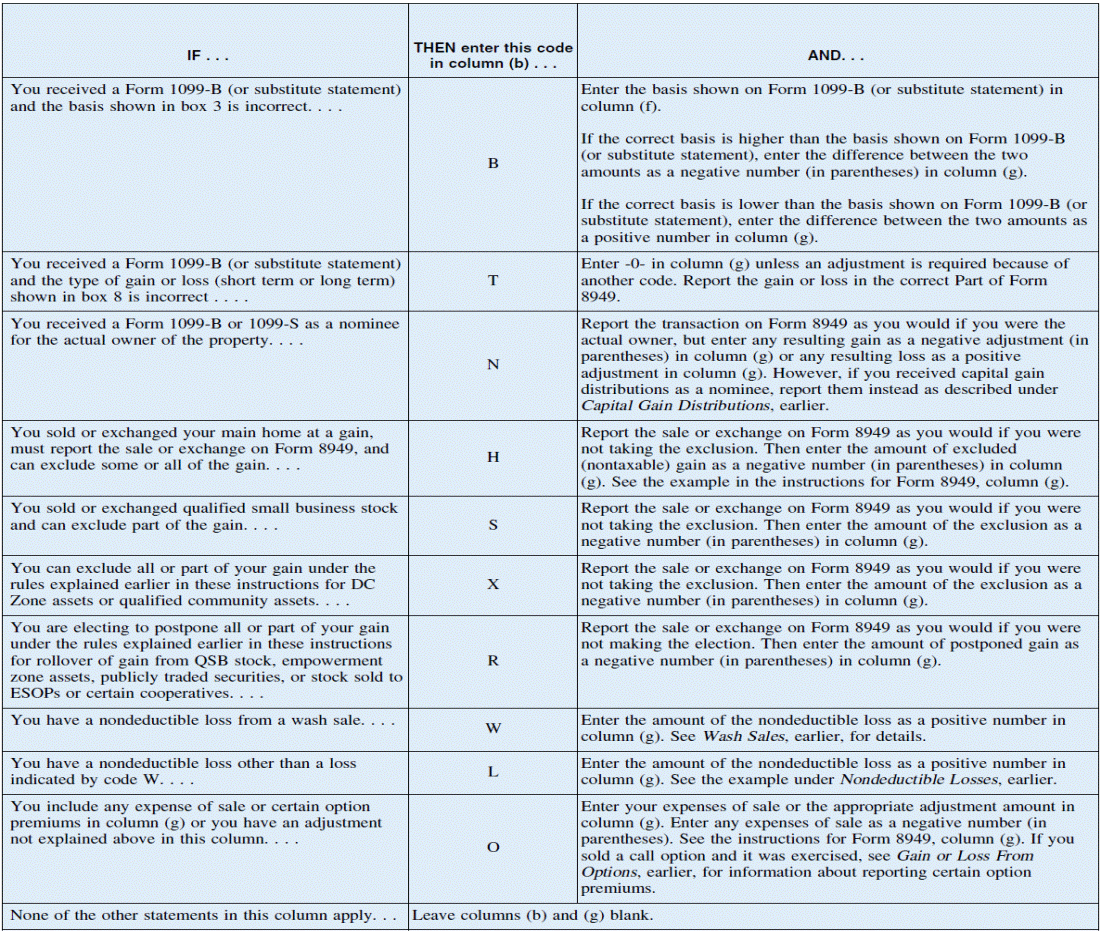
Since the gain/loss column is not on the face of the Form 8949 (as it was on the Schedule D-1 last year), you can view the entry’s gain/loss amount on a worksheet behind the Form 8949 entries. From anywhere on the form, do Alt-W to see the gain/loss for the transaction. In addition, you can see the short-term/long-term code. This code is calculated based on the dates entered for “Date Acquired” and “Date Sold”. If “Various” is entered as the “Date Acquired”, then the sale is considered long-term. To change this to short-term, the automatically calculated code should be changed to “blank”. You can also change the long-term code to “28% Collectible” if necessary.
Car and Truck Worksheet
This worksheet summarizes the vehicle expense information and shows the mileage and actual expense detail for each vehicle. This worksheet is a result of entering vehicles on the depreciation system. Use the steps below to enter vehicle information:
1. Access the depreciation system by pressing Ctrl-N. Then select Car/Truck, Vehicle Allocation.
2. Select “New Asset” and then enter the description, date in service and class code for the vehicle. Class code 6 is for regular, non-SUV vehicles.
3. On the next screen, enter the basis of the vehicle and answer the questions. Standard mileage can be forced on this screen.
4. The next tab is for entering Mileage and Expenses. Enter the total mileage and any commuting mileage. Then enter the miles for each activity. One vehicle can be used for multiple activities, so just enter the business miles for each activity. Enter actual expenses on this screen also.
5. On the Depreciation tab, you will see the depreciation calculated for the vehicle. If you wish to elect out of the special depreciation allowance, then go to the Bonus Depr. button and mark the “Elect out” box. Otherwise, bonus depreciation will be calculated for the vehicle. If you have placed the vehicle in service in a prior year, utilized a different software program and current year business percentage is different than prior year(s), then enter the "Adjusted Prior Depr." on the depreciation tab. This must be done because Crosslink assumes the same business percentage in the prior year(s) as the current tax year.
6. Now, go to the Car/Truck Worksheet form to see the summary of expenses for all vehicles. The expenses (either actual or standard mileage) will be taken from the Car/Truck Worksheet to the activity.
The following automobile depreciation limits are shown below for the period 1987 thru 2012.
|
Placed in Service From |
To |
1st Yr Depr |
Depr. Later Yrs. |
|
1987 |
1988 |
$2,560 |
$4,100 2nd yr $2,450 3rd yr $1,475 4th, 5th |
|
|
|
|
|
|
1989 |
1990 |
$2,660 |
$4,200 2nd yr $2,550 3rd yr $1,475 4th, 5th |
|
|
|
|
|
|
1991 |
1991 |
$2,660 |
$4,300 2nd yr $2,550 3rd yr $1,575 4th, 5th |
|
|
|
|
|
|
1992 |
1992 |
$2,760 |
$4,400 2nd yr $2,650 3rd yr $1,675 4th, 5th |
|
|
|
|
|
|
1993 |
1993 |
$2,860 |
$4,600 2nd yr $2,750 3rd yr $1,675 4th, 5th |
|
|
|
|
|
|
1994 |
1994 |
$2,960 |
$4,700 2nd yr $2,850 3rd yr $1,675 4th, 5th |
|
|
|
|
|
|
1995 |
1996 |
$3,060 |
$4,900 2nd yr $2,950 3rd yr $1,775 4th, 5th |
|
|
|
|
|
|
1997 |
1998 |
$3,160 |
$5,000 2nd yr $3,050 3rd yr $1,775 4th, 5th |
|
|
|
|
|
|
1999 |
1999 |
$3,060 |
$5,000 2nd yr $2,950 3rd yr $1,775 4th, 5th |
|
|
|
|
|
|
2000 |
2001* |
$3,060 |
$4,900 2nd yr $2,950 3rd yr $1,775 4th, 5th |
|
|
|
|
|
|
* Until September 11, 2001. Post September 11, 2001 rates are shown below. |
|||
|
|
|
|
|
|
2001 |
2003** |
$7,660 |
$4,900 2nd yr $2,950 3rd yr $1,775 4th, 5th |
|
|
|
|
|
|
** Until May 5, 2003. Post May 5, 2003 rates are shown below. |
|||
|
|
|
|
|
|
2003 |
2003 |
$10,710 |
$4,900 2nd yr $2,950 3rd yr $1,775 4th, 5th |
|
|
|
|
|
|
2004 |
2004 |
$10,710 |
$4,900 2nd yr $2,950 3rd yr $1,775 4th, 5th |
|
|
|
|
|
|
2005 |
2005 |
$3,060 |
$4,900 2nd yr $2,950 3rd yr $1,775 4th, 5th |
|
|
|
|
|
|
2006 |
2006 |
$2,960 |
$4,800 2nd yr $2,850 3rd yr $1,775 4th, 5th |
|
2007 |
2007 |
$3,060 |
$4,900 2nd yr $2,850 3rd yr $1,775 4th, 5th |
|
2008 |
Bonus depreciation allowed |
$2,960 |
$4,800 2nd yr $2,850 3rd yr $1,775 4th, 5th |
|
2009 |
Bonus depreciation allowed |
$2,960 |
$4,800 2nd yr $2,850 3rd yr $1,775 4th, 5th |
|
2010 |
Bonus depreciation allowed |
$3,060 |
$4,900 2nd yr $2,950 3rd yr $1,775 4th, 5th |
|
2011 |
Bonus depreciation allowed |
$3,060 |
$4,900 2nd yr $2,950 3rd yr $1,775 4th, 5th |
|
2012 |
Bonus depreciation allowed |
$3,160 |
$5,100 2nd yr $3,050 3rd yr $1,875 4th, 5th |
The following depreciation amounts are to be used for the purpose of computing gain or loss on a disposition of the vehicle if the standard mileage rate method has been utilized.
|
Rate per mile |
Maximum depreciation 15,000 limit (1987 to 1989) |
|
|
Year |
Rate |
|
|
1990 - 1991 |
.11 |
(All business miles) |
|
1992 - 1993 |
.115 |
(All business miles) |
|
1994 - 1998 |
.12 |
(All business miles) |
|
2000 |
.14 |
(All business miles) |
|
2001 - 2002 |
.15 |
(All business miles) |
|
2003 - 2004 |
.16 |
(All business miles) |
|
2005 - 2006 |
.17 |
(All business miles) |
|
2007 |
.19 |
(All business miles) |
|
2008 – 2009 |
.21 |
(All business miles) |
|
2010 |
.23 |
(All business miles) |
|
2011 |
.22 |
(All business miles) |