Federal Form Help
The following information has been provided to assist in the preparation of Federal tax returns.
Dependent Codes:
1 Dependent lived with taxpayer
2 Dependent did not live with taxpayer due to divorce or separate maintenance agreement
3 Dependent is taxpayer's parent
4 Other dependent
1) Dependent lived with taxpayer - A person lives with you for the entire year as a member of your household. You are considered to occupy the same household despite temporary absences due to special circumstances such as illness, education, business, vacation and military service.
2) Dependent did not live with taxpayer due to divorce or separate maintenance agreement - If you are the noncustodial parent (the parent who had custody for the shorter period of time) you can claim the child as a dependent if either (a) or (b) applies:
(a) The custodial parent agrees not to claim the child's exemption by signing Form 8332. You, as the noncustodial parent, must attach this signed Form 8332 (or a substantially similar statement) to your return. If divorce decree went into effect after 1984 and before 2009, the noncustodial parent may be able to include certain pages from the decree or agreement instead of Form 8332.
(b) Your divorce decree went into effect prior to 1985; it states you can claim the child as a dependent; and you have given at least $600 in child support.
3) Dependent is taxpayer's parent - You can claim your parents or step parents who do not live with you as dependents if the other dependency tests are met.
4) Other dependents - A person related to you in any of the following ways does not need to live with you to be claimed as dependent:
Your brother, sister, stepbrother, stepsister, half-brother, or half-sister
Your grandparent or other direct ancestor, but not foster parent
An aunt or uncle, a niece or nephew
Your father-in-law, mother-in-law, son-in-law, daughter-in law, brother-in-law, or sister-in-law
EIC Code
E - Indicates taxpayer qualifies for Earned Income Credit and there is a
qualifying child under age 19.
K – Dependent is qualifying child and was kidnapped.
S - Dependent is under age 24 at the end of the tax year and is a full time
student.
D - Dependent is permanently and totally disabled.
N - Enter an 'N' if dependent is ineligible for EIC and you wish to override
CrossLink's preliminary calculation that a dependent was eligible.
Eligible Child Tax Credit Flag
X - Indicates a child is eligible for tax credit.
. - Indicates a child is not eligible for tax credit. To override CrossLink's preliminary calculation and remove an 'X' from this field, enter the (spacebar) then (enter) key.
Form 2441 Dependent Care Flag
X - Enter an 'X' to transfer dependent's information to Form 2441 when the form is attached to a return.
Blank - Prevent dependent's information from being automatically transferred to Form 2441.
D – Enter a ‘D’ to indicate the dependent is over 13 and disabled and is eligible for the dependent care credit.
Non-Qualifying Children
Children who lived with you but whom someone else is claiming on their tax returns. As of the 2005 tax year you cannot use non-qualifying children to claim the EIC. EIC qualified children MUST be related to the taxpayer and have lived with the taxpayer for more than half the year. Children of divorced or separated parents can side step the half year rule provided the custodial parent gives up the right to claim the children as dependents on his or her tax return. Enter a ‘D’ in the dependent care expenses column to indicate the child is over 13 and disabled and is eligible for the dependent care credit. Enter a ‘C’ to indicate the child is eligible for the dependent care credit due to the taxpayer being the custodial parent.
Form W-2
Use Form W-2 to report wages.
Box C:
Foreign Addresses:
Check the “Foreign” box in the Employer’s address section to enter a foreign address for the employer. The domestic address fields must be cleared out before the foreign address is entered.
Ministers and Members of Religious Orders:
Check this box if the wages were received as a minister or member of a religious order from a church or qualified church controlled organization that has a certificate in effect electing an exemption from employer social security and Medicare taxes and the taxpayer has NOT filed Form 4361 and received IRS approval to be exempt from paying self-employment tax.
If this box is checked, the W-2 should show no social
security taxes (
If Form 4361 was filed and IRS approval was received, paying self-employment tax on salaries and other income for services performed as a minister or a member of a religious order is exempt. In this case, the box on Form W-2, line 3 should be checked for "... wages not subject to social security."
Church Employee Income:
Check this box if the wages were received, as an employee (other than as a minister or member of a religious order), from a church or qualified church controlled organization that has a certificate in effect electing an exemption from employer social security and Medicare taxes.
If $108.28 or more was received as church employee income, self-employment tax must be paid.
If this box is checked, the W-2 should show no social
security taxes (
Wages Not Subject to Social Security:
Check this box if the W-2 wages are not subject to social security and no social security was withheld on the W-2. For example, if the taxpayer has filed Form 4361 and received IRS approval to be exempt from self-employment and Medicare taxes.
If this box is checked, the W-2 should show no social
security taxes (
Box 12:
Employer Use Codes:
A = Uncollected Social Security or RRTA tax on tips
B = Uncollected Medicare tax on tips
C = Taxable Cost of group term life insurance over $50,000
D = Elective deferrals to a Section 401(k) cash or deferred arrangement
E = Elective deferrals to a Section 403(b) salary reduction agreement
F = Elective deferrals to a Section 408(k)(6) salary reduction SEP
G = Elective and non-elective deferrals to a Section 457(b) deferred
compensation plan
H = Elective deferrals to a Section 501(c)(18)(D) tax-exempt organization plan
J = Nontaxable sick pay
K = 20% excise tax on excess golden parachute payments
L = Nontaxable part of employee business expense reimbursements
M = Uncollected Social Security or RRTA tax on taxable cost of group term life
insurance over $50,000 (former employees only)
N = Uncollected Medicare tax on taxable cost of group term life insurance over
$50,000 (former employees only)
P = Excludable reimbursed moving expense
Q = Nontaxable Combat pay
R = Employer contributions to an Archer MSA
S = Employee salary reduction contributions to Section 408(p) SIMPLE
T = Adoption benefits
V = Income from the exercise of nonstatutory stock options. This code has no
tax effect -
amount should already be reported in
W = Employer contribution to an employee's Health Saving Account (HSA)
Y = Deferrals under a section 409A nonqualified deferred compensation plan.
Z = Income under section 409A on a nonqualified deferred compensation plan.
AA= Designated Roth contributions under a 401(k) plan
BB= Designated Roth contributions under a 403(B) plan
DD= Cost of Employer-Sponsored health coverage (nontaxable)
EE= Designated Roth contribution under a governmental 457(b)plan
Box 13a - Statutory Employee:
If the statutory employee box is checked, an associated Schedule C or C-EZ needs to be created to carry the income to the return.
Box 13b - Retirement Plan:
If the pension plan box is checked, special limits may apply to the amount of IRA contributions the taxpayer may deduct.
Box 14 - Other:
This box contains items that are not pre-defined by the IRS, some of which need to be included on the 1040. Use the following codes to include the amounts as Non-Taxable Earned Income.
NEI - Other Non-taxable Earned Income.
IRC125 - Section 125 cafeteria plan contributions.
IRC125S - NY City flexible benefit plan contributions subject to state tax.
IRC125N - Section 125 cafeteria plan contributions not subject to New York State tax
414HSUB - NY State 414(h) plans subject to state tax.
414HNOT - NY State 414(h) plans not subject to state tax.
UNION - Union dues withheld by employer.
We provided the literal NEI as a catch-all for the many literals that may be used by various employers.
Railroad Employers:
For railroad employees subject to FICA, W-2 Boxes 1 & 2 are completed as well as Boxes 3, 4, 5, 6 and 7.
For railroad employees subject to RRTA, W-2 Boxes 1 & 2 are completed, Boxes 3, 4, 5, 6 and 7 are left blank, and then in Box 14, RRTA compensation, Tier I tax, Tier II tax, Medicare Tax and Additional Medicare Tax are entered.
For W-2's subject to RRTA, enter the wages in Box 1 and withholding in Box 2. Then X the checkbox in Box 3 for "Enter X if wages are not subject to social security". This will cause Boxes 3, 4, 5 and 6 to not calculate, but to be left blank. Go to Box 14 and enter amounts for RRTA compensation, Tier I tax, Tier II tax, Medicare Tax and Additional Medicare Tax. Form 8959 uses amounts entered in these Box 14 fields to calculate the Additional Medicare Tax, if any.
Box 17 - State Use:
North Carolina:
Enter code “M” in the State Use field of federal Form W-2 to indicate wages should be excluded from NC income. The amount will carry to Form D-400, Line 49, Other Deductions.
Pennsylvania:
Enter code “M” in the State Use field of federal Form W-2 to indicate wages should be excluded from PA income.
Form W-2G
Use Form W-2G to report certain gambling winnings.
Form W-2G should be received if the taxpayer received:
(a) $600 or more in gambling winnings and the payout is at least 300 times the
amount of the wager (except winnings from bingo, keno, and slot machines)
(b) $1,200 or more in gambling winnings from bingo or slot machines
(c) $1,500 or more in proceeds (winnings minus wager) from keno
(d) $5,000 or more in winnings (reduced by the wager or buy-in) from a poker tournament
(e) Any gambling winnings subject to Federal income tax withholding
State Abbreviation:
Gambling winnings will not carry to Schedule T when "1" is entered in State Use field on Form W-2G (US03 8200). This is true regardless of the state code present on W-2G (US03 0200).
Form 1099-C
Amount of Debt Canceled:
Enter the
cancellation of debt income in
This is the computation for Cancellation of Debt from Publication 544:
1. Enter the total amount of the debt immediately prior to the foreclosure.
2. Enter the fair market value of the property from Form 1099-C, box 7.
3. Subtract line 2 from line 1. If less than zero, enter zero.
Note: Generally, this line 3 number will be the same as that on Form 1099-C, box 2.
There are 4 exceptions that make cancellation of debt nontaxable. If any of these apply, do not enter the amount on this form, but complete Form 982 instead for the exclusion of income.
- Bankruptcy: Debts discharged through bankruptcy are not considered taxable income.
- Insolvency: If you are insolvent when the debt is canceled, some or all of the canceled debt may not be taxable to you. You are insolvent when your total debts are more than the fair market value of your total assets. Insolvency can be fairly complex to determine so see IRS Publication 908.
- Certain farm debts: If you incurred the debt directly in operation of a farm, more than half your income from the prior three years was from farming, and the loan was owed to a person or agency regularly engaged in lending, your canceled debt is generally not considered taxable income.
- Non-recourse loans: A non-recourse loan is a loan for which the lender’s only remedy in case of default is to repossess the property being financed or used as collateral. That is, the lender cannot pursue you personally in case of default. Forgiveness of a non-recourse loan resulting from a foreclosure does not result in cancellation of debt income. However, it may result in other tax consequences.
What to do if you receive a 1099-A and not a 1099-C (related to principle residences).
A Form 1099-A is issued to a borrower when the property securing the loan is repossessed or foreclosed by the lender (or abandoned by the borrower). The property then is considered to be sold by the borrower to the lender.
Note: The vast majority of 1099-A forms received by taxpayers in CA and in many other states are going to be informational only (taxpayer doesn’t report the transaction on the tax return). For example, by law your first mortgage in CA is a nonrecourse loan; as a result, most taxpayers in CA would get a 1099-A and get no 1099-C (unless you had refinanced the loan to a recourse loan).
The information off a 1099-A could be used to determine the sales price in the scenario a user would need to do a Home Sale worksheet. However, keep in mind that most homes that are foreclosures or short sales are probably upside down still so there is no gain. The only time you would have a gain is if you refinanced and used some of the loan money for purposes other than the home (which would reduce taxpayer’s basis in home). The Home Sale worksheet is used when you have a gain or need to report the sale because taxpayer received a 1099S.
If a taxpayer receives Form 1099-A from a foreclosure or abandonment on her home, she may have reportable income as a result of any gain on the deemed sale back to the lender. Gain on this transaction is generally measured by the difference between the value the taxpayer received in giving up the property and the taxpayer's adjusted basis in the property. A loss on the disposition of personal use property (including the taxpayer's residence) is not deductible and not reported on the Sch. D.
If the loan was a nonrecourse loan (Form 1099-A box 5 marked "no"), then the value received (considered the sales price) by the taxpayer is the "Outstanding balance amount" reported in box 2 (plus any other consideration the taxpayer may have received in giving up the property to the lender). If the loan is recourse (Form 1099-A box 5 marked "yes"), then the value received by the taxpayer is the lower of the "Outstanding balance amount" reported in Box 2 or the fair market value (FMV) amount reported in Box 4 (plus any other consideration the taxpayer received in giving up the property).
Note: A nonrecourse loan is one in which the borrower is not personally liable (the borrower's liability is limited to the value of the asset secured by the loan). Thus, a homeowner with a nonrecourse mortgage may lose his home in foreclosure, but the lender cannot go after any other assets owned by the borrower. This differs from a recourse loan in which the borrower is personally liable. Thus, if the borrower's outstanding mortgage exceeds the value of the foreclosed home, the lender may attach other assets belonging to the borrower to satisfy the mortgage balance.
The gain from the sale that results from a foreclosure or abandonment is reported on the Home Sale worksheet, Form 8949, and Form 1040 Schedule D.
Note: A lender issues Form 1099-C to report the cancellation of debt, which is a separate event from the sale reported on Form 1099-A.
Interest if Included in Box 2:
If the cancellation of debt income is attributable to
nonbusiness debt, and is carried to Form 1040 as “Other Income”, the interest
amount is not deductible. But if the cancellation of debt income is
attributable to business debt and is carried to the Schedule C, E or F, the
amount entered in this field will be a deduction from the income amount entered
in
Bankruptcy:
If the Identifiable Event Code is “A” for Bankruptcy, review instructions for Form 982 to determine if you should file that form instead of including the canceled debt as income using the Form 1099-C. Remember, all amounts entered in Box 2 will be taken to the return as taxable income. Any excluded income from the completed Form 982 does not carry to the Form 1040 as a reduction of this canceled debt income.
Form 1099-DIV
Tax-Exempt Interest:
If the tax-exempt interest is taxable to the state entered in the “State Code” field, then enter a code of “B” in the “Type” field. If the tax-exempt interest is not taxable to the state entered in the “State Code” field, enter a code of “C” in the “Type” field. All amounts entered as tax-exempt interest are federally tax-exempt. If code “B” is entered, then the amount of tax-exempt interest will be an addition to income on the state return.
Form 1099-INT
Tax-Exempt Interest:
If the tax-exempt interest is taxable to the state entered in the “State Code” field, then enter a code of “B” in the “Type” field. If the tax-exempt interest is not taxable to the state entered in the “State Code” field, enter a code of “C” in the “Type” field. All amounts entered as tax-exempt interest are federally tax-exempt. If code “B” is entered, then the amount of tax-exempt interest will be an addition to income on the state return.
Form 1099-Misc
Link to fields
Select the Form name of the form that the amount of income is associated with. For example, if the amount for nonemployee compensation should be taken to the Schedule C, select the correct Schedule C from the “Link to F3” choice list. The other income amounts on this form need to be associated with a form to be taken to the proper place in the return.
Box 13:
No input is allowed in this field. Check the IRS instructions on how to handle any amount in Box 13.
Box 14:
No input is allowed in this field. Check the IRS instructions on how to handle any amount in Box 14.
Box 17, State Use:
Form 1099-MISC, State Income information will carry to PA Schedule MC. Use the State Use field (USG6 8210) to indicate the PA payment type for Schedule MC, column B.
Form 1099-R and RRB-1099-R
Railroad Retirement Recipients
Translation from FORM RRB-1099-R (pension equivalent form) to Federal 1099-R
RRB-1099-R Federal 1099-R
Box 7 Box 1
Box 9 Box 4
Box 3 Box 9b
Although distribution codes are not shown on the
RRB-1099-R, enter a code of “7” in the “Distribution Code”
Check box 2b “Taxable Amount not Determined”. Then complete the Simplified Method Worksheet below the 1099-R input screen to calculate the taxable amount.
Tier 1 benefits (Form RRB-1099) are entered as Social Security benefits on Form 1040, line 20.
Box 2a. Taxable Amount of Distribution:
If the distribution was from an IRA, complete Form 8606.
If this box is blank, see the instructions for the Simplified General Rule Worksheet.
Simplified General Rule Worksheet
Use the Simplified General Rule Worksheet to determine
the taxable amount (
1. The annuity started AFTER July 1, 1986 and you used this method last year to figure the taxable portion.
a. Payments are from a qualified employee plan, a qualified employee annuity, or a tax-sheltered annuity.
b. Payments began before the taxpayer turned 75 or are guaranteed for 5 years or less.
2. The annuity started after November 18, 1996 and both of the following apply:
a. You receive your pension or annuity payments from a qualified employee plan, qualified employee annuity or a tax-sheltered annuity plan (403(b))
b. On your annuity starting date you are under 75 or you are entitled to less than five years of guaranteed payments.
Enter the smaller of the taxable amount on the 1099R or the taxable amount from the worksheet into Box 2a.
Capital Gain:
A Form 1099-R capital gain is not the same as a Schedule D capital gain. If the taxpayer or spouse receiving the lump sum distribution is at least 70 years old or the taxpayer or spouse is the beneficiary of someone at least 70 years old you may elect to treat the capital gain in box 3 as a capital gain for Form 4972 and bypass Schedule D. If the taxpayer or spouse is aged 70 and above, or a beneficiary of someone aged 70 and above, we will automatically calculate the 4792 capital gain amount. If the election is made, check the box to use the Form 4972.
Pension/IRA Distribution Codes:
Code Description
1 Early distribution subject to 10% penalty.
2 Early distribution NOT subject to 10% penalty.
3 Disability. For these purposes, see IRC 72 (m)(7).
Y Disability. Force the taxable amount to 1040 as wages.
V Disability. Force the taxable amount to 1040 as a pension.
4 Payments due to death. See Form 4972 10 yr averaging.
5 Prohibited transaction subject to penalty. See Form 5329.
6 Section 1035 exchange.
7 Normal distribution.
8 Excess contributions/deferrals & earnings taxable in 2012.
9 Cost of current life insurance protection.
A Eligible for 10 year averaging. See Form 4972.
B Designated Roth account distribution.
D Annuity payments from nonqualified annuities that may be subject to sec. 1411 tax
E Distributions under Employee Plans Compliance Resolution System (EPCSRS).
F Charitable Gift Annuity.
G Direct rollover-and rollover contribution.
H Direct rollover of designated Roth account to Roth IRA.
J Early distribution from a Roth IRA, no known exception.
K Distribution of IRA assets not having a readily available FMV
L Loans treated as deemed distribution under section 72(p)
N Recharacterized IRA contribution made in 2012.
P Excess contributions plus earnings/excess deferrals taxable in 2011.
Q Qualified distribution from a Roth IRA.
R IRA contribution made in 2011, recharacterized in 2012.
S Early distribution from SIMPLE IRA in first 2 years.
T Roth IRA distribution, exception applies.
U Dividend distribution from ESOP under sec. 404(k)
W Charges for purchasing qualified LT care insurance contracts.
1099-Rs with code "S" will be taxed at 25% on Form 5329.
Form 4972 - 10 year averaging
Check "Yes" to elect the 10 year averaging
method. If this box is checked and the distribution code in
Form 4972 - Capital gain election
For taxpayers over age 70
If the taxpayer or spouse receiving the lump sum distribution
is at least 70 years old or the taxpayer or spouse is the beneficiary of
someone at least 70 years old you may elect to treat the capital gain in
Hint: A taxpayer who is on a fixed income and has an effective tax rate of less than 20% should consider the advantages and disadvantages of electing capital gain treatment for lump sum distributions, prior to making the election.
For taxpayers under age 70
If the taxpayer or spouse is the beneficiary of someone aged 70 and above and desires to secure the benefits of capital gains treatment on Form 4972 the beneficiary will need to complete the questions in Part 1 of Form 4972 to secure the capital gain treatment. Only a beneficiary of someone aged 70 and above can use Form 4972. All other beneficiaries and taxpayers securing a capital gain on Form 1099R must report that gain on Schedule D and should not check this box.
Distributions excepted from additional tax:
Some distributions can be exempt from additional tax; the 10% additional tax does not apply to certain distributions specifically excepted by the Code. Enter the amount that can be excluded if less than 100%. In the field provided, enter the applicable exception number (01-12) from the list below.
NO. EXCEPTION
01 Distribution due to separation from service in or after the year of reaching age 55 (does not apply to IRAs)
02 Distribution made as a part of a series of substantially equal periodic payments (made at least annually) for
your life (or life expectancy) or the joint lives (or joint life expectancies) of you and your designated
beneficiary (if from a qualified employee plan, payments must begin after separation from service)
03 Distribution due to total and permanent disability
04 Distribution due to death (does not apply to modified endowment contracts)
05 Distribution to the extent you have unreimbursed medical expenses that exceed 10.0% (7.5% if you or your spouse are
Age 65 or older) of AGI
06 Distributions made to an alternate payee under a qualified domestic relations order (i.e. divorce)(does not apply to IRAs)
07 Distributions made to pay health insurance premiums if the taxpayer is unemployed (only applies to an IRA)
08 Distributions equal to or less than your qualified higher education expenses (only applies to an IRA)
09 Distributions made to pay for a first time home purchase (only applies to an IRA)
10 Distributions due to an IRS levy of the qualified plan (does not apply to IRAs)
11 Qualified distributions to reservist while serving on active duty for at least 180 days
12 Other (See instructions for Form 5329)
Indirect Rollover
X the Indirect Rollover box if the distribution was received and then rolled over within the proper time frame and the taxpayer has proper documentation of the roll over. If the amount rolled over was not 100% of the taxable amount, then enter the amount that was rolled over in the “Amount rolled over if not 100%” box.
State Use
Arizona
If the pension received is from public sources, enter “P” in the state use box, field US048240. If the pension received is from military sources, enter "M" in the state use box, field US048240. If the pension received is from other Government sources, enter "G" in the state use box, field US048240. If the pension received is from Railroad Retirement sources, enter "R" in the state use box, field US048240
District of Columbia
If the pension received is from public sources, enter “P” in the state use box, field US048240. If the pension received is from military sources, enter "M" in the state use box, field US048240. If the pension received is from a Distribution Code 2 Exemption, enter "E" in the state use box, field US048240. If the pension received is from a non-military deceased spouse, enter "D" in the state use box, field US048240.
Indiana
If the pension received is from military sources, enter "M" in the state use box, field US048240. For a Resident return, the Military Retirement Income carries to the Schedule 2, Military Service Deduction Worksheet, Line 3. The Military Service Deduction worksheet can be found behind Schedule 2, Line 7. For a Non-Resident return, the Military Retirement Income carries to the Schedule C, Military Service Deduction Worksheet, Line 3. The Military Service Deduction worksheet can be found behind Schedule C, Line 7.
Michigan
If the pension received is from military sources, enter "M" in the state use box, field US048240. If the pension received is from public sources, such as police, fire or other government, enter “P” in the state use box, field US048240. If the pension should be exempted from the Schedule 1 subtraction, enter “E” in the state use box, field US048240. If the pension is not a military pension and was received for a deceased spouse, enter “D” in the state use box, field US048240. These items will flow to either Schedule 1 or Form 4884 as appropriate.
A distribution code "3" when the individual is
under 59 1/2 is considered early distribution and is taxable to MS. However,
payments from PERS for disability are exempt from income. Enter a "P"
in the state use box, field US048240, and "MS" in the state use box,
field US040246, to exclude this income from the
Pension information will carry to Schedule P, Part I, line 1a if a code “A” is entered on 1099-R, state use box (US04 8240). Information will carry to Schedule P, Part I, Line 1b if a code “B” is entered on 1099-R, state use box (US04 8240)
If the pension received is from military sources, enter "M" in the state use box, field US048240. If the pension is from non-military sources, leave state use box, field US048240 blank. Military pensions carry to the "Eligible military pension income" line of the Pension Income Deduction Worksheet. Non-military pensions carry to the "Eligible non-military pension income" line.
If the pension received is from military sources, enter
"M" in the state use box, field US048240. If the pension is from
public sources other than military, enter a “P” in the state use box, field
US048240. If the pension is from Rail Road Retirement, enter “R” in the state
use box, field US048240. If pension received is from private source leave state
use box, field US048240 blank. The allowable
New York
If you received a pension or other distribution from a NYS or local government pension plan or federal government pension plan, then enter code G as the state use code on Form 1099-R, line 17a.
Enter a code in the State Use field of federal Form 1099-R to indicate which line the retirement benefits should carry to on the NC return.
Valid Entries:
(B) Bailey Settlement. Amount in State Distribution will carry to D-400S, line 8
(R) Railroad Retirement Benefits. Amount in State Distribution will carry to D-400S, line 7
If the pension received is from any government source,
including the Armed Forces, enter "G" in state use box, field
US048240 and "OK" in state use box, field US040246. The allowable
Form 1099-R, State Distribution will only carry to PA
Schedule MC when a "T" is entered in the State Use field (US04 8240).
This will indicate it is taxable to
If the pension received is from any WV police, sheriff's or firemen's retirement system, enter 'F' in the state use box, field US048240, and 'WV' in the state use box, field US040246. If the pension received is from any WV Teachers Retirement, Public Employees Retirement, Federal Retirement and any form of military retirement enter 'P' and 'WV' in the state use boxes, fields US048240, and US040246, respectively. The taxable amount will carry to the appropriate line on page 2 of Form IT-140/IT-140NR and calculate the exclusion.
Schedule A
Use Schedule A to figure your itemized deductions.
In most cases, your Federal income tax will be less if you take the larger of your itemized deductions or your standard deduction.
If you itemize, you may deduct:
(a) Amounts you paid for certain:
- Contributions
- Interest
- Miscellaneous expenses
- Taxes
(b) Certain casualty and theft losses
(c) Part of your medical and dental expenses
(d) Part of your unreimbursed employee business expenses
Medical and Dental Expenses:
You may only deduct the part of your medical and dental expenses that exceed 10.0% of your Federal Adjusted Gross Income (7.5% if you or your spouse are age 65 or older).
Enter the total medical and dental expenses, after reducing these expenses by any payments received from insurance or other sources. Include amounts paid for insurance premiums for medical and dental care. This amount must be reduced by any self-employed health insurance deduction claimed on your Form 1040, line 29.
Include medical and dental bills paid for:
-Taxpayer
-Spouse
-All dependents claimed on the return
-Any child not claimed as a dependent because of the rules for children of divorced or separated parents.
-Any person that could have been claimed as a dependent on the return if that person had not received $3,950 or more of income or had not filed a joint tax return.
Examples of deductible medical and dental expenses:
-Prescription medicines and drugs, or insulin; Medical doctors, dentists, eye doctors, physical therapists, acupuncturists, and psychoanalysts (medical care only); Medical examination, X-ray and laboratory services and whirlpool baths that were doctor-ordered; Nursing help (including employment taxes paid); Hospital care (including meals and lodging), clinic costs, and lab fees; The supplemental part of Medicare insurance (Medicare B); premiums paid for Medicare Part D insurance; Medical aids such as eyeglasses, contact lenses, hearing aids, braces, crutches, wheelchairs, and guide dogs; Lodging expenses (but not meals) while away from home to receive medical care in a hospital or a medical care facility related to a hospital. Do not include more than $50 a night for each eligible person; Ambulance service and other travel costs to get medical care. If the taxpayer used their own vehicle, actual cost of gas and oil may be claimed or 24 cents a mile.
Taxes You Paid:
You may only deduct State and Local Income Taxes, Real Estate Taxes, Personal Property Taxes, and any other taxes that do not include one of the following:
(a) Certain State and Local Taxes
- Assessments for sidewalks or other property improvements
- Car inspection fees
- License fees
- Taxes on gasoline
- Taxes you paid for someone else
(b) Customs Duties
(c) Federal Estate and Gift Taxes
(d) Federal Income and Excise Taxes
(e) Federal Unemployment Taxes (FUTA)
(f) Medicare Taxes
(g) Railroad Retirement Taxes (RRTA)
(h) Social Security Taxes
(i) Sales Taxes
2014 General Sales Tax:
|
2014
Optional Local Sales Tax Tables for Certain Local Jurisdictions |
|||||||||||||||||||||||||
|
|
|
|
|
|
|
|
|
|
|
|
|
|
|
|
|
|
|
|
|
||||||
|
Income |
Exemptions |
Exemptions |
Exemptions |
Exemptions |
|||||||||||||||||||||
|
At |
But |
1 |
2 |
3 |
4 |
5 |
Over |
1 |
2 |
3 |
4 |
5 |
Over |
1 |
2 |
3 |
4 |
5 |
Over |
1 |
2 |
3 |
4 |
5 |
Over |
|
Local Table A |
Local Table B |
Local Table C |
Local Table D |
||||||||||||||||||||||
|
$0 |
$20,000 |
38 |
43 |
46 |
48 |
50 |
52 |
47 |
53 |
58 |
62 |
64 |
68 |
56 |
64 |
69 |
73 |
77 |
81 |
36 |
39 |
40 |
42 |
43 |
44 |
|
20,000 |
30,000 |
60 |
66 |
71 |
74 |
77 |
81 |
71 |
82 |
89 |
94 |
99 |
105 |
87 |
100 |
108 |
114 |
120 |
127 |
60 |
64 |
67 |
69 |
71 |
73 |
|
30,000 |
40,000 |
71 |
79 |
84 |
88 |
91 |
96 |
84 |
97 |
105 |
111 |
117 |
124 |
104 |
119 |
129 |
136 |
143 |
151 |
73 |
78 |
82 |
85 |
87 |
89 |
|
40,000 |
50,000 |
81 |
90 |
96 |
100 |
104 |
109 |
96 |
110 |
119 |
126 |
132 |
140 |
119 |
136 |
147 |
156 |
163 |
173 |
85 |
91 |
95 |
98 |
101 |
104 |
|
50,000 |
60,000 |
89 |
99 |
106 |
111 |
115 |
121 |
106 |
122 |
132 |
140 |
146 |
155 |
132 |
151 |
163 |
173 |
181 |
192 |
96 |
103 |
107 |
111 |
114 |
117 |
|
60,000 |
70,000 |
97 |
108 |
115 |
121 |
125 |
131 |
115 |
132 |
143 |
152 |
159 |
169 |
144 |
164 |
178 |
189 |
197 |
209 |
105 |
113 |
119 |
122 |
125 |
130 |
|
70,000 |
80,000 |
105 |
117 |
124 |
130 |
135 |
141 |
124 |
142 |
154 |
163 |
170 |
181 |
155 |
177 |
192 |
203 |
212 |
225 |
115 |
124 |
129 |
133 |
137 |
141 |
|
80,000 |
90,000 |
112 |
124 |
132 |
139 |
144 |
150 |
132 |
151 |
164 |
173 |
181 |
192 |
165 |
189 |
205 |
217 |
227 |
240 |
124 |
133 |
139 |
143 |
147 |
152 |
|
90,000 |
100,000 |
118 |
131 |
140 |
147 |
152 |
159 |
139 |
159 |
173 |
183 |
192 |
203 |
175 |
200 |
217 |
230 |
240 |
255 |
132 |
142 |
148 |
153 |
157 |
162 |
|
100,000 |
120,000 |
127 |
141 |
150 |
157 |
163 |
171 |
149 |
171 |
185 |
196 |
205 |
218 |
188 |
215 |
233 |
247 |
258 |
274 |
143 |
154 |
161 |
166 |
171 |
176 |
|
120,000 |
140,000 |
138 |
154 |
164 |
171 |
178 |
186 |
162 |
186 |
201 |
213 |
223 |
237 |
205 |
235 |
254 |
269 |
282 |
299 |
158 |
170 |
178 |
184 |
189 |
195 |
|
140,000 |
160,000 |
149 |
166 |
176 |
184 |
191 |
200 |
175 |
200 |
216 |
229 |
240 |
254 |
221 |
253 |
274 |
290 |
304 |
322 |
172 |
186 |
194 |
201 |
206 |
212 |
|
160,000 |
180,000 |
159 |
176 |
188 |
197 |
204 |
213 |
186 |
212 |
230 |
244 |
255 |
271 |
236 |
270 |
293 |
310 |
324 |
344 |
186 |
200 |
209 |
216 |
222 |
229 |
|
180,000 |
200,000 |
168 |
187 |
199 |
208 |
216 |
226 |
196 |
225 |
243 |
258 |
270 |
286 |
250 |
286 |
310 |
328 |
343 |
364 |
198 |
214 |
224 |
231 |
237 |
245 |
|
200,000 |
225,000 |
178 |
198 |
210 |
220 |
228 |
239 |
208 |
237 |
257 |
272 |
285 |
302 |
265 |
303 |
329 |
348 |
364 |
386 |
212 |
228 |
239 |
247 |
253 |
261 |
|
225,000 |
250,000 |
189 |
209 |
223 |
233 |
241 |
253 |
220 |
251 |
272 |
288 |
301 |
319 |
281 |
322 |
348 |
369 |
385 |
409 |
226 |
244 |
255 |
264 |
270 |
279 |
|
250,000 |
275,000 |
199 |
220 |
234 |
245 |
254 |
266 |
231 |
264 |
286 |
303 |
316 |
336 |
296 |
339 |
367 |
388 |
406 |
431 |
240 |
259 |
271 |
280 |
287 |
297 |
|
275,000 |
300,000 |
208 |
231 |
246 |
257 |
266 |
279 |
242 |
276 |
299 |
317 |
331 |
351 |
311 |
355 |
385 |
407 |
426 |
452 |
254 |
274 |
286 |
296 |
303 |
313 |
|
300,000 |
or more |
265 |
294 |
313 |
327 |
338 |
354 |
306 |
349 |
378 |
400 |
418 |
444 |
397 |
454 |
492 |
520 |
544 |
577 |
336 |
362 |
379 |
392 |
402 |
415 |
|
Which Optional Local Sales Tax Table Should I Use? |
|||||||||||||||||||||||||
|
IF
you live in |
AND you live in… |
THEN
use |
|||||||||||||||||||||||
|
Alaska |
|
|
Any locality |
|
C |
|
|
||||||||||||||||||
|
Arizona |
Chandler, Glendale, Gilbert, Mesa, Peoria, Phoenix, Scottsdale, Tempe, Tucson, Yuma, or any other locality |
|
B |
|
|
||||||||||||||||||||
|
Arkansas |
|
Any Locality |
|
B |
|
|
|||||||||||||||||||
|
Colorado |
Adams County, Arapahoe County, Boulder County, Centennial, Colorado Springs, Denver City/Denver County, El Paso County, Larimer County, Pueblo County, or any other locality |
|
A |
|
|
||||||||||||||||||||
|
|
Greeley, Jefferson County, Lakewood, Longmont or Pueblo City. |
|
B |
|
|
||||||||||||||||||||
|
|
|
|
Arvada, Boulder, Fort Collins, Thornton or Westminster |
|
C |
|
|
||||||||||||||||||
|
Georgia |
|
Any locality |
|
B |
|
|
|||||||||||||||||||
|
Illinois |
City of Aurora |
|
B |
|
|
||||||||||||||||||||
|
|
|
|
Any other locality |
|
A |
|
|
||||||||||||||||||
|
Louisiana |
|
Ascension Parish, Bossier Parish, Caddo Parish, Calcasieu Parish, East Baton Rouge Parish, Iberia Parish, Jefferson Parish, Lafayette Parish, Lafourche Parish, Livingston Parish, Orleans Parish, Ouachita Parish, Rapides Parish, St. Bernard Parish, St. Landry Parish, St Tammany Parish, Tangipahoa Parish or Terrebonne Parish |
|
C |
|
|
|||||||||||||||||||
|
|
|
|
Any other locality |
|
B |
|
|
||||||||||||||||||
|
Missouri |
|
|
Any locality |
|
B |
|
|
||||||||||||||||||
|
New York |
|
Counties: Albany, Allegany, Broome, Cattaraugus,
Cayuga, Chautauqua, Chemung, Chenango, Clinton, Columbia, Cortland, Delaware,
Dutchess, Erie, Essex, Franklin, Fulton, Genesee,
Greene, Hamilton, Herkimer, Jefferson, Lewis, Livingston, Madison, Monroe,
Montgomery, Nassau, Niagara, Oneida, Onondaga, Ontario, Orange, Orleans,
Oswego, Otsego, Putnam, Rensselaer, Rockland, St. Lawrence, Saratoga,
Schenectady, Schoharie, Schuyler, Seneca, Steuben, Suffolk, Sullivan, Tioga,
Tompkins, Ulster, Warren, Washington, Wayne, Westchester, Wyoming or Yates |
|
B |
|
|
|||||||||||||||||||
|
|
|
|
Any other locality |
|
D* |
|
|
||||||||||||||||||
|
North Carolina |
Any locality |
|
A |
|
|
||||||||||||||||||||
|
South Carolina |
|
Aiken County, Horry County, Lexington County, Newberry County, Orangeburg County, York County or Myrtle Beach |
|
A |
|
|
|||||||||||||||||||
|
|
|
Bamberg County, Charleston County, Cherokee County, Chesterfield County, Darlington County, Dillon County, Florence County, Hampton County, Jasper County, Lee County, Marion County, Marlboro County or Any other locality |
|
B |
|
|
|||||||||||||||||||
|
Tennessee |
|
Any locality |
|
B |
|
|
|||||||||||||||||||
|
Utah |
|
|
Any locality |
|
A |
|
|
||||||||||||||||||
|
Virginia |
|
Any locality |
|
B |
|
|
|||||||||||||||||||
|
West Virginia |
|
Any locality |
|
B |
|
|
|||||||||||||||||||
|
* Note: Local Table D is just 25% of the NY State table. Instead of adding this table, we could tell taxpayers in these other NY localities to use the ratio method. |
|||||||||||||||||||||||||
|
2014 Optional State Sales Tax Tables |
|||||||||||||||||||||||||||||||
|
|
|
|
|
|
|
|
|
|
|
|
|
|
|
|
|
|
|
|
|
|
|
|
|
|
|
|
|
|
|
|
|
|
Income |
Exemptions |
Exemptions |
Exemptions |
Exemptions |
Exemptions |
||||||||||||||||||||||||||
|
At |
But |
1 |
2 |
3 |
4 |
5 |
Over |
1 |
2 |
3 |
4 |
5 |
Over |
1 |
2 |
3 |
4 |
5 |
Over |
1 |
2 |
3 |
4 |
5 |
Over |
1 |
2 |
3 |
4 |
5 |
Over |
|
Alabama |
|
1 |
4.0000% |
Arizona |
|
2 |
5.6000% |
Arkansas |
|
2 |
6.5000% |
California |
|
3 |
7.5000% |
Colorado |
|
2 |
2.9000% |
||||||||||||
|
$0 |
$20,000 |
223 |
263 |
290 |
310 |
328 |
352 |
214 |
237 |
251 |
262 |
271 |
283 |
283 |
315 |
335 |
350 |
363 |
380 |
267 |
292 |
308 |
321 |
330 |
344 |
111 |
124 |
133 |
139 |
144 |
151 |
|
$20,000 |
$30,000 |
329 |
387 |
426 |
456 |
481 |
517 |
364 |
403 |
428 |
446 |
462 |
482 |
460 |
513 |
546 |
572 |
592 |
620 |
446 |
488 |
515 |
536 |
552 |
574 |
174 |
194 |
207 |
217 |
225 |
236 |
|
$30,000 |
$40,000 |
384 |
451 |
496 |
531 |
560 |
601 |
448 |
496 |
527 |
550 |
569 |
595 |
558 |
621 |
662 |
693 |
718 |
753 |
546 |
598 |
631 |
656 |
676 |
703 |
208 |
232 |
247 |
259 |
268 |
281 |
|
$40,000 |
$50,000 |
431 |
505 |
556 |
595 |
628 |
673 |
524 |
580 |
616 |
644 |
666 |
696 |
644 |
718 |
765 |
801 |
830 |
869 |
635 |
695 |
734 |
763 |
787 |
818 |
237 |
264 |
282 |
295 |
306 |
320 |
|
$50,000 |
$60,000 |
473 |
554 |
609 |
652 |
687 |
737 |
594 |
658 |
699 |
730 |
755 |
789 |
722 |
805 |
859 |
899 |
931 |
976 |
716 |
785 |
829 |
861 |
888 |
924 |
264 |
294 |
313 |
328 |
339 |
356 |
|
$60,000 |
$70,000 |
510 |
598 |
657 |
703 |
741 |
795 |
658 |
729 |
775 |
809 |
837 |
875 |
794 |
886 |
945 |
989 |
1025 |
1074 |
792 |
867 |
916 |
952 |
981 |
1021 |
288 |
320 |
341 |
357 |
370 |
388 |
|
$70,000 |
$80,000 |
545 |
638 |
701 |
750 |
790 |
847 |
719 |
797 |
847 |
884 |
915 |
956 |
862 |
961 |
1025 |
1073 |
1112 |
1165 |
862 |
945 |
998 |
1037 |
1069 |
1112 |
310 |
345 |
368 |
385 |
399 |
418 |
|
$80,000 |
$90,000 |
577 |
675 |
742 |
793 |
836 |
896 |
777 |
861 |
915 |
955 |
988 |
1033 |
925 |
1032 |
1100 |
1152 |
1194 |
1251 |
929 |
1018 |
1075 |
1117 |
1152 |
1198 |
331 |
368 |
392 |
410 |
425 |
446 |
|
$90,000 |
$100,000 |
607 |
710 |
780 |
834 |
879 |
942 |
832 |
922 |
979 |
1023 |
1058 |
1106 |
985 |
1099 |
1172 |
1227 |
1272 |
1333 |
992 |
1088 |
1148 |
1194 |
1230 |
1280 |
350 |
390 |
415 |
435 |
450 |
472 |
|
$100,000 |
$120,000 |
647 |
757 |
831 |
888 |
936 |
1003 |
906 |
1004 |
1067 |
1115 |
1153 |
1206 |
1066 |
1189 |
1269 |
1328 |
1377 |
1443 |
1078 |
1182 |
1248 |
1297 |
1337 |
1391 |
377 |
419 |
447 |
467 |
484 |
507 |
|
$120,000 |
$140,000 |
699 |
817 |
896 |
958 |
1010 |
1082 |
1005 |
1114 |
1184 |
1237 |
1279 |
1338 |
1173 |
1309 |
1396 |
1462 |
1515 |
1588 |
1192 |
1306 |
1379 |
1434 |
1478 |
1538 |
411 |
457 |
487 |
510 |
528 |
553 |
|
$140,000 |
$160,000 |
747 |
873 |
957 |
1023 |
1078 |
1155 |
1099 |
1218 |
1295 |
1353 |
1399 |
1464 |
1274 |
1421 |
1516 |
1588 |
1646 |
1726 |
1299 |
1424 |
1504 |
1564 |
1612 |
1677 |
444 |
493 |
525 |
550 |
569 |
596 |
|
$160,000 |
$180,000 |
792 |
924 |
1013 |
1083 |
1141 |
1222 |
1187 |
1316 |
1399 |
1462 |
1512 |
1582 |
1368 |
1526 |
1628 |
1705 |
1768 |
1853 |
1400 |
1535 |
1621 |
1685 |
1737 |
1808 |
474 |
526 |
561 |
586 |
607 |
636 |
|
$180,000 |
$200,000 |
833 |
972 |
1066 |
1139 |
1200 |
1285 |
1272 |
1411 |
1499 |
1566 |
1621 |
1695 |
1457 |
1627 |
1736 |
1818 |
1884 |
1976 |
1497 |
1641 |
1733 |
1802 |
1857 |
1933 |
502 |
558 |
594 |
621 |
644 |
674 |
|
$200,000 |
$225,000 |
877 |
1023 |
1121 |
1198 |
1261 |
1351 |
1362 |
1510 |
1605 |
1677 |
1735 |
1815 |
1552 |
1732 |
1848 |
1936 |
2007 |
2104 |
1599 |
1753 |
1851 |
1924 |
1984 |
2064 |
532 |
591 |
629 |
658 |
682 |
714 |
|
$225,000 |
$250,000 |
924 |
1077 |
1180 |
1260 |
1327 |
1421 |
1460 |
1618 |
1721 |
1798 |
1860 |
1945 |
1654 |
1847 |
1970 |
2064 |
2140 |
2244 |
1709 |
1874 |
1979 |
2058 |
2121 |
2207 |
564 |
626 |
667 |
698 |
722 |
757 |
|
$250,000 |
$275,000 |
968 |
1127 |
1235 |
1319 |
1389 |
1487 |
1553 |
1722 |
1831 |
1913 |
1979 |
2070 |
1751 |
1955 |
2087 |
2186 |
2266 |
2376 |
1815 |
1990 |
2101 |
2185 |
2252 |
2344 |
594 |
660 |
703 |
735 |
761 |
797 |
|
$275,000 |
$300,000 |
1009 |
1176 |
1288 |
1375 |
1448 |
1550 |
1643 |
1822 |
1937 |
2024 |
2094 |
2191 |
1845 |
2060 |
2198 |
2303 |
2387 |
2504 |
1917 |
2102 |
2219 |
2307 |
2379 |
2476 |
623 |
692 |
737 |
771 |
798 |
836 |
|
$300,000 |
or more |
1256 |
1461 |
1598 |
1705 |
1794 |
1919 |
2199 |
2439 |
2594 |
2711 |
2805 |
2935 |
2413 |
2696 |
2878 |
3015 |
3126 |
3279 |
2540 |
2785 |
2942 |
3059 |
3153 |
3282 |
798 |
885 |
942 |
985 |
1020 |
1068 |
|
Income |
Connecticut |
|
4 |
6.3500% |
District of Columbia |
4 |
5.7500% |
Florida |
|
1 |
6.0000% |
Georgia |
|
2 |
4.0000% |
Hawaii |
|
|
1,7 |
4.0000% |
|||||||||||
|
$0 |
$20,000 |
263 |
289 |
305 |
317 |
327 |
340 |
168 |
181 |
189 |
195 |
200 |
207 |
238 |
261 |
276 |
287 |
296 |
308 |
151 |
168 |
179 |
187 |
194 |
203 |
220 |
255 |
279 |
297 |
312 |
333 |
|
$20,000 |
$30,000 |
432 |
475 |
502 |
522 |
539 |
561 |
284 |
307 |
322 |
332 |
341 |
353 |
396 |
434 |
459 |
478 |
493 |
513 |
241 |
267 |
284 |
297 |
308 |
322 |
356 |
414 |
452 |
482 |
507 |
542 |
|
$30,000 |
$40,000 |
526 |
578 |
611 |
636 |
656 |
683 |
350 |
379 |
397 |
410 |
421 |
436 |
483 |
531 |
561 |
584 |
602 |
627 |
289 |
321 |
341 |
357 |
369 |
387 |
430 |
501 |
548 |
584 |
614 |
656 |
|
$40,000 |
$50,000 |
609 |
670 |
708 |
737 |
760 |
792 |
409 |
443 |
464 |
480 |
493 |
510 |
561 |
616 |
651 |
678 |
699 |
729 |
332 |
368 |
391 |
409 |
423 |
443 |
496 |
578 |
632 |
674 |
708 |
757 |
|
$50,000 |
$60,000 |
685 |
753 |
797 |
829 |
856 |
891 |
464 |
502 |
526 |
544 |
559 |
579 |
632 |
695 |
734 |
764 |
789 |
822 |
370 |
411 |
437 |
456 |
472 |
494 |
556 |
647 |
708 |
755 |
794 |
849 |
|
$60,000 |
$70,000 |
755 |
830 |
878 |
914 |
943 |
983 |
514 |
556 |
583 |
604 |
620 |
642 |
698 |
767 |
811 |
844 |
871 |
907 |
405 |
449 |
478 |
499 |
517 |
541 |
611 |
711 |
779 |
830 |
873 |
933 |
|
$70,000 |
$80,000 |
820 |
902 |
955 |
994 |
1025 |
1068 |
561 |
608 |
638 |
660 |
678 |
702 |
759 |
834 |
882 |
918 |
948 |
988 |
438 |
486 |
516 |
540 |
558 |
584 |
662 |
771 |
844 |
900 |
947 |
1012 |
|
$80,000 |
$90,000 |
882 |
970 |
1027 |
1069 |
1103 |
1149 |
606 |
657 |
689 |
713 |
732 |
759 |
817 |
898 |
950 |
989 |
1020 |
1063 |
468 |
519 |
552 |
577 |
597 |
625 |
711 |
828 |
906 |
966 |
1016 |
1086 |
|
$90,000 |
$100,000 |
940 |
1035 |
1095 |
1140 |
1176 |
1226 |
649 |
704 |
738 |
764 |
784 |
813 |
873 |
959 |
1014 |
1056 |
1090 |
1136 |
497 |
551 |
586 |
613 |
634 |
663 |
756 |
881 |
964 |
1029 |
1082 |
1156 |
|
$100,000 |
$120,000 |
1019 |
1122 |
1187 |
1236 |
1276 |
1329 |
708 |
767 |
804 |
833 |
855 |
886 |
947 |
1041 |
1101 |
1147 |
1183 |
1233 |
536 |
594 |
632 |
660 |
683 |
715 |
818 |
953 |
1043 |
1113 |
1170 |
1250 |
|
$120,000 |
$140,000 |
1124 |
1237 |
1309 |
1363 |
1407 |
1466 |
785 |
851 |
893 |
924 |
949 |
984 |
1046 |
1150 |
1216 |
1266 |
1307 |
1362 |
587 |
651 |
692 |
723 |
748 |
783 |
899 |
1047 |
1147 |
1223 |
1287 |
1375 |
|
$140,000 |
$160,000 |
1222 |
1346 |
1425 |
1484 |
1531 |
1596 |
858 |
931 |
977 |
1011 |
1039 |
1077 |
1139 |
1253 |
1325 |
1380 |
1424 |
1484 |
635 |
704 |
748 |
782 |
809 |
846 |
975 |
1136 |
1244 |
1328 |
1396 |
1493 |
|
$160,000 |
$180,000 |
1315 |
1448 |
1533 |
1596 |
1647 |
1717 |
928 |
1006 |
1056 |
1093 |
1123 |
1164 |
1227 |
1349 |
1427 |
1486 |
1533 |
1599 |
680 |
753 |
801 |
836 |
865 |
905 |
1047 |
1220 |
1335 |
1425 |
1499 |
1602 |
|
$180,000 |
$200,000 |
1403 |
1545 |
1636 |
1704 |
1758 |
1833 |
994 |
1078 |
1132 |
1172 |
1204 |
1248 |
1310 |
1441 |
1525 |
1588 |
1639 |
1708 |
722 |
800 |
850 |
888 |
919 |
961 |
1115 |
1299 |
1422 |
1518 |
1597 |
1707 |
|
$200,000 |
$225,000 |
1496 |
1648 |
1745 |
1817 |
1875 |
1955 |
1064 |
1155 |
1212 |
1255 |
1290 |
1337 |
1399 |
1538 |
1628 |
1695 |
1749 |
1824 |
766 |
849 |
903 |
943 |
975 |
1020 |
1186 |
1383 |
1514 |
1616 |
1699 |
1817 |
|
$225,000 |
$250,000 |
1597 |
1759 |
1863 |
1940 |
2002 |
2087 |
1141 |
1238 |
1300 |
1346 |
1383 |
1434 |
1494 |
1644 |
1739 |
1811 |
1869 |
1949 |
814 |
902 |
959 |
1002 |
1036 |
1084 |
1263 |
1473 |
1613 |
1721 |
1811 |
1936 |
|
$250,000 |
$275,000 |
1693 |
1865 |
1975 |
2057 |
2123 |
2213 |
1214 |
1318 |
1384 |
1433 |
1473 |
1527 |
1586 |
1744 |
1846 |
1922 |
1984 |
2068 |
860 |
952 |
1012 |
1057 |
1094 |
1144 |
1337 |
1559 |
1707 |
1822 |
1916 |
2049 |
|
$275,000 |
$300,000 |
1785 |
1967 |
2083 |
2170 |
2240 |
2335 |
1285 |
1395 |
1465 |
1517 |
1559 |
1617 |
1674 |
1841 |
1949 |
2029 |
2094 |
2184 |
903 |
1001 |
1064 |
1111 |
1149 |
1202 |
1407 |
1641 |
1798 |
1918 |
2018 |
2158 |
|
$300,000 |
or more |
2350 |
2591 |
2744 |
2859 |
2951 |
3078 |
1721 |
1870 |
1965 |
2036 |
2093 |
2171 |
2211 |
2434 |
2576 |
2683 |
2770 |
2889 |
1166 |
1292 |
1372 |
1433 |
1482 |
1550 |
1836 |
2142 |
2347 |
2505 |
2636 |
2819 |
|
Income |
Idaho |
|
|
1 |
6.0000% |
Illinois |
|
|
2 |
6.2500% |
Indiana |
|
4 |
7.0000% |
Iowa |
|
|
1 |
6.0000% |
Kansas |
|
1 |
6.1500% |
||||||||
|
$0 |
$20,000 |
337 |
396 |
436 |
467 |
493 |
529 |
251 |
281 |
301 |
316 |
329 |
346 |
288 |
322 |
343 |
360 |
373 |
391 |
246 |
273 |
291 |
304 |
315 |
330 |
354 |
413 |
453 |
483 |
509 |
545 |
|
$20,000 |
$30,000 |
501 |
588 |
647 |
692 |
730 |
783 |
389 |
434 |
465 |
488 |
507 |
533 |
448 |
500 |
533 |
558 |
579 |
607 |
407 |
453 |
483 |
506 |
524 |
549 |
546 |
637 |
698 |
746 |
785 |
840 |
|
$30,000 |
$40,000 |
586 |
687 |
756 |
809 |
852 |
914 |
462 |
516 |
551 |
578 |
601 |
632 |
533 |
595 |
634 |
664 |
688 |
721 |
497 |
554 |
590 |
618 |
640 |
671 |
648 |
756 |
828 |
884 |
931 |
996 |
|
$40,000 |
$50,000 |
660 |
773 |
849 |
908 |
957 |
1026 |
525 |
586 |
626 |
657 |
682 |
718 |
607 |
677 |
722 |
756 |
783 |
821 |
577 |
644 |
686 |
718 |
744 |
780 |
736 |
859 |
941 |
1005 |
1057 |
1131 |
|
$50,000 |
$60,000 |
725 |
849 |
932 |
997 |
1051 |
1126 |
582 |
649 |
694 |
728 |
756 |
795 |
674 |
751 |
801 |
839 |
869 |
911 |
651 |
726 |
774 |
810 |
840 |
880 |
815 |
951 |
1042 |
1113 |
1171 |
1253 |
|
$60,000 |
$70,000 |
784 |
917 |
1007 |
1077 |
1135 |
1216 |
634 |
707 |
755 |
792 |
822 |
864 |
734 |
818 |
873 |
914 |
947 |
992 |
718 |
801 |
855 |
895 |
927 |
972 |
887 |
1035 |
1134 |
1211 |
1274 |
1363 |
|
$70,000 |
$80,000 |
838 |
980 |
1076 |
1150 |
1212 |
1298 |
681 |
760 |
812 |
851 |
884 |
929 |
790 |
881 |
939 |
983 |
1019 |
1068 |
782 |
872 |
930 |
974 |
1010 |
1059 |
953 |
1112 |
1219 |
1301 |
1369 |
1465 |
|
$80,000 |
$90,000 |
888 |
1038 |
1140 |
1218 |
1283 |
1375 |
726 |
809 |
864 |
907 |
941 |
989 |
842 |
939 |
1001 |
1048 |
1086 |
1138 |
842 |
939 |
1002 |
1049 |
1088 |
1140 |
1015 |
1184 |
1298 |
1386 |
1458 |
1560 |
|
$90,000 |
$100,000 |
935 |
1093 |
1199 |
1282 |
1351 |
1447 |
768 |
856 |
914 |
959 |
995 |
1046 |
891 |
994 |
1060 |
1109 |
1149 |
1205 |
899 |
1003 |
1070 |
1121 |
1162 |
1218 |
1074 |
1252 |
1372 |
1465 |
1542 |
1649 |
|
$100,000 |
$120,000 |
998 |
1166 |
1279 |
1367 |
1440 |
1542 |
824 |
919 |
981 |
1028 |
1067 |
1122 |
957 |
1067 |
1138 |
1191 |
1234 |
1293 |
976 |
1089 |
1162 |
1217 |
1262 |
1323 |
1152 |
1343 |
1472 |
1571 |
1654 |
1769 |
|
$120,000 |
$140,000 |
1080 |
1260 |
1382 |
1477 |
1556 |
1666 |
898 |
1000 |
1068 |
1119 |
1162 |
1221 |
1043 |
1163 |
1240 |
1298 |
1345 |
1409 |
1078 |
1203 |
1284 |
1345 |
1395 |
1463 |
1253 |
1462 |
1602 |
1710 |
1800 |
1925 |
|
$140,000 |
$160,000 |
1155 |
1348 |
1478 |
1579 |
1663 |
1781 |
967 |
1076 |
1149 |
1204 |
1250 |
1313 |
1123 |
1252 |
1335 |
1398 |
1448 |
1518 |
1175 |
1312 |
1400 |
1467 |
1521 |
1595 |
1348 |
1573 |
1723 |
1839 |
1936 |
2071 |
|
$160,000 |
$180,000 |
1225 |
1429 |
1567 |
1673 |
1762 |
1886 |
1030 |
1147 |
1224 |
1283 |
1331 |
1398 |
1198 |
1335 |
1424 |
1490 |
1544 |
1618 |
1265 |
1413 |
1508 |
1580 |
1638 |
1719 |
1436 |
1675 |
1835 |
1959 |
2062 |
2205 |
|
$180,000 |
$200,000 |
1291 |
1506 |
1650 |
1762 |
1855 |
1986 |
1091 |
1214 |
1295 |
1357 |
1409 |
1480 |
1269 |
1414 |
1508 |
1578 |
1635 |
1714 |
1352 |
1510 |
1612 |
1689 |
1751 |
1837 |
1520 |
1772 |
1942 |
2073 |
2181 |
2333 |
|
$200,000 |
$225,000 |
1360 |
1585 |
1737 |
1855 |
1952 |
2090 |
1154 |
1284 |
1369 |
1435 |
1489 |
1564 |
1342 |
1496 |
1595 |
1670 |
1730 |
1813 |
1443 |
1612 |
1722 |
1804 |
1871 |
1962 |
1607 |
1873 |
2053 |
2191 |
2306 |
2466 |
|
$225,000 |
$250,000 |
1433 |
1670 |
1830 |
1953 |
2056 |
2200 |
1221 |
1359 |
1449 |
1519 |
1576 |
1655 |
1422 |
1585 |
1689 |
1768 |
1832 |
1920 |
1542 |
1724 |
1840 |
1928 |
2000 |
2098 |
1700 |
1982 |
2172 |
2318 |
2440 |
2610 |
|
$250,000 |
$275,000 |
1503 |
1750 |
1917 |
2046 |
2154 |
2305 |
1285 |
1429 |
1525 |
1598 |
1658 |
1741 |
1497 |
1668 |
1779 |
1862 |
1929 |
2021 |
1637 |
1830 |
1954 |
2047 |
2123 |
2228 |
1788 |
2085 |
2284 |
2439 |
2566 |
2745 |
|
$275,000 |
$300,000 |
1569 |
1826 |
2000 |
2135 |
2247 |
2404 |
1347 |
1497 |
1597 |
1673 |
1736 |
1823 |
1569 |
1748 |
1864 |
1951 |
2022 |
2118 |
1728 |
1932 |
2063 |
2162 |
2243 |
2353 |
1873 |
2184 |
2392 |
2554 |
2687 |
2874 |
|
$300,000 |
or more |
1959 |
2277 |
2492 |
2658 |
2796 |
2990 |
1713 |
1902 |
2028 |
2124 |
2203 |
2312 |
1998 |
2226 |
2373 |
2484 |
2574 |
2697 |
2288 |
2559 |
2734 |
2866 |
2973 |
3120 |
2376 |
2770 |
3034 |
3239 |
3408 |
3645 |
|
|
|
Kentucky |
|
4 |
6.0000% |
Louisiana |
|
2 |
4.0000% |
Maine |
|
|
4 |
5.5000% |
Maryland |
|
4 |
6.0000% |
Massachusetts |
4 |
6.2500% |
||||||||||
|
$0 |
$20,000 |
235 |
262 |
279 |
293 |
303 |
318 |
161 |
175 |
184 |
191 |
196 |
204 |
146 |
159 |
167 |
173 |
178 |
184 |
208 |
229 |
244 |
255 |
264 |
276 |
201 |
219 |
230 |
239 |
246 |
255 |
|
$20,000 |
$30,000 |
371 |
414 |
441 |
462 |
479 |
502 |
267 |
291 |
306 |
318 |
327 |
339 |
246 |
267 |
281 |
291 |
299 |
310 |
343 |
380 |
404 |
422 |
437 |
458 |
317 |
345 |
363 |
376 |
387 |
402 |
|
$30,000 |
$40,000 |
445 |
496 |
529 |
553 |
573 |
601 |
326 |
356 |
374 |
388 |
399 |
415 |
302 |
328 |
345 |
358 |
368 |
381 |
419 |
464 |
493 |
515 |
533 |
559 |
379 |
413 |
434 |
450 |
463 |
481 |
|
$40,000 |
$50,000 |
509 |
567 |
605 |
633 |
656 |
688 |
379 |
413 |
435 |
451 |
464 |
482 |
352 |
383 |
402 |
417 |
429 |
445 |
486 |
538 |
572 |
598 |
619 |
648 |
434 |
472 |
496 |
514 |
529 |
549 |
|
$50,000 |
$60,000 |
568 |
632 |
674 |
705 |
731 |
766 |
427 |
466 |
490 |
509 |
523 |
544 |
398 |
433 |
455 |
472 |
485 |
503 |
547 |
606 |
644 |
673 |
697 |
731 |
483 |
525 |
552 |
573 |
589 |
611 |
|
$60,000 |
$70,000 |
621 |
691 |
736 |
771 |
799 |
837 |
471 |
514 |
541 |
562 |
578 |
600 |
441 |
479 |
504 |
522 |
537 |
557 |
604 |
668 |
711 |
743 |
770 |
806 |
528 |
574 |
603 |
626 |
643 |
668 |
|
$70,000 |
$80,000 |
670 |
746 |
795 |
832 |
862 |
903 |
513 |
560 |
589 |
612 |
629 |
654 |
480 |
523 |
550 |
570 |
586 |
608 |
656 |
727 |
773 |
808 |
837 |
877 |
569 |
619 |
651 |
675 |
694 |
720 |
|
$80,000 |
$90,000 |
716 |
797 |
850 |
889 |
921 |
965 |
552 |
603 |
635 |
659 |
678 |
704 |
518 |
564 |
593 |
615 |
632 |
656 |
706 |
782 |
832 |
870 |
901 |
944 |
608 |
661 |
695 |
721 |
741 |
769 |
|
$90,000 |
$100,000 |
760 |
846 |
901 |
943 |
977 |
1024 |
590 |
644 |
678 |
703 |
724 |
752 |
554 |
603 |
634 |
657 |
676 |
701 |
754 |
835 |
888 |
929 |
962 |
1008 |
645 |
701 |
737 |
764 |
786 |
815 |
|
$100,000 |
$120,000 |
818 |
911 |
970 |
1015 |
1052 |
1103 |
640 |
699 |
736 |
764 |
786 |
817 |
603 |
656 |
690 |
715 |
736 |
763 |
818 |
906 |
964 |
1008 |
1044 |
1093 |
694 |
755 |
793 |
822 |
846 |
877 |
|
$120,000 |
$140,000 |
895 |
996 |
1061 |
1110 |
1150 |
1205 |
707 |
772 |
813 |
844 |
868 |
902 |
668 |
727 |
764 |
792 |
815 |
845 |
902 |
1000 |
1064 |
1112 |
1152 |
1207 |
759 |
825 |
867 |
899 |
924 |
959 |
|
$140,000 |
$160,000 |
967 |
1076 |
1146 |
1199 |
1243 |
1302 |
771 |
841 |
886 |
919 |
946 |
983 |
729 |
793 |
834 |
865 |
889 |
923 |
982 |
1088 |
1158 |
1211 |
1254 |
1314 |
819 |
891 |
936 |
970 |
997 |
1035 |
|
$160,000 |
$180,000 |
1034 |
1150 |
1226 |
1282 |
1328 |
1392 |
830 |
906 |
954 |
990 |
1020 |
1059 |
786 |
856 |
900 |
933 |
960 |
996 |
1057 |
1171 |
1247 |
1304 |
1350 |
1415 |
875 |
952 |
1000 |
1036 |
1066 |
1106 |
|
$180,000 |
$200,000 |
1098 |
1221 |
1301 |
1361 |
1410 |
1477 |
887 |
968 |
1020 |
1058 |
1090 |
1132 |
842 |
916 |
963 |
999 |
1027 |
1066 |
1129 |
1251 |
1331 |
1392 |
1442 |
1511 |
929 |
1009 |
1061 |
1099 |
1130 |
1173 |
|
$200,000 |
$225,000 |
1165 |
1295 |
1380 |
1443 |
1495 |
1566 |
946 |
1033 |
1089 |
1130 |
1163 |
1209 |
900 |
980 |
1030 |
1068 |
1099 |
1140 |
1204 |
1335 |
1420 |
1486 |
1539 |
1613 |
985 |
1070 |
1125 |
1165 |
1198 |
1243 |
|
$225,000 |
$250,000 |
1237 |
1375 |
1464 |
1532 |
1587 |
1662 |
1011 |
1104 |
1164 |
1208 |
1243 |
1292 |
963 |
1049 |
1103 |
1143 |
1176 |
1220 |
1286 |
1426 |
1517 |
1587 |
1644 |
1723 |
1045 |
1136 |
1193 |
1236 |
1271 |
1319 |
|
$250,000 |
$275,000 |
1305 |
1451 |
1545 |
1616 |
1674 |
1754 |
1073 |
1172 |
1235 |
1282 |
1320 |
1371 |
1024 |
1114 |
1172 |
1215 |
1250 |
1297 |
1364 |
1512 |
1609 |
1683 |
1744 |
1828 |
1102 |
1197 |
1258 |
1304 |
1341 |
1391 |
|
$275,000 |
$300,000 |
1371 |
1523 |
1622 |
1697 |
1758 |
1841 |
1133 |
1237 |
1304 |
1353 |
1393 |
1448 |
1082 |
1178 |
1239 |
1285 |
1321 |
1371 |
1439 |
1596 |
1698 |
1776 |
1840 |
1929 |
1157 |
1257 |
1321 |
1368 |
1407 |
1460 |
|
$300,000 |
or more |
1764 |
1960 |
2086 |
2182 |
2260 |
2367 |
1498 |
1637 |
1725 |
1791 |
1844 |
1917 |
1440 |
1569 |
1650 |
1711 |
1760 |
1827 |
1898 |
2105 |
2241 |
2345 |
2429 |
2546 |
1485 |
1613 |
1695 |
1756 |
1805 |
1872 |
|
|
|
Michigan |
|
4 |
6.0000% |
Minnesota |
|
1 |
6.8750% |
Mississippi |
|
1 |
7.0000% |
Missouri |
|
2 |
4.2250% |
Nebraska |
|
1 |
5.5000% |
||||||||||
|
$0 |
$20,000 |
226 |
251 |
266 |
278 |
288 |
301 |
235 |
254 |
265 |
274 |
281 |
291 |
414 |
476 |
518 |
550 |
576 |
613 |
172 |
195 |
211 |
223 |
233 |
247 |
223 |
247 |
262 |
273 |
282 |
294 |
|
$20,000 |
$30,000 |
357 |
395 |
419 |
437 |
452 |
473 |
394 |
426 |
446 |
461 |
473 |
489 |
642 |
739 |
803 |
853 |
893 |
950 |
272 |
309 |
334 |
353 |
368 |
390 |
371 |
410 |
436 |
455 |
470 |
491 |
|
$30,000 |
$40,000 |
427 |
472 |
501 |
523 |
541 |
565 |
483 |
522 |
547 |
566 |
581 |
601 |
763 |
878 |
955 |
1014 |
1062 |
1129 |
325 |
370 |
400 |
422 |
441 |
466 |
453 |
502 |
533 |
556 |
575 |
601 |
|
$40,000 |
$50,000 |
488 |
540 |
573 |
598 |
618 |
646 |
562 |
609 |
638 |
660 |
677 |
701 |
868 |
1000 |
1087 |
1154 |
1209 |
1285 |
373 |
424 |
457 |
483 |
504 |
534 |
527 |
583 |
619 |
647 |
669 |
699 |
|
$50,000 |
$60,000 |
543 |
601 |
638 |
665 |
688 |
719 |
636 |
688 |
722 |
746 |
766 |
793 |
963 |
1109 |
1205 |
1279 |
1340 |
1425 |
415 |
472 |
509 |
538 |
562 |
594 |
594 |
658 |
699 |
730 |
755 |
789 |
|
$60,000 |
$70,000 |
594 |
656 |
697 |
727 |
751 |
785 |
703 |
762 |
799 |
826 |
848 |
878 |
1048 |
1207 |
1313 |
1393 |
1460 |
1552 |
454 |
516 |
557 |
588 |
614 |
650 |
656 |
727 |
772 |
806 |
834 |
872 |
|
$70,000 |
$80,000 |
641 |
708 |
751 |
784 |
810 |
847 |
767 |
831 |
871 |
901 |
925 |
958 |
1128 |
1299 |
1412 |
1499 |
1570 |
1670 |
490 |
557 |
601 |
635 |
663 |
701 |
714 |
792 |
841 |
878 |
908 |
949 |
|
$80,000 |
$90,000 |
685 |
757 |
803 |
837 |
866 |
904 |
827 |
896 |
940 |
972 |
998 |
1034 |
1202 |
1384 |
1505 |
1598 |
1674 |
1780 |
524 |
595 |
643 |
679 |
708 |
749 |
769 |
853 |
906 |
946 |
979 |
1023 |
|
$90,000 |
$100,000 |
726 |
802 |
851 |
888 |
918 |
959 |
885 |
959 |
1005 |
1040 |
1068 |
1106 |
1272 |
1465 |
1593 |
1690 |
1771 |
1883 |
556 |
632 |
682 |
720 |
751 |
794 |
822 |
911 |
968 |
1011 |
1046 |
1093 |
|
$100,000 |
$120,000 |
782 |
863 |
916 |
956 |
988 |
1032 |
962 |
1043 |
1094 |
1132 |
1162 |
1204 |
1366 |
1573 |
1710 |
1815 |
1901 |
2021 |
599 |
680 |
734 |
775 |
809 |
855 |
892 |
990 |
1052 |
1098 |
1136 |
1188 |
|
$120,000 |
$140,000 |
854 |
944 |
1001 |
1044 |
1079 |
1127 |
1065 |
1155 |
1212 |
1254 |
1288 |
1333 |
1488 |
1713 |
1862 |
1977 |
2071 |
2202 |
655 |
744 |
803 |
847 |
884 |
935 |
986 |
1094 |
1163 |
1214 |
1256 |
1314 |
|
$140,000 |
$160,000 |
923 |
1019 |
1081 |
1127 |
1165 |
1217 |
1163 |
1262 |
1324 |
1370 |
1407 |
1457 |
1602 |
1845 |
2005 |
2129 |
2230 |
2371 |
708 |
804 |
867 |
915 |
955 |
1010 |
1075 |
1193 |
1268 |
1324 |
1370 |
1433 |
|
$160,000 |
$180,000 |
986 |
1089 |
1155 |
1204 |
1245 |
1300 |
1255 |
1361 |
1428 |
1478 |
1518 |
1572 |
1708 |
1966 |
2138 |
2269 |
2377 |
2527 |
757 |
859 |
927 |
979 |
1021 |
1080 |
1158 |
1285 |
1366 |
1427 |
1477 |
1544 |
|
$180,000 |
$200,000 |
1047 |
1155 |
1225 |
1278 |
1320 |
1379 |
1343 |
1457 |
1529 |
1583 |
1625 |
1684 |
1808 |
2082 |
2263 |
2402 |
2517 |
2676 |
804 |
912 |
984 |
1039 |
1083 |
1146 |
1238 |
1374 |
1461 |
1526 |
1579 |
1651 |
|
$200,000 |
$225,000 |
1110 |
1225 |
1299 |
1355 |
1400 |
1462 |
1436 |
1559 |
1636 |
1693 |
1739 |
1801 |
1913 |
2202 |
2394 |
2541 |
2662 |
2831 |
853 |
968 |
1043 |
1101 |
1149 |
1215 |
1322 |
1467 |
1560 |
1630 |
1687 |
1764 |
|
$225,000 |
$250,000 |
1178 |
1300 |
1378 |
1437 |
1485 |
1551 |
1537 |
1669 |
1751 |
1813 |
1862 |
1929 |
2025 |
2332 |
2535 |
2691 |
2819 |
2997 |
905 |
1027 |
1108 |
1169 |
1220 |
1290 |
1414 |
1569 |
1669 |
1744 |
1804 |
1887 |
|
$250,000 |
$275,000 |
1242 |
1371 |
1453 |
1516 |
1566 |
1635 |
1634 |
1774 |
1862 |
1927 |
1980 |
2051 |
2132 |
2454 |
2668 |
2832 |
2967 |
3155 |
955 |
1084 |
1169 |
1233 |
1287 |
1360 |
1501 |
1666 |
1772 |
1852 |
1916 |
2004 |
|
$275,000 |
$300,000 |
1304 |
1439 |
1526 |
1591 |
1644 |
1716 |
1728 |
1876 |
1969 |
2038 |
2094 |
2169 |
2234 |
2572 |
2796 |
2968 |
3109 |
3305 |
1003 |
1138 |
1227 |
1295 |
1351 |
1428 |
1585 |
1760 |
1872 |
1956 |
2024 |
2117 |
|
$300,000 |
or more |
1676 |
1848 |
1959 |
2042 |
2109 |
2202 |
2303 |
2502 |
2627 |
2720 |
2795 |
2896 |
2842 |
3272 |
3557 |
3775 |
3955 |
4205 |
1292 |
1464 |
1578 |
1665 |
1737 |
1836 |
2100 |
2334 |
2483 |
2596 |
2686 |
2811 |
|
|
|
Nevada |
|
5 |
6.8500% |
New Jersey |
|
4,6 |
7.0000% |
New Mexico |
|
1 |
5.1250% |
New York |
|
2 |
4.0000% |
North Carolina |
2 |
4.7500% |
|||||||||||
|
$0 |
$20,000 |
265 |
293 |
311 |
324 |
335 |
350 |
248 |
266 |
278 |
286 |
293 |
302 |
195 |
217 |
231 |
241 |
250 |
262 |
144 |
154 |
161 |
166 |
170 |
175 |
221 |
250 |
270 |
285 |
297 |
314 |
|
$20,000 |
$30,000 |
412 |
455 |
482 |
503 |
520 |
543 |
413 |
443 |
463 |
477 |
489 |
505 |
337 |
375 |
400 |
419 |
434 |
455 |
238 |
256 |
268 |
276 |
283 |
292 |
350 |
398 |
429 |
452 |
472 |
498 |
|
$30,000 |
$40,000 |
490 |
541 |
574 |
598 |
618 |
646 |
504 |
542 |
566 |
584 |
599 |
618 |
419 |
467 |
498 |
522 |
541 |
567 |
291 |
313 |
327 |
338 |
346 |
357 |
420 |
477 |
514 |
543 |
566 |
598 |
|
$40,000 |
$50,000 |
558 |
616 |
653 |
681 |
704 |
735 |
586 |
631 |
659 |
680 |
696 |
719 |
492 |
550 |
587 |
614 |
637 |
668 |
338 |
364 |
380 |
392 |
402 |
415 |
481 |
547 |
589 |
622 |
648 |
685 |
|
$50,000 |
$60,000 |
619 |
683 |
725 |
755 |
780 |
815 |
661 |
712 |
743 |
767 |
786 |
812 |
561 |
626 |
669 |
701 |
727 |
762 |
382 |
411 |
429 |
443 |
454 |
468 |
536 |
609 |
657 |
693 |
723 |
764 |
|
$60,000 |
$70,000 |
675 |
745 |
789 |
823 |
850 |
888 |
730 |
786 |
822 |
848 |
869 |
898 |
625 |
698 |
745 |
781 |
810 |
850 |
421 |
453 |
474 |
489 |
501 |
518 |
587 |
667 |
719 |
759 |
791 |
836 |
|
$70,000 |
$80,000 |
727 |
802 |
850 |
886 |
915 |
955 |
795 |
856 |
895 |
924 |
947 |
978 |
685 |
766 |
818 |
857 |
889 |
933 |
459 |
494 |
516 |
532 |
546 |
564 |
634 |
720 |
777 |
819 |
855 |
903 |
|
$80,000 |
$90,000 |
775 |
855 |
906 |
944 |
975 |
1018 |
857 |
923 |
964 |
995 |
1020 |
1054 |
743 |
831 |
887 |
930 |
965 |
1013 |
494 |
532 |
556 |
573 |
588 |
607 |
678 |
770 |
830 |
876 |
914 |
966 |
|
$90,000 |
$100,000 |
821 |
905 |
959 |
999 |
1032 |
1077 |
915 |
986 |
1030 |
1063 |
1090 |
1126 |
798 |
892 |
954 |
1000 |
1037 |
1089 |
527 |
568 |
593 |
613 |
628 |
649 |
719 |
817 |
881 |
930 |
970 |
1025 |
|
$100,000 |
$120,000 |
881 |
972 |
1030 |
1073 |
1108 |
1157 |
994 |
1071 |
1119 |
1155 |
1184 |
1224 |
873 |
977 |
1044 |
1094 |
1136 |
1192 |
572 |
617 |
645 |
665 |
682 |
705 |
775 |
881 |
950 |
1002 |
1045 |
1104 |
|
$120,000 |
$140,000 |
961 |
1059 |
1122 |
1170 |
1208 |
1260 |
1098 |
1184 |
1238 |
1278 |
1310 |
1353 |
973 |
1089 |
1165 |
1221 |
1267 |
1331 |
632 |
681 |
712 |
735 |
754 |
779 |
848 |
964 |
1039 |
1097 |
1144 |
1209 |
|
$140,000 |
$160,000 |
1036 |
1141 |
1209 |
1260 |
1301 |
1357 |
1197 |
1291 |
1349 |
1393 |
1428 |
1476 |
1069 |
1197 |
1280 |
1343 |
1393 |
1463 |
689 |
743 |
776 |
802 |
822 |
849 |
917 |
1042 |
1124 |
1186 |
1236 |
1307 |
|
$160,000 |
$180,000 |
1105 |
1217 |
1289 |
1343 |
1387 |
1447 |
1290 |
1391 |
1454 |
1502 |
1540 |
1591 |
1159 |
1299 |
1389 |
1457 |
1512 |
1588 |
742 |
800 |
837 |
864 |
886 |
915 |
981 |
1114 |
1202 |
1268 |
1323 |
1398 |
|
$180,000 |
$200,000 |
1171 |
1289 |
1365 |
1423 |
1469 |
1533 |
1379 |
1487 |
1555 |
1606 |
1646 |
1702 |
1247 |
1397 |
1494 |
1568 |
1627 |
1709 |
793 |
855 |
894 |
923 |
947 |
978 |
1041 |
1183 |
1276 |
1347 |
1404 |
1484 |
|
$200,000 |
$225,000 |
1239 |
1365 |
1445 |
1506 |
1555 |
1622 |
1473 |
1588 |
1661 |
1716 |
1759 |
1818 |
1340 |
1502 |
1606 |
1685 |
1750 |
1838 |
847 |
913 |
955 |
986 |
1011 |
1045 |
1105 |
1256 |
1354 |
1429 |
1490 |
1575 |
|
$225,000 |
$250,000 |
1313 |
1446 |
1531 |
1595 |
1647 |
1718 |
1575 |
1698 |
1776 |
1835 |
1881 |
1945 |
1441 |
1616 |
1729 |
1814 |
1883 |
1978 |
905 |
976 |
1021 |
1054 |
1081 |
1117 |
1174 |
1334 |
1438 |
1518 |
1583 |
1673 |
|
$250,000 |
$275,000 |
1383 |
1522 |
1612 |
1679 |
1734 |
1808 |
1672 |
1803 |
1887 |
1948 |
1998 |
2066 |
1538 |
1725 |
1846 |
1937 |
2012 |
2113 |
961 |
1036 |
1084 |
1119 |
1148 |
1186 |
1239 |
1407 |
1518 |
1602 |
1671 |
1766 |
|
$275,000 |
$300,000 |
1450 |
1596 |
1690 |
1760 |
1817 |
1895 |
1766 |
1905 |
1993 |
2058 |
2111 |
2182 |
1633 |
1832 |
1960 |
2057 |
2136 |
2245 |
1014 |
1094 |
1144 |
1182 |
1212 |
1253 |
1301 |
1478 |
1594 |
1683 |
1755 |
1855 |
|
$300,000 |
or more |
1850 |
2035 |
2154 |
2243 |
2315 |
2414 |
2340 |
2526 |
2644 |
2731 |
2802 |
2897 |
2222 |
2496 |
2672 |
2806 |
2915 |
3064 |
1342 |
1449 |
1516 |
1566 |
1607 |
1661 |
1676 |
1905 |
2054 |
2168 |
2261 |
2390 |
|
|
|
North Dakota |
|
1 |
5.0000% |
Ohio |
|
|
1 |
5.7500% |
Oklahoma |
|
1 |
4.5000% |
Pennsylvania |
|
1 |
6.0000% |
Rhode Island |
|
4 |
7.0000% |
|||||||||
|
$0 |
$20,000 |
188 |
210 |
225 |
237 |
246 |
259 |
225 |
245 |
258 |
268 |
275 |
286 |
243 |
279 |
303 |
322 |
338 |
359 |
194 |
210 |
220 |
228 |
234 |
243 |
255 |
278 |
293 |
304 |
313 |
325 |
|
$20,000 |
$30,000 |
295 |
330 |
353 |
370 |
385 |
405 |
371 |
404 |
426 |
442 |
455 |
472 |
379 |
435 |
473 |
502 |
526 |
560 |
319 |
346 |
363 |
376 |
386 |
400 |
397 |
433 |
455 |
472 |
486 |
504 |
|
$30,000 |
$40,000 |
352 |
394 |
421 |
442 |
459 |
483 |
452 |
493 |
519 |
538 |
554 |
576 |
452 |
519 |
564 |
598 |
627 |
667 |
388 |
421 |
442 |
458 |
471 |
488 |
472 |
515 |
541 |
562 |
578 |
600 |
|
$40,000 |
$50,000 |
402 |
449 |
481 |
505 |
524 |
552 |
523 |
571 |
601 |
624 |
642 |
667 |
515 |
591 |
642 |
682 |
714 |
760 |
449 |
488 |
512 |
530 |
545 |
566 |
537 |
586 |
616 |
639 |
658 |
683 |
|
$50,000 |
$60,000 |
447 |
500 |
534 |
561 |
583 |
613 |
589 |
642 |
677 |
702 |
723 |
751 |
572 |
657 |
713 |
757 |
793 |
844 |
505 |
548 |
576 |
597 |
614 |
637 |
596 |
650 |
684 |
709 |
730 |
758 |
|
$60,000 |
$70,000 |
488 |
545 |
583 |
612 |
636 |
669 |
649 |
708 |
746 |
774 |
797 |
828 |
624 |
716 |
778 |
826 |
865 |
920 |
557 |
605 |
635 |
658 |
677 |
702 |
650 |
708 |
745 |
773 |
795 |
825 |
|
$70,000 |
$80,000 |
527 |
588 |
628 |
660 |
685 |
721 |
705 |
770 |
811 |
841 |
866 |
900 |
672 |
771 |
838 |
889 |
931 |
990 |
605 |
657 |
690 |
715 |
736 |
763 |
699 |
762 |
802 |
832 |
855 |
888 |
|
$80,000 |
$90,000 |
562 |
628 |
671 |
704 |
731 |
769 |
758 |
828 |
872 |
905 |
932 |
968 |
717 |
823 |
894 |
948 |
993 |
1056 |
650 |
707 |
743 |
770 |
791 |
821 |
745 |
812 |
855 |
886 |
912 |
947 |
|
$90,000 |
$100,000 |
596 |
665 |
711 |
746 |
775 |
815 |
809 |
883 |
930 |
965 |
994 |
1033 |
760 |
871 |
946 |
1004 |
1052 |
1119 |
693 |
754 |
792 |
821 |
844 |
876 |
789 |
860 |
905 |
938 |
965 |
1002 |
|
$100,000 |
$120,000 |
641 |
715 |
764 |
802 |
833 |
876 |
877 |
958 |
1009 |
1047 |
1078 |
1120 |
817 |
936 |
1017 |
1079 |
1130 |
1202 |
752 |
817 |
859 |
890 |
916 |
950 |
847 |
923 |
971 |
1007 |
1036 |
1076 |
|
$120,000 |
$140,000 |
700 |
781 |
835 |
876 |
909 |
956 |
967 |
1056 |
1112 |
1155 |
1189 |
1235 |
891 |
1022 |
1109 |
1177 |
1233 |
1311 |
829 |
901 |
947 |
982 |
1010 |
1048 |
923 |
1006 |
1059 |
1098 |
1130 |
1173 |
|
$140,000 |
$160,000 |
755 |
842 |
900 |
944 |
981 |
1031 |
1052 |
1149 |
1210 |
1256 |
1294 |
1344 |
960 |
1101 |
1195 |
1268 |
1328 |
1412 |
901 |
980 |
1031 |
1068 |
1099 |
1141 |
994 |
1084 |
1140 |
1182 |
1216 |
1263 |
|
$160,000 |
$180,000 |
806 |
899 |
961 |
1008 |
1047 |
1101 |
1132 |
1236 |
1302 |
1352 |
1392 |
1446 |
1025 |
1175 |
1275 |
1353 |
1417 |
1507 |
969 |
1054 |
1109 |
1150 |
1182 |
1228 |
1060 |
1155 |
1216 |
1261 |
1297 |
1346 |
|
$180,000 |
$200,000 |
855 |
954 |
1019 |
1069 |
1110 |
1167 |
1208 |
1319 |
1390 |
1443 |
1485 |
1544 |
1086 |
1245 |
1351 |
1433 |
1501 |
1596 |
1034 |
1125 |
1183 |
1227 |
1262 |
1311 |
1123 |
1224 |
1287 |
1335 |
1374 |
1426 |
|
$200,000 |
$225,000 |
906 |
1010 |
1079 |
1132 |
1176 |
1236 |
1288 |
1407 |
1482 |
1539 |
1584 |
1646 |
1150 |
1318 |
1431 |
1518 |
1589 |
1690 |
1103 |
1200 |
1262 |
1309 |
1346 |
1398 |
1188 |
1295 |
1362 |
1413 |
1453 |
1509 |
|
$225,000 |
$250,000 |
961 |
1071 |
1144 |
1201 |
1247 |
1311 |
1375 |
1501 |
1582 |
1642 |
1691 |
1758 |
1219 |
1397 |
1516 |
1608 |
1684 |
1790 |
1177 |
1281 |
1347 |
1397 |
1438 |
1493 |
1258 |
1371 |
1443 |
1496 |
1539 |
1598 |
|
$250,000 |
$275,000 |
1013 |
1129 |
1206 |
1265 |
1314 |
1381 |
1457 |
1592 |
1677 |
1741 |
1793 |
1864 |
1284 |
1471 |
1597 |
1694 |
1774 |
1886 |
1248 |
1358 |
1429 |
1482 |
1524 |
1583 |
1325 |
1444 |
1519 |
1575 |
1620 |
1682 |
|
$275,000 |
$300,000 |
1063 |
1185 |
1265 |
1327 |
1378 |
1448 |
1537 |
1679 |
1769 |
1837 |
1891 |
1966 |
1347 |
1543 |
1674 |
1776 |
1860 |
1977 |
1316 |
1432 |
1507 |
1563 |
1608 |
1670 |
1388 |
1513 |
1592 |
1651 |
1698 |
1763 |
|
$300,000 |
or more |
1362 |
1517 |
1619 |
1698 |
1763 |
1853 |
2023 |
2210 |
2330 |
2419 |
2491 |
2589 |
1721 |
1970 |
2137 |
2266 |
2373 |
2522 |
1731 |
1886 |
1985 |
2059 |
2119 |
2201 |
1768 |
1926 |
2027 |
2102 |
2162 |
2245 |
|
|
|
South Carolina |
2 |
6.0000% |
South Dakota |
|
1 |
4.0000% |
Tennessee |
|
2 |
7.0000% |
Texas |
|
|
1 |
6.2500% |
Utah |
|
|
2 |
4.7000% |
|||||||||
|
$0 |
$20,000 |
234 |
257 |
272 |
284 |
293 |
305 |
235 |
271 |
296 |
314 |
330 |
351 |
366 |
416 |
450 |
475 |
496 |
525 |
254 |
283 |
301 |
315 |
326 |
342 |
236 |
267 |
288 |
304 |
317 |
335 |
|
$20,000 |
$30,000 |
386 |
425 |
450 |
469 |
484 |
505 |
366 |
423 |
461 |
490 |
514 |
548 |
579 |
658 |
711 |
751 |
784 |
830 |
419 |
466 |
497 |
520 |
539 |
565 |
376 |
426 |
459 |
484 |
504 |
533 |
|
$30,000 |
$40,000 |
470 |
519 |
549 |
572 |
591 |
616 |
437 |
505 |
550 |
584 |
613 |
653 |
693 |
789 |
852 |
900 |
940 |
995 |
510 |
568 |
606 |
634 |
657 |
688 |
452 |
512 |
551 |
581 |
606 |
640 |
|
$40,000 |
$50,000 |
545 |
601 |
637 |
664 |
685 |
715 |
498 |
575 |
627 |
666 |
699 |
744 |
793 |
903 |
975 |
1030 |
1075 |
1138 |
591 |
658 |
702 |
735 |
762 |
799 |
518 |
587 |
632 |
666 |
695 |
734 |
|
$50,000 |
$60,000 |
614 |
677 |
718 |
748 |
772 |
805 |
553 |
639 |
696 |
740 |
776 |
827 |
884 |
1006 |
1086 |
1147 |
1198 |
1268 |
664 |
741 |
790 |
828 |
858 |
899 |
578 |
655 |
705 |
743 |
775 |
819 |
|
$60,000 |
$70,000 |
677 |
747 |
792 |
825 |
852 |
888 |
603 |
697 |
759 |
807 |
846 |
901 |
967 |
1099 |
1187 |
1254 |
1309 |
1386 |
732 |
817 |
872 |
913 |
946 |
992 |
633 |
717 |
772 |
814 |
848 |
896 |
|
$70,000 |
$80,000 |
736 |
812 |
861 |
897 |
926 |
966 |
649 |
750 |
817 |
869 |
911 |
971 |
1043 |
1187 |
1281 |
1354 |
1413 |
1495 |
796 |
888 |
948 |
993 |
1029 |
1079 |
684 |
774 |
834 |
879 |
917 |
968 |
|
$80,000 |
$90,000 |
792 |
874 |
926 |
965 |
997 |
1040 |
693 |
800 |
872 |
927 |
972 |
1035 |
1115 |
1268 |
1369 |
1447 |
1510 |
1598 |
856 |
956 |
1020 |
1068 |
1107 |
1161 |
732 |
829 |
892 |
941 |
981 |
1036 |
|
$90,000 |
$100,000 |
845 |
933 |
988 |
1030 |
1064 |
1110 |
733 |
848 |
923 |
982 |
1030 |
1097 |
1183 |
1345 |
1453 |
1535 |
1602 |
1695 |
913 |
1020 |
1088 |
1140 |
1181 |
1239 |
777 |
880 |
947 |
999 |
1041 |
1100 |
|
$100,000 |
$120,000 |
917 |
1012 |
1072 |
1118 |
1154 |
1204 |
788 |
911 |
992 |
1055 |
1106 |
1178 |
1274 |
1449 |
1564 |
1652 |
1725 |
1825 |
991 |
1106 |
1180 |
1236 |
1282 |
1344 |
838 |
948 |
1021 |
1077 |
1123 |
1186 |
|
$120,000 |
$140,000 |
1011 |
1117 |
1183 |
1233 |
1274 |
1329 |
860 |
993 |
1082 |
1151 |
1207 |
1285 |
1393 |
1584 |
1710 |
1807 |
1886 |
1996 |
1092 |
1220 |
1302 |
1364 |
1414 |
1483 |
917 |
1039 |
1118 |
1179 |
1229 |
1299 |
|
$140,000 |
$160,000 |
1101 |
1216 |
1288 |
1343 |
1387 |
1447 |
927 |
1071 |
1167 |
1240 |
1301 |
1385 |
1505 |
1712 |
1848 |
1952 |
2037 |
2156 |
1189 |
1328 |
1417 |
1485 |
1540 |
1615 |
992 |
1123 |
1210 |
1276 |
1330 |
1404 |
|
$160,000 |
$180,000 |
1185 |
1308 |
1387 |
1445 |
1493 |
1557 |
989 |
1143 |
1245 |
1323 |
1388 |
1478 |
1609 |
1830 |
1975 |
2086 |
2178 |
2305 |
1279 |
1429 |
1525 |
1598 |
1657 |
1739 |
1062 |
1202 |
1294 |
1365 |
1423 |
1503 |
|
$180,000 |
$200,000 |
1265 |
1397 |
1481 |
1544 |
1594 |
1663 |
1048 |
1211 |
1319 |
1402 |
1471 |
1566 |
1708 |
1942 |
2096 |
2214 |
2311 |
2446 |
1365 |
1525 |
1629 |
1707 |
1770 |
1857 |
1128 |
1277 |
1375 |
1450 |
1511 |
1596 |
|
$200,000 |
$225,000 |
1350 |
1490 |
1580 |
1647 |
1701 |
1775 |
1109 |
1282 |
1396 |
1485 |
1557 |
1658 |
1812 |
2060 |
2223 |
2348 |
2451 |
2594 |
1456 |
1627 |
1738 |
1821 |
1888 |
1981 |
1197 |
1356 |
1460 |
1539 |
1604 |
1695 |
|
$225,000 |
$250,000 |
1441 |
1592 |
1687 |
1759 |
1817 |
1896 |
1175 |
1358 |
1480 |
1573 |
1650 |
1757 |
1923 |
2186 |
2360 |
2493 |
2602 |
2753 |
1555 |
1738 |
1856 |
1945 |
2017 |
2116 |
1272 |
1440 |
1551 |
1635 |
1705 |
1800 |
|
$250,000 |
$275,000 |
1528 |
1688 |
1790 |
1866 |
1927 |
2011 |
1238 |
1431 |
1559 |
1657 |
1738 |
1851 |
2029 |
2307 |
2490 |
2630 |
2745 |
2904 |
1649 |
1843 |
1968 |
2063 |
2139 |
2245 |
1343 |
1521 |
1638 |
1727 |
1800 |
1901 |
|
$275,000 |
$300,000 |
1613 |
1781 |
1889 |
1969 |
2034 |
2122 |
1298 |
1500 |
1634 |
1737 |
1822 |
1941 |
2131 |
2422 |
2614 |
2761 |
2882 |
3049 |
1739 |
1944 |
2077 |
2177 |
2258 |
2369 |
1412 |
1598 |
1721 |
1814 |
1891 |
1997 |
|
$300,000 |
or more |
2127 |
2350 |
2492 |
2599 |
2684 |
2801 |
1657 |
1915 |
2086 |
2218 |
2326 |
2478 |
2740 |
3114 |
3361 |
3550 |
3705 |
3920 |
2292 |
2564 |
2740 |
2872 |
2979 |
3127 |
1822 |
2063 |
2221 |
2342 |
2441 |
2578 |
|
|
|
Vermont |
|
1 |
6.0000% |
Virginia |
|
2 |
4.3000% |
Washington |
|
1 |
6.5000% |
West Virginia |
|
2 |
6.0000% |
Wisconsin |
|
1 |
5.0000% |
||||||||||
|
$0 |
$20,000 |
163 |
174 |
181 |
186 |
190 |
195 |
178 |
203 |
218 |
230 |
240 |
254 |
260 |
287 |
304 |
316 |
327 |
341 |
250 |
279 |
297 |
311 |
323 |
338 |
212 |
233 |
247 |
257 |
266 |
277 |
|
$20,000 |
$30,000 |
253 |
270 |
281 |
288 |
294 |
303 |
274 |
310 |
334 |
352 |
367 |
388 |
431 |
476 |
504 |
526 |
543 |
567 |
413 |
461 |
492 |
516 |
535 |
561 |
347 |
382 |
405 |
422 |
436 |
455 |
|
$30,000 |
$40,000 |
301 |
321 |
334 |
343 |
350 |
360 |
324 |
367 |
395 |
417 |
434 |
459 |
526 |
581 |
616 |
642 |
663 |
693 |
503 |
563 |
601 |
630 |
653 |
686 |
421 |
465 |
493 |
513 |
530 |
553 |
|
$40,000 |
$50,000 |
343 |
366 |
380 |
390 |
399 |
410 |
368 |
416 |
448 |
472 |
492 |
520 |
611 |
674 |
715 |
746 |
770 |
804 |
584 |
653 |
697 |
731 |
758 |
796 |
487 |
538 |
570 |
594 |
614 |
640 |
|
$50,000 |
$60,000 |
380 |
406 |
422 |
433 |
442 |
455 |
407 |
460 |
495 |
522 |
544 |
574 |
688 |
760 |
806 |
840 |
868 |
907 |
657 |
735 |
786 |
824 |
855 |
897 |
547 |
604 |
641 |
668 |
690 |
720 |
|
$60,000 |
$70,000 |
415 |
442 |
459 |
472 |
482 |
496 |
442 |
500 |
538 |
567 |
591 |
624 |
760 |
839 |
889 |
928 |
959 |
1001 |
725 |
811 |
867 |
909 |
943 |
991 |
603 |
666 |
706 |
736 |
760 |
793 |
|
$70,000 |
$80,000 |
446 |
476 |
494 |
508 |
519 |
533 |
475 |
537 |
578 |
609 |
634 |
670 |
826 |
912 |
968 |
1009 |
1043 |
1090 |
789 |
883 |
943 |
989 |
1027 |
1078 |
654 |
723 |
767 |
799 |
826 |
862 |
|
$80,000 |
$90,000 |
476 |
507 |
527 |
541 |
553 |
569 |
506 |
572 |
615 |
648 |
675 |
712 |
890 |
982 |
1042 |
1087 |
1123 |
1173 |
849 |
950 |
1016 |
1065 |
1105 |
1161 |
703 |
777 |
824 |
859 |
888 |
927 |
|
$90,000 |
$100,000 |
503 |
537 |
558 |
573 |
585 |
602 |
534 |
604 |
650 |
685 |
713 |
753 |
950 |
1049 |
1112 |
1160 |
1199 |
1252 |
906 |
1014 |
1084 |
1137 |
1180 |
1239 |
750 |
828 |
878 |
916 |
946 |
988 |
|
$100,000 |
$120,000 |
540 |
576 |
599 |
615 |
628 |
646 |
573 |
647 |
696 |
733 |
764 |
806 |
1030 |
1138 |
1207 |
1259 |
1302 |
1360 |
983 |
1101 |
1177 |
1234 |
1281 |
1345 |
812 |
898 |
952 |
993 |
1026 |
1071 |
|
$120,000 |
$140,000 |
589 |
628 |
652 |
670 |
685 |
704 |
623 |
704 |
757 |
797 |
830 |
876 |
1138 |
1257 |
1333 |
1391 |
1437 |
1502 |
1085 |
1215 |
1299 |
1363 |
1415 |
1486 |
895 |
989 |
1049 |
1094 |
1130 |
1180 |
|
$140,000 |
$160,000 |
634 |
677 |
703 |
722 |
738 |
758 |
670 |
757 |
813 |
857 |
892 |
941 |
1239 |
1369 |
1452 |
1515 |
1566 |
1636 |
1181 |
1323 |
1415 |
1485 |
1541 |
1619 |
973 |
1075 |
1141 |
1190 |
1229 |
1283 |
|
$160,000 |
$180,000 |
676 |
721 |
749 |
770 |
786 |
809 |
714 |
805 |
866 |
912 |
949 |
1001 |
1334 |
1474 |
1563 |
1631 |
1686 |
1762 |
1271 |
1425 |
1524 |
1599 |
1660 |
1744 |
1046 |
1156 |
1226 |
1279 |
1322 |
1380 |
|
$180,000 |
$200,000 |
716 |
764 |
793 |
815 |
833 |
856 |
755 |
852 |
915 |
964 |
1003 |
1058 |
1424 |
1574 |
1670 |
1743 |
1801 |
1882 |
1358 |
1522 |
1628 |
1708 |
1773 |
1863 |
1115 |
1233 |
1308 |
1365 |
1410 |
1472 |
|
$200,000 |
$225,000 |
758 |
808 |
840 |
863 |
881 |
906 |
798 |
900 |
967 |
1018 |
1060 |
1118 |
1520 |
1680 |
1783 |
1860 |
1923 |
2009 |
1449 |
1624 |
1738 |
1823 |
1893 |
1989 |
1189 |
1314 |
1395 |
1455 |
1503 |
1570 |
|
$225,000 |
$250,000 |
803 |
856 |
889 |
914 |
933 |
959 |
844 |
952 |
1022 |
1076 |
1121 |
1182 |
1624 |
1795 |
1905 |
1987 |
2055 |
2147 |
1548 |
1735 |
1857 |
1948 |
2023 |
2125 |
1268 |
1402 |
1488 |
1552 |
1604 |
1675 |
|
$250,000 |
$275,000 |
845 |
901 |
936 |
962 |
982 |
1010 |
887 |
1001 |
1075 |
1132 |
1178 |
1242 |
1723 |
1904 |
2021 |
2109 |
2180 |
2278 |
1642 |
1841 |
1970 |
2068 |
2147 |
2256 |
1344 |
1486 |
1577 |
1645 |
1700 |
1776 |
|
$275,000 |
$300,000 |
886 |
944 |
981 |
1008 |
1029 |
1059 |
929 |
1047 |
1125 |
1184 |
1233 |
1300 |
1818 |
2010 |
2133 |
2226 |
2301 |
2405 |
1733 |
1944 |
2080 |
2183 |
2266 |
2381 |
1416 |
1567 |
1663 |
1735 |
1793 |
1872 |
|
$300,000 |
or more |
1128 |
1203 |
1249 |
1283 |
1311 |
1348 |
1178 |
1326 |
1424 |
1498 |
1559 |
1643 |
2401 |
2655 |
2819 |
2942 |
3042 |
3179 |
2289 |
2569 |
2750 |
2886 |
2998 |
3151 |
1860 |
2059 |
2186 |
2281 |
2357 |
2462 |
|
|
|
Wyoming |
|
1 |
4.0000% |
||||||||||||||||||||||||||
|
$0 |
$20,000 |
160 |
175 |
184 |
191 |
197 |
204 |
||||||||||||||||||||||||
|
$20,000 |
$30,000 |
266 |
290 |
305 |
317 |
326 |
339 |
Note: Residents of Alaska do not have a state sales tax, but should follow the instructions on the next page to determine their local sales tax amount. |
|||||||||||||||||||||||
|
$30,000 |
$40,000 |
324 |
354 |
372 |
387 |
398 |
414 |
||||||||||||||||||||||||
|
$40,000 |
$50,000 |
376 |
410 |
432 |
449 |
462 |
480 |
||||||||||||||||||||||||
|
$50,000 |
$60,000 |
423 |
462 |
487 |
506 |
520 |
541 |
||||||||||||||||||||||||
|
$60,000 |
$70,000 |
467 |
510 |
537 |
558 |
574 |
597 |
||||||||||||||||||||||||
|
$70,000 |
$80,000 |
508 |
555 |
585 |
607 |
625 |
649 |
||||||||||||||||||||||||
|
$80,000 |
$90,000 |
547 |
597 |
629 |
653 |
673 |
699 |
||||||||||||||||||||||||
|
$90,000 |
$100,000 |
583 |
637 |
671 |
697 |
718 |
746 |
||||||||||||||||||||||||
|
$100,000 |
$120,000 |
633 |
691 |
729 |
757 |
779 |
810 |
||||||||||||||||||||||||
|
$120,000 |
$140,000 |
698 |
763 |
804 |
835 |
860 |
894 |
||||||||||||||||||||||||
|
$140,000 |
$160,000 |
760 |
831 |
876 |
909 |
937 |
974 |
||||||||||||||||||||||||
|
$160,000 |
$180,000 |
818 |
894 |
943 |
979 |
1008 |
1048 |
||||||||||||||||||||||||
|
$180,000 |
$200,000 |
874 |
955 |
1007 |
1046 |
1077 |
1119 |
||||||||||||||||||||||||
|
$200,000 |
$225,000 |
932 |
1019 |
1074 |
1116 |
1149 |
1195 |
||||||||||||||||||||||||
|
$225,000 |
$250,000 |
996 |
1089 |
1148 |
1192 |
1227 |
1276 |
||||||||||||||||||||||||
|
$250,000 |
$275,000 |
1056 |
1155 |
1217 |
1264 |
1302 |
1354 |
||||||||||||||||||||||||
|
$275,000 |
$300,000 |
1114 |
1219 |
1285 |
1334 |
1374 |
1429 |
||||||||||||||||||||||||
|
$300,000 |
or more |
1470 |
1608 |
1696 |
1762 |
1815 |
1887 |
||||||||||||||||||||||||
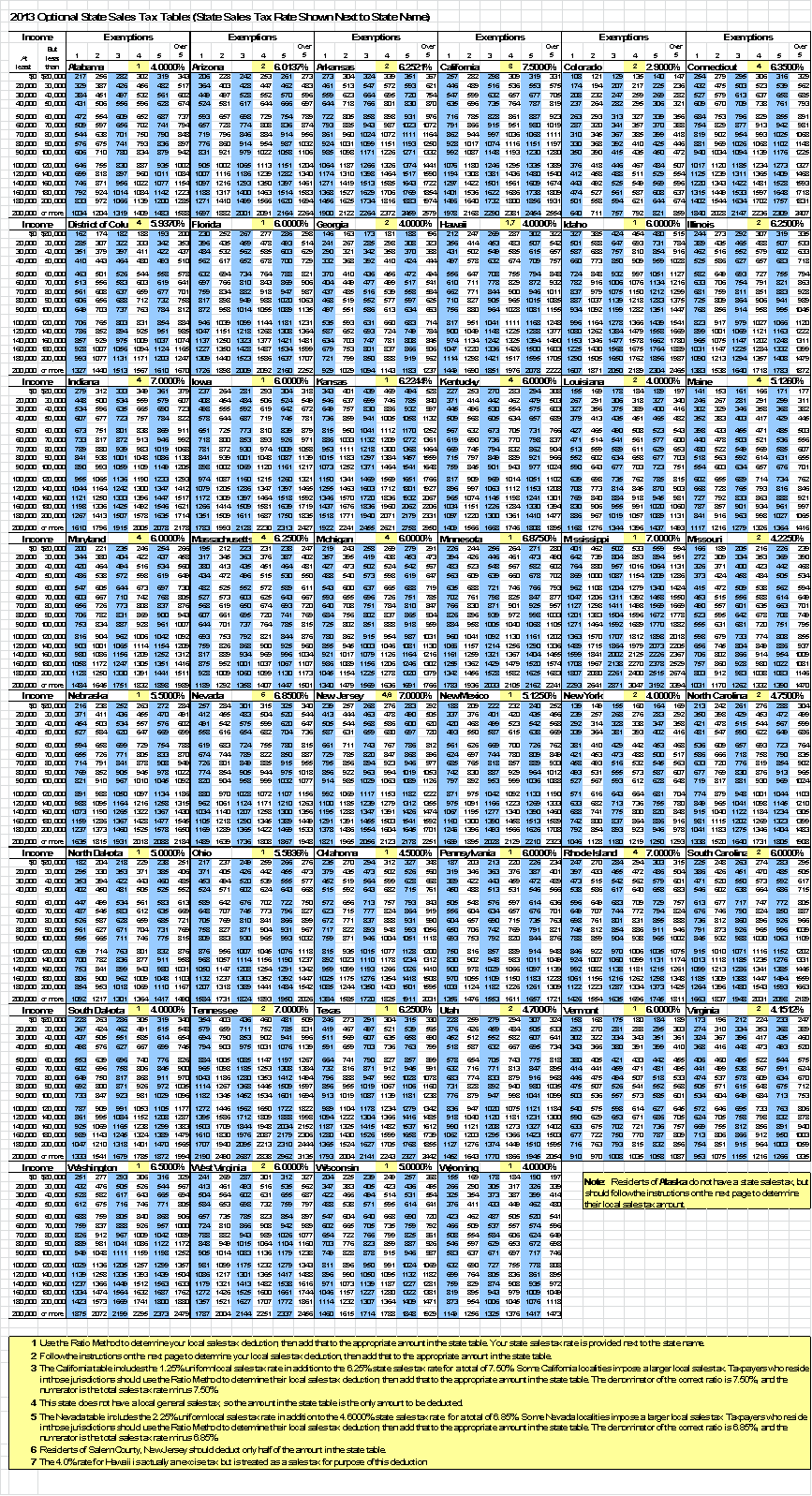
Real estate taxes:
If the return contains any deduction for real estate taxes on Form 8829 or the Business Use of Home worksheet for Schedule F or Form 4835, preparers using Crosslink for tax preparation (not imported returns) must enter the total real estate taxes paid on Schedule A line 6.
Schedule A Line 10:
If the return contains Form 8396 or any deduction for mortgage interest on Form 8829 or the Business Use of Home worksheet for Schedule F or Form 4835, preparers using Crosslink for tax preparation (not imported returns) must enter the total home mortgage interest on Schedule A line 10.
Interest You Paid:
In general, if you paid interest during the tax year that applies to any period after the tax year, you may deduct only amounts that apply for the current tax year.
Home Mortgage Interest:
The amount of home mortgage interest you may deduct depends on:
(a) the date you took out the mortgage,
(b) how you used the proceeds, and
(c) the amount of the mortgage.
Mortgage Interest Credit:
The deduction for home mortgage interest must be reduced by any mortgage interest credit claimed on Form 8396. Crosslink will reduce the total mortgage interest by the amount of mortgage interest credit claimed.
Mortgage Interest Adjustment:
Crosslink will reduce the home mortgage interest by the business portion of the home mortgage interest claimed on Form 8829 or the Business Use of Home worksheet for Schedule F or Form 4835.
Points Not Reported on Form 1098:
Points are shown on your settlement statement. Only points you paid to borrow money are deductible over the life of the loan. Points paid for other purposes are not deductible. You can fully deduct points in the year paid if meet all the tests in Publication 936. If points are due to refinancing a mortgage, they must be deducted over the life of the loan.
Mortgage Insurance Premiums:
Enter the qualified mortgage premiums you paid under a mortgage insurance contract issued during the year in connection with home acquisition debt that was secured by your first or second home. Mortgage insurance premiums cannot be deducted if the Adjusted Gross Income exceeds $109,000 ($54,500 married filing separately). The deduction is limited for AGI’s between $100,000 ($50,000 MFS) and $109,000 ($54,500).
Investment interest:
To claim investment interest expense deduction, Form 4952 should be completed unless all four of the following apply.
1. The only investment income was from interest or dividends.
2. There are no other deductible expenses connected with the production of the
interest or dividends.
3. Investment interest expense is not more than investment income.
4. No disallowed investment interest expense from a prior year is carried over.
Crosslink will automatically add the amount calculated on Form 4952 to line 14 of the Schedule A if the Form 4952 is attached.
Gifts to Charity:
You may deduct contributions or gifts you gave to organizations that are charitable, educational, literary, religious, or scientific in purpose. You may also deduct what you gave to organizations that work to prevent cruelty to children or animals. You may also deduct the mileage driven on behalf of a charitable organization at 14 cents a mile. The Pension Protection Act of 2006 mandates that a gift of cash, no matter the amount, must be evidenced by a cancelled check, bank record or receipt from the donee organization that shows the name of the donee organization, the date of the contribution and the amount of the contribution.
Casualty and Theft Losses:
Use Form 4684 to report casualty or theft losses. You may be able to deduct part or all of each loss caused by theft, vandalism, fire, storm or similar causes, and car, boat or other accidents.
Job Expenses and Certain Miscellaneous Deductions:
Most miscellaneous deductions cannot be deducted in full. There is a 2% of Adjusted Gross Income (AGI) limit, so you can only deduct the part of these expenses that exceed 2% of AGI.
Other Miscellaneous Deductions:
Miscellaneous deductions that are not subject to the 2% AGI limit are reported on line 28. Only the following expenses can be deducted:
(a) Amortizable bond premium on bonds acquired before October 23, 1986
(b) Certain unrecovered investment in a pension
(c) Deduction for repayment of amounts under a claim of right if more than
$3,000
(d) Federal estate tax on income in respect of a decedent
(e) Gambling losses (to the extent of winnings reported on Form 1040, line 21)
(f) Impairment-related work expenses of a disabled person
(g) Casualty and theft losses from income-producing property from Form 4684,
lines 32 and 38b or Form 4797, line 18a
(h) Loss from other activities from Schedule K-1
(i) Ordinary loss attributable to a contingent payment debt instrument or inflation-indexed debt instrument
Schedule B
File Schedule B if any of the following apply:
(a) Taxpayer had over $1,500 in taxable interest
(b) Any of the Special Rules apply:
- Accrued interest
- Amortizable bond premium
- Nominees
- Original issue discount (OID)
- Seller-financed mortgages
(c) Taxpayer is claiming the exclusion of interest from series EE and I U.S. savings
bonds issued after 1989
(d) Taxpayer had over $1,500 in ordinary dividends
(e) Taxpayer received dividends as a nominee
(f) Taxpayer had a foreign account
(g) Taxpayer was a grantor of or transferor to a foreign trust
Line 7a Question 1:
Check the “Yes” box if at any time during the tax year you had a financial interest in or signature authority over a financial account located
in a foreign country. See the definitions that follow. Check the “Yes” box even if you are not required to file FinCEN Form 114, Report of Foreign Bank and Financial Accounts (FBAR).
Financial account. A financial account includes, but is not limited to, a securities, brokerage, savings, demand, checking, deposit, time deposit, or other account maintained with a financial institution (or other person performing the services of a financial institution). A financial account also includes a commodity futures or options account, an insurance policy with a cash value (such as a whole life insurance policy), an annuity policy with a cash value, and shares in a mutual fund or similar pooled fund (that is, a fund that is available to the general public with a regular net asset value determination and regular redemptions).
Financial account located in a foreign country. A financial account is located in a foreign country if the account is physically located outside of the United States. For example, an account maintained with a branch of a United States bank that is physically located outside of the United States is a foreign financial account. An account maintained with a branch of a foreign bank that is physically located in the United States is not a foreign financial account.
Signature authority. Signature authority is the authority of an individual (alone or in conjunction with another individual) to control the disposition of assets held in a foreign financial account by direct communication (whether in writing or otherwise) to the bank or other financial institution that maintains the financial account. See the FinCEN Form 114 instructions for exceptions, and definitions of "financial interest," "United States," and other relevant terms. Do not consider the exceptions relating to signature authority in answering Question 1 on line 7a.
Line 7a Question 2:
See FinCEN Form 114 and its instructions to determine whether you must file the form. Check the “Yes” box if you are required to file the form; check the "No" box if you are not required to file the form. If you checked the “Yes” box to Question 2 on line 7a, FinCEN Form 114 must be electronically filed with the Financial Crisis Enforcement Network (FinCEN) at the following website: http://bsaefiling.fincen.treas.gov/main.html . Do not attach FinCEN Form 114 to your tax return. To be considered timely, FinCEN Form 114 must be received by June 30, 2014.
If you are required to file FinCEN Form 114 but do not properly do so, you may have to pay a civil penalty up to $10,000. A person who willfully fails to report an account or provide account identifying information may be subject to a civil penalty equal to the greater of $100,000 or 50 percent of the balance in the account at the time of the violation. Willful violations may also be subject to criminal penalties.
Line 7b:
If you are required to file FinCEN Form 114, enter the name of the foreign country or countries in the space provided on line 7b. Attach a separate statement if you need more space.
Line 8:
If you received a distribution from a foreign trust, you must provide additional information. For this purpose, a loan of cash or marketable securities generally is considered to be a distribution. See Form 3520 for details.
If you were the grantor of, or transferor to, a foreign trust that existed during 2013, you may have to file Form 3520.
Do not attach Form 3520 to Form 1040. Instead, file it at the address shown in its instructions.
If you were treated as the owner of a foreign trust under the grantor trust rules, you are also responsible for ensuring that the foreign trust files Form 3520-A. Form 3520-A is due on March 17, 2014, for a calendar year trust. See the instructions for Form 3520-A for more details.
Schedule C
Use Schedule C to report:
(a) Income or loss subject to self-employment tax from a business you operated or a profession you practiced as a sole proprietor
(b) Wages and expenses you had as a statutory employee
(c) Certain income shown on Form 1099-Misc
Note: This activity may subject you to state and local taxes and other requirements such as business licenses and fees.
Exemption from Self-employment Tax:
To claim an exemption from Self-employment tax, enter an X in this box. The exemption can be due to a religious affiliation, fees of a Notary Public or nonresident aliens living in the US and not covered under the US social security system. If this box is X’d, the income will not carry to the Schedule SE.
Insurance:
To take the deduction for self employed health insurance the insurance policy must be in the name of the business. There is an IRS letter ruling, 200524001, in which the IRS grants the deduction for health insurance for a sole proprietor that secured health insurance under his personal name. The deduction is limited to the smaller of eligible health insurance premiums, or net profit from the business minus the deduction for one-half of SE tax and any deduction for self-employed SEP, SIMPLE, or qualified plan contributions.
Schedule C-EZ
File Schedule C-EZ if all of the following apply:
(a) Had only one business as a sole proprietor or statutory employee
(b) Had business expenses of $5,000 or less
(c) Use the cash method of accounting
(d) Did not have an inventory at any time during the year
(e) Did not have a net loss from your business
(f) Had no employees during the year
(g) Are not required to file Form 4562 for this business
(h) Do not deduct expenses for business use of your home
(i) Do not have prior year unallowed passive activity losses from this business
Note: If any of the above do not apply you must use Schedule C.
Exemption from Self-employment Tax:
To claim an exemption from Self-employment tax, enter an X in this box. The exemption can be due to a religious affiliation, fees of a Notary Public or nonresident aliens living in the US and not covered under the US social security system. If this box is X’d, the income will not carry to the Schedule SE.
Schedule D
Use Schedule D to report:
(a) Sale or exchange of a capital asset not reported on another form or Schedule (Detail entered on Form 8949)
(b) Capital gain distributions not reported directly on Form 1040, line 13
(c) Gains from involuntary conversions of capital assets not held for business or profit
(d) Nonbusiness bad debts
Detail capital gains and losses are entered on the Form 8949 with totals carrying over to the Schedule D. If you have no adjustments to report and basis was reported to the IRS on Form 1099-B, instead of using Form 8949, the totals can be entered on Line 1a (short-term) and Line 8a (long-term).
Schedule E
Use Schedule E to report income or loss from:
(a) Estates
(b) Partnerships
(c) Rental real estate
(d) Residual interests in REMIC's
(e) Royalties
(f) S corporations
(g) Trusts
Property Type :
The “Type of Property” is a required entry. Select the property type from the types listed below. If the type is “Other”, then a description of that other type must be entered.
(1) Single Family Residence
(2) Multi-Family Residence
(3) Vacation or Short-Term Rental
(4) Commercial
(5) Land
(6) Royalties
(7) Self-Rental
(8) Other, please describe
For property Types 5 and 7, the net rental income is recharacterized as non-passive income and will not carry to the Form 8582. Net rental loss will remain passive.
Number of Days Rented/Used Personal :
An entry is required in the “Number of Days Rented” field for all property types except (6) Royalties. If the property is used as both a rental and a home, the “Number of Days Used Personal” must be entered and will be used for the vacation home calculations. The number of days rented plus the number of days used for personal purposes cannot exceed the number of days in the year (365 for 2014). If however, the property was held out for rent but was not actually rented for even one day, leave the days rented field blank. In this case, if the days used personal is also zero, the rental will be treated as a normal passive rental.
Type of Rental
If a dwelling unit was used for personal purposes as well as rented out to others at fair rental value, the treatment of income and expenses depends on the number of personal use days. If personal use of the dwelling is MORE than 14 days or 10% of the days rented, the rental is labeled a “Vacation Home.” An example of a vacation home is a summer cabin or mountain condo that is used personally as well as rented to others when the owners are not using it. Losses on vacation homes are not allowed to be taken except the rental portion of mortgage interest, rental portion of real estate taxes and direct rental expenses are allowed to be taken on the Schedule E in full. Any disallowed indirect expenses can be carried over to future years. A “Vacation Home Limitation Worksheet” will be prepared showing the expenses allowed as well as the carryover amounts.
If a dwelling was used for personal purposes NOT MORE than the greater of 14 days or 10% of days rented, the rental is considered a normal passive rental and losses are allowed based on the passive loss rules.
If a dwelling is used as a residence and rented out for only 14 days or less, the rental income and expenses do not have to be reported on the Schedule E.
If a taxpayer has a duplex or apartments and lives in one of the units, then they need to enter the number of days the rental unit was rented. The personal unit’s expenses are not to be included in the expenses entered on the Schedule E. Instead, enter mortgage interest and real estate taxes for this personal unit on the Schedule A.
Vacation Home Worksheet :
When the rental is a vacation home, the expenses should be entered on the “Vacation Home Expense Detail” worksheet instead of directly on the Schedule E. This worksheet has columns for “Indirect” expenses and “Direct” expenses. Enter fully deductible expenses in the “Direct” column. The percent of business use is calculated from the days entered. This percent is used to allocate the expenses in the “Indirect” column to the rental.
Vacation Home Mortgage Interest and Real Estate Taxes :
If the rental is considered a Vacation Home, you must answer the “Was this property a principal residence” question on the Proforma Schedule E. Doing this will carry the rental portion of the mortgage interest and real estate taxes to the Schedule A as an adjustment. For this reason, the gross mortgage interest and real estate taxes MUST be entered on the Schedule A, as the gross amounts entered on the Schedule E do not carry over to the Schedule A.
Active Participation
Check the Active Participation box if the taxpayer meets the requirements of active participation as described below. Otherwise, leave the field blank.
Do not check the box if the taxpayer is using this worksheet to report royalty income.
Active
Participation
The taxpayer and spouse must have owned at least 10% of the rental property
during the entire tax year and made management decisions in a significant and
bona fide sense. Management decisions that may count as active participation
include:
Approving new tenants,
Deciding on rental terms,
Arranging repairs and maintenance,
Approving capital or repair expenditures, and
Other similar decisions.
Note: The requirements for active participation are less stringent than the requirements for material participation.
Special Allowance
If the Active Participation box is checked, the taxpayer will be eligible
to deduct up to $25,000 in passive loss from non-passive income, adjusted by
the taxpayer's Modified Adjusted Gross Income.
For more details and information, see Form 8582.
Note: Form 8582 will be automatically added to this return if applicable.
Prior Year Unallowed Loss
Enter the prior year loss for this activity from Worksheet 5, column (c) of the previous year's Form 8582, if applicable.
Current Year Disposition
Check the box if this property or the taxpayer's interest in the property or other investment was sold during the tax year. This will allow any current loss as well as any passive activity loss carryovers to be taken in full.
Real Estate Professional
Check the box if the taxpayer or spouse qualifies as a Real Estate Professional. Otherwise, select leave the field blank.
Generally, rental activities are passive activities even if the taxpayer materially participated in them. However, if the taxpayer qualifies as a real estate professional, rental real estate activities in which the taxpayer materially participated are not passive activities. For this purpose, each interest the taxpayer has in a rental real estate activity is a separate activity.
The taxpayer qualifies as a real estate professional for the year if he or she meets both of the following requirements:
More than half of the personal services the taxpayer performed in all trades or businesses during the tax year were performed in real property trades or businesses (defined below) in which the taxpayer materially participated.
The taxpayer performed more than 750 hours of services during the tax year in real property trades or businesses in which the taxpayer materially participated.
Note for Married Taxpayers: If the taxpayer and spouse are filing a joint return, one person must meet both of these requirements without taking into consideration the activities of the other spouse.
Real Property Trades or Businesses
A real property trade or business is a trade or business that does any of
the following with real property:
Develops or redevelops it
Constructs or reconstructs it
Acquires it
Converts it
Rents or leases it
Operates or manages it
Brokers it
Do not count personal services the taxpayer performed as an employee in real property trades or businesses unless the taxpayer was a 5% owner of the employer. The taxpayer is a 5% owner if they owned (or are considered to have owned) more than 5% of the employer's outstanding stock, outstanding voting stock, or capital or profits interest.
Rental Real Estates as One Activity
The taxpayer must report each rental real estate activity as an individual
activity, unless he or she elects not to by claiming an election under IRC
section 469(c)(7)(a) that he or she is a real estate professional. Please note
that this election cannot be revoked unless the taxpayer can show that his or
her facts and circumstances have materially changed.
Schedule EIC
Schedule EIC will automatically calculate based on entries from the Client Data Screen, Form 1040/A/EZ EIC worksheet, Form 8867 as well as the income and deductions throughout the return.
There is no need to override any fields on Schedule EIC. CrossLink will automatically calculate eligibility based on Dependent(s) SSN, Age, Relationship and number of months lived with taxpayer.
All relevant questions of Form 8867 must be answered before Form EIC will be added to the return and calculate the EIC.
Schedule F
Use Schedule F to report farm income and farm expenses.
Note: This activity may subject you to state and local taxes and other requirements such as business licenses and fees.
Agricultural Activity Codes
CROP PRODUCTS
111100 OILSEED AND GRAIN FARMING
111210 VEGETABLE AND MELON FARMING
111300 FRUIT AND TREE NUT FARMING
111400 GREENHOUSE, NURSERY, AND FLORICULTURE PRODUCTION
111900 OTHER CROP FARMING
ANIMAL PRODUCTION
112111 BEEF CATTLE RANCHING AND FARMING
112112 CATTLE FEEDERS
112120 DAIRY CATTLE AND MILK PRODUCTION
112210 HOG AND PIG FARMING
112300 POULTRY AND EGG PRODUCTION
112400 SHEEP AND GOAT FARMING
112510 ANIMAL AQUACULTURE
112900 OTHER ANIMAL PRODUCTION
FORESTRY AND LOGGING
113000 FORESTRY
& LOGGING (
Exemption from Self-employment Tax:
To claim an exemption from Self-employment tax, enter an X in this box. The exemption can be due to a religious affiliation or nonresident aliens living in the US and not covered under the US social security system. If this box is X’d, the income will not carry to the Schedule SE.
Schedule H
Use Schedule H to figure household employment taxes.
Schedule H must be filed if any of the questions on lines A, B, or C were answered yes.
A household employee is defined as someone hired to do household work under the control of the taxpayer. Some household employees
include:
(a) Babysitters
(b) Caretakers
(c) Cleaning people
(d) Drivers
(e) Health aides
(f) Housekeepers
(g) Nannies
(h) Private nurses
(i) Yard workers
Workers from agencies and self-employed persons cannot be considered household employees.
Line A:
If you pay a household employee $1,900 or more in cash wages during 2014, you must report and pay social security and Medicare taxes on all the wages. The test applies to cash wages paid in 2014 regardless of when the wages were earned.
Cash wages:
Cash wages include wages paid by checks, money orders, etc. They do not include the value of food, lodging, clothing, or other noncash items given to a household employee. Also, do not include amounts paid to:
(a) A spouse
(b) Children under the age of 21
(c) A parent
(d) An employee under the age of 18 at any time during the current tax year
Exceptions for parents:
Count the cash wages paid to a parent for work in or around the house if all of the following apply:
(a) The child living with the taxpayer was under the age of 18 or had a physical or mental condition that required the personal care of an adult for at least 4 continuous weeks in a calendar quarter.
(b) The taxpayer was divorced and not remarried, a widow or widower, or married to and living with a person whose physical or mental condition prevented him/her from caring for the child during that 4 week period.
Exceptions for employees under the age of 18:
Count the cash wages paid to a person who was under the age of 18 and not a student, if providing household services was his/her principle occupation.
The taxpayer may give the employee as much as $100 a month for his/her expenses to commute to the home by public transportation without the repayment counting as cash wages. However, if the taxpayer gave the employee more that $100 a month for these expenses, then the amount over the $100 must be included as cash wages.
Line 1:
Enter on line 1 the total cash wages paid in 2014 to each household employee who meets the $1,900 test.
If the taxpayer paid any household employee cash wages of more than $117,000 in 2014, include only the first $117,000 of that employee's cash wages on line 1 but include the employee's total cash wages on line 3.
Line 10:
Contributions:
Contributions are state required payments made by the taxpayer, as an employer, to the state unemployment fund for the payment of unemployment benefits.
Line 14:
Enter the total of contributions paid to the state unemployment fund for 2014. If you did not have to make contributions because the state gave you a 0% experience rate, enter “0% RATE” on line 14.
Line 15:
Enter the total cash wages paid in 2014 to each household employee, including employees paid less than $1,000. But do not include cash wages paid to your spouse, your child under 21, or your parent. If you paid any household employee more than $7,000 in 2014, include on line 15 only the first $7,000 of that employee’s cash wages.
Line 23:
If you are a household employer in a credit reduction state, enter the total credit reduction amount. A credit reduction state is one where the “Reduction Rate” is greater than zero.
ST Reduction Rate
AK .000
AL .000
AR .000
AZ .000
CA .012
CO .000
CT .017
DC .000
DE .000
FL .000
GA .000
HI .000
IA .000
ID .000
IL .000
IN .015
KS .000
KY .012
LA .000
MA .000
MD .000
ME .000
MI .000
MN .000
MO .000
MS .000
MT .000
NC .012
ND .000
NE .000
NH .000
NJ .000
NM .000
NV .000
NY .012
OH .012
OK .000
OR .000
PA .000
RI .000
SC .000
SD .000
TN .000
TX .000
UT .000
VA .000
VT .000
WA .000
WI .000
WV .000
WY .000
PR .000
VI .012
Schedule J
Use Schedule J (Form 1040) to elect to figure your 2014 income tax by averaging over the previous 3 years (base years), all or part of your 2014 taxable income from your trade or business of farming or fishing. This election may give you a lower tax if your 2014 income from farming or fishing is high and your taxable income for one or more of the 3 prior years was low.
Schedule R
Use Schedule R to figure the credit for:
(a) Disabled persons
(b) Elderly persons
The credit is based on the taxpayer's filing status, age, and income. If the taxpayer is married filing jointly, the credit is also based on the spouse's age and income.
The credit may be taken if any of the following apply:
(a) The taxpayer was age 65 or older at the end of the tax year
(b) The taxpayer was under age 65 at the end of the tax year and all of the following apply:
- Taxpayer was permanently and totally disabled on the date he/she retired.
- The taxpayer received taxable disability income during the year.
- On January 1, the taxpayer had not reached mandatory retirement age
Line 11:
If box 2, 4, 5, 6, or 9 is checked in Part I, complete line 11 as follows:
(a) If
(b) If
(c) If
Schedule SE
Use Schedule SE to figure the tax due on net earnings from self-employment.
I. Short Schedule SE:
You may use Short Schedule SE if all of the following apply:
(a) You are not a minister, member of a religious order, or Christian Science practitioner who received IRS approval not to be taxed on earnings from these sources but you owe self-employment tax on other earnings
(b) You are not using one of the optional methods to figure your net earnings
(c) You did not receive church employee income reported on Form W-2 of $108.28 or more
(d) The total of your wages and tips subject to Social Security or Railroad Retirement tax plus your net earnings from self-employment were not more than $117,000
(e) You did not receive tips subject to Social Security or Medicare tax that you did not report to your employer
II. Long Schedule SE:
You must file Schedule SE if one of the following applies:
(a) You were self-employed and your net earnings from self-employment (other than church employee income) were $400 or more
(b) You had church employee income of $108.28 or more
(c) You reported wages on Form 8919, Uncollected Social Security and Medicare Tax on Wages.
Note:
(1) The Social Security Administration uses the information from Schedule SE to figure your benefits under the Social Security program.
(2) This tax applies no matter how old you are and even if you are already receiving Social Security or Medicare benefits.
Form IN
Invoice Form (FORM IN) contains information regarding the fees for services provided. When the form is added, CrossLink will carryforward the taxpayer's name and address. As amounts are entered, CrossLink will automatically calculate the subtotal, sales tax, total, and balance due.
Form 1040
File Form 1040 if any of the following apply, the taxpayer:
1. Received any of the following types of income:
(a) Self-employment income
(b) Tips not reported to an employer
(c) Capital gain distributions or nontaxable distributions
(d) Income received as a partner in a partnership, shareholder in an S
corporation, or a beneficiary of an estate or trust
2. Received or paid interest on securities transferred between interest payment dates
3. Can exclude any of the following types of income:
(a) Foreign
earned income he/she received as a
(b) Certain
income received from sources in a
bona fide
resident of
4. Had a financial account in a foreign country, such as a bank account or
securities account
- Exception: If the combined value of the accounts was $10,000 or less during
all of the tax
year or if the accounts were with a
operated by a
5. Received a distribution from a foreign trust after August 20, 1998
6. Is reporting original issue discount (OID) in an amount more or less than the
amount shown on Form 1099-OID
Presidential Election Campaign Fund:
This fund helps pay for Presidential election campaigns. The fund reduces candidates' dependence on large contributions from individuals and groups and places candidates on an equal financial footing in the general election.
Unemployment Compensation:
If you received unemployment compensation for the current tax year and had a repayment of a portion or all of the unemployment compensation you received, you may deduct the repayment amount from the taxable unemployment compensation shown on line 19, Form 1040. If you repaid a portion or all of the unemployment compensation in the current tax year and it was for unemployment compensation received in an earlier tax year you may deduct the repayment amount on Schedule A.
Other Income:
Use this line to report any income not reported elsewhere. Do not include nontaxable amounts. Do not report income from self-employment or fees earned as a notary public on this line of the 1040. Instead report this on Schedule C or C-EZ.
Educators Expense:
If you are an eligible educator, you may be able to deduct up to $250 of expenses you paid for purchases of books and classroom supplies. These out-of-pocket expenses may lower your tax bill even if you don’t itemize your deductions.
Business Expenses:
Business related travel expenses of National Guard and reserve members who traveled more than 100 miles from home to perform services (drill) in the National Guard or reserve; Business related performing-arts-related expenses as a qualified performing artist and business expenses of fee-basis state or local government officials can be deducted here. All others must take business expense deductions on Schedule A using Form 2106.
Self Employed Health Insurance Deduction:
You may be able to deduct the amount you paid for health insurance for your self, spouse and dependents if you had a profit for the year on your Schedule C or F; Or you used one of the optional methods to figure your net income from self employment on Form Schedule SE, or you received wages from a S Corporation in which you were a more than 2% shareholder. Note: the health insurance plan must be established under your business to be deductible from gross income. If the health insurance plan is not established under the business you may be able to deduct the insurance cost on Schedule A subject to the 10.0% (7.5% if over age 65) limitation.
Student Loan Interest Deduction:
This deduction may be taken if all of the following apply:
1. Interest was paid this year on a qualified student loan
2. You paid interest in the tax year on a qualified student loan
3. Filing status is any of the following:
- Single
- Married Filing Jointly
- Head of Household
- Qualifying Widow(er)
4. Modified adjusted gross income is less than:
- $80,000 for Single, Head of Household, or Qualifying
Widow(er)
- $160,000 for Married Filing Jointly
5. Was not claimed as a dependent on another person's current year tax return
Tuition and Fees Deduction:
A maximum Tuition and Fees Deduction amount of $4,000 is allowed. The Tuition and Fees deduction is for qualified tuition and fees paid to a post secondary educational institution. The Tuition and Fees deduction is a deduction for the Adjusted Gross Income. Qualified post secondary educational institutions include colleges, universities and some vocational schools. It does not include any schools with a curriculum for grades K through 12. You cannot take the tuition and fees deduction and also claim the education credits on Form 8863 for the same student. You can however take the deduction or credit that is most beneficial to the taxpayer.
Note: If the education expenses paid for was paid with money that was borrowed, i.e. loaned, the money that was paid to the institution directly by the taxpayer or on the taxpayers’ behalf qualifies for a Tuition and Fees deduction for the taxpayer.
Domestic Production Activity Deduction:
This deduction can equal nine percent of the gross
qualified production activities income or taxable income for the taxable
year. However, the deduction for a taxable year is limited to 50 percent
of the W-2 wages PAID by the taxpayer. Qualified production activities include
manufacturing, producing, growing, and extracting tangible personal property,
computer software, and sound recordings, and the construction and substantial
renovation of real property including infrastructure. The production of
certain films is also a qualifying activity as are certain engineering or
architectural services. For gross receipts to be considered domestic production
gross receipts that are used in calculating qualified production activities
income, the gross receipts must be the result of a lease, rental, sale,
license, exchange or other disposition of the property and the qualified
production activity that created these receipts must have occurred in whole or
in significant part within the
Other Adjustments:
PPR – Personal Property Rental - Reporting nonbusiness income.If you are not in the business of renting personal property, report your rental income on Form 1040, line 21. List the type and amount of the income on the dotted line next to line 21 and report the expenses on line 35 with the “PPR” selected from the menu. A nonbusiness rental would be considered something you rent which is not ordinarily held out for rent. For example, the rental of your personal car and the expenses you incurred would be considered “PPR” expenses, which you can deduct on line 36 of Form 1040.
501(C)(18)(D) – If a section 501(C)(18(D) pension plan has incurred specific expenses, you may be able to deduct those expenses on line 36 of Form 1040. See Publication 525 - Taxable and Nontaxable Income, for further information.
Jury Pay – Jury duty pay if you gave the pay to your employer because your employer paid your salary while you served on jury duty. “Jury Pay” must also be entered as Other Income on Form 1040, line 21.
RFST – Reforestation amortization expense. You can choose to amortize a limited amount of reforestation costs for qualified timber property over a period of 84 months. Reforestation costs are the direct costs of planting or seeding for forestation or reforestation. You must use Form 4562 to report the initial amortization expenditure before claiming the expense on line 35 of Form 1040.
SUB-PAY TRA – Supplemental Unemployment Benefits. If supplemental unemployment benefits have to be repaid to qualify for a trade readjustment allowance under the Trade Act of 1974, report the repayment on line 36 of Form 1040. For further information on repayment of supplemental unemployment benefits refer to Publication 17.
UDC – Attorney fees and court costs for actions involving certain unlawful discrimination claims, but only to the extent of gross income from such actions.
WBF - Attorney fees and court costs you paid in connection with an award from the IRS for information you provided that helped the IRS detect tax law violations, up the amount of the award includible in gross income
403(b) – Contributions by certain chaplains to section 403(b) plans.
Excess Advance Premium Tax Credit Repayment:
The premium tax credit helps pay premiums for health insurance purchased from the Health Insurance Marketplace. If advance payments of this credit were made for coverage for you, your spouse or your dependent, complete Form 8962. If you received excess Advance Premium Tax Credit (APTC) that has to be repaid, it will be shown on Form 8962, line 29 and carried to this line.
Foreign Tax Credit:
You generally can choose to take income taxes you paid or
accrued during the year to a foreign country or
Note: a taxpayer cannot take a foreign tax credit on
income that was excluded from
1. Foreign earned income exclusion.
2. Foreign housing exclusion.
3. Income from
4. Possession exclusion.
5. Extraterritorial income exclusion.
Child Tax Credit:
The credit can be as much as $1,000 for each qualifying child and is in addition to the child and dependent care credit and the earned income credit.
A child is a qualifying child if all of the following apply:
The child:
1. Is claimed as the taxpayer's dependent on Form 1040 or the taxpayer is paper filing the tax return with Form 8332 attached.
2. Was under age 17 at the end of the current tax year
3. Is the taxpayer's adopted child, daughter, foster child, grandchild, son, or stepchild (cannot be a parent)
4. Is a
First-time Home Buyer Credit Repayment:
If Form 5405 is attached, the repayment credit will carry to line 60b of the Form 1040. If the home was not disposed of, but instead you are just paying back the credit at 1/15th of the amount of the credit taken on the 2008 home purchase, enter that repayment amount in the field next to line 60b.
Health Care: Individual Responsibility Full-Year Coverage:
If you had qualifying health care coverage (called minimum essential coverage) for every month of 2014 for yourself, your spouse (if filing jointly), and anyone you could or did claim as a dependent, check the box on this line and leave the amount field blank. Otherwise, do not check the box on this line and see the instructions for Form 8965.
Minimum essential coverage. Most health care coverage that people have is minimum essential coverage.
Minimum essential coverage includes:
Health care coverage provided by your employer,
Health insurance coverage you buy through the Health Insurance Market-place,
Many types of government-sponsored health coverage including Medicare, most Medicaid coverage, and most health care coverage provided to veterans and active duty service members, and
Certain types of coverage you buy directly from an insurance company. See the instructions for Form 8965 for more information on what qualifies for minimum essential coverage.
Health Care: Shared Responsibility Payment Penalty:
If you or another member of your tax household had neither minimum essential coverage nor a coverage exemption for any month during 2014, the worksheet attached to Line 61 (and also from Form 8965) will need to be competed. The penalty calculated from this worksheet carries to Line 61. If you indicated “Full-Year Coverage”, no penalty is due on the return.
Other Taxes:
HSA -Additional tax on health savings account (HSA) distributions (Form 8889, Part II)
HDHP - Additional tax on an HSA be-cause you did not remain an eligible individual during the testing period (Form 8889, Part III)
MSA - Additional tax on Archer MSA distributions (Form 8853)
MED MSA - Additional tax on Medicare Ad-vantage MSA distributions (Form 8853)
ICR - Investment credit recapture (Form 4255)
LIHCR - Low-income housing credit recapture (Form 8611)
8834R - Qualified plug-in electric vehicle credit recapture (Form 8834, Part I)
IECR - Indian employment credit recapture (Form 8845)
NMCR - New markets credit recapture (Form 8874)
ECCFR - Credit for employer-provided child care facilities recapture (Form 8882)
AMVCR - Alternative motor vehicle credit recapture (Form 8910)
ARPCR - Alternative fuel vehicle refueling property credit recapture (Form 8911)
8936R - Qualified plug-in electric drive motor vehicle credit recapture (Form 8936)
FMSR - Recapture of federal mortgage subsidy
COBRA - Recapture of COBRA premium assistance. If you received premium assistance under COBRA continuation coverage that covered you, your spouse, or any of your dependents, and your modified adjusted gross income is more than $125,000 ($250,000 if married filing jointly), see Pub. 502.
Sec 72(m)(5) - Section 72(m)(5) excess benefits tax (see Pub. 560).
UT - Uncollected social security and Medicare or RRTA tax on tips or group-term life insurance. This tax should be shown in box 12 of Form W-2 with codes A and B or M and N.
EPP - Golden parachute payments. If you received an excess parachute payment (EPP), you must pay a 20% tax on it. This tax should be shown in box 12 of Form W-2 with code K. If you received a Form 1099-MISC, the tax is 20% of the EPP shown in box 13.
ADT - Tax on accumulation distribution of trusts (see Form 4970).
ISC - Excise tax on insider stock compensation from an expatriated corporation. See section 4985.
453(1)(3) - Interest on the tax due on installment income from the sale of certain residential lots and timeshares.
453A(c) - Interest on the deferred tax on gain from certain installment sales with a sales price over $150,000.
FITPP - Additional tax on recapture of a charitable contribution deduction relating to a fractional interest in tangible personal property. See Pub. 526.
8697 or 8866 - Look-back interest under section 167(g) or 460(b). See Form 8697 or 8866.
HCTC - Any negative amount on Form 8885, line 5, because of advance payments of the health coverage tax credit you received for months you were not eligible. Enter this additional tax as a positive amount.
NQDC - Additional tax on income you received from a nonqualified deferred compensation plan that fails to meet the requirements of section 409A. This income should be shown in box 12 of Form W-2 with code Z, or in box 15b of Form 1099-MISC. The tax is 20% of the amount required to be included in income plus an interest amount deter-mined under section 409A(a)(1)(B)(ii). See section 409A(a)(1)(B) for details.
457A - Additional tax on compensation you received from a nonqualified defer-red compensation plan described in section 457A if the compensation would have been includible in your income in an earlier year except that the amount was not determinable until 2012. The tax is 20% of the amount required to be included in income plus an interest amount determined under section 457A(c)(2). See section 457A for de-tails.
1040NR - Tax on noneffectively connected income for any part of the year you were a nonresident alien (see the Instructions for Form 1040NR).
Net Premium Tax Credit:
You may be eligible to claim the premium tax credit if you, your spouse, or a dependent enrolled in health insurance through the Health Insurance Marketplace. The premium tax credit helps pay for this health insurance. Complete Form 8962 to determine the amount of your premium tax credit, if any. Enter the amount, if any from Form 8962, line 26. See Pub. 974 and the instructions for Form 8962 for more information.
IP PIN (Identity Protection PIN):
If the taxpayer received the IRS Letter 4869C that contains an IP PIN, enter that 6 digit IP PIN in this field. The IP PIN contained in this letter is only valid for this tax year and only for Forms 1040, 1040A and 1040EZ. If filing a joint return and both filers received the IRS Letter 4869C with an IP PIN, enter both with the taxpayer’s entered first and the spouse’s entered in the second field. If filing a joint return and only the spouse received the IRS Letter 4869C with an IP PIN, enter that IP PIN in the first IP PIN field.
Form 1040A
File Form 1040A if all of the following apply:
1. Taxpayer had only:
(a) Wages, salaries, tips
(b) Interest and dividends
(c) Capital gain distributions
(d) Taxable scholarship or fellowship grants
(e) Pensions, annuities, IRA's
(f) Unemployment compensation
(g) Taxable social security and railroad retirement benefits
(h) Alaska Permanent Fund dividends
2. The only adjustments to income the taxpayer claims are
1. IRA deduction
2. Student loan interest deduction
3. Tuition and fees
4. Educator expenses
3. Taxpayer does not itemize deductions
4. Taxable income is less than $100,000
5. The only tax credits the taxpayer claims are:
(a) Child tax credit
(b) Additional child tax credit
(c) Education credit
(d) Earned income credit
(e) Credit for child and dependent care expenses
(f) Credit for the elderly or the disabled
(g) Retirement savings contribution credit
Presidential Election Campaign Fund:
This fund helps pay for Presidential election campaigns. The fund reduces candidates' dependence on large contributions from individuals and groups and places candidates on an equal financial footing in the general election.
Student Loan Interest Deduction:
This deduction may be taken if all of the following apply:
1. Interest was paid this year on a qualified student loan
2. At least part of the interest paid this year was paid during the first 60 months that payments were required to be made
3. Filing status is any of the following:
- Single
- Married Filing Jointly
- Head of Household
- Qualifying Widow(er)
4. Modified adjusted gross income is less than:
- $80,000 for Single, Head of Household, or Qualifying Widow(er)
- $160,000 for Married Filing Jointly
5. Was not claimed as a dependent on another person's current tax return
Net Premium Tax Credit:
You may be eligible to claim the premium tax credit if you, your spouse, or a dependent enrolled in health insurance through the Health Insurance Marketplace. The premium tax credit helps pay for this health insurance. Complete Form 8962 to determine the amount of your premium tax credit, if any. Enter the amount, if any from Form 8962, line 26. See Pub. 974 and the instructions for Form 8962 for more information.
Child Tax Credit:
The credit can be as much as $1,000 for each qualifying child and is in addition to the child and dependent care credit and the earned income credit.
A child is a qualifying child if all of the following apply, the child:
1. Is claimed as the taxpayer's dependent on Form 1040 or the taxpayer is paper filing with Form 8332 attached.
2. Was under age 17 at the end of the current tax year
3. Is the taxpayer's adopted child, daughter, foster child, grandchild, son, or stepchild (cannot be a parent)
4. Is a
Health Care: Individual Responsibility Full-Year Coverage:
If you had qualifying health care coverage (called minimum essential coverage) for every month of 2014 for yourself, your spouse (if filing jointly), and anyone you could or did claim as a dependent, check the box on this line and leave the amount field blank. Otherwise, do not check the box on this line and see the instructions for Form 8965.
Minimum essential coverage. Most health care coverage that people have is minimum essential coverage.
Minimum essential coverage includes:
Health care coverage provided by your employer,
Health insurance coverage you buy through the Health Insurance Market-place,
Many types of government-sponsored health coverage including Medicare, most Medicaid coverage, and most health care coverage provided to veterans and active duty service members, and
Certain types of coverage you buy directly from an insurance company. See the instructions for Form 8965 for more information on what qualifies for minimum essential coverage.
Health Care: Shared Responsibility Payment Penalty:
If you or another member of your tax household had neither minimum essential coverage nor a coverage exemption for any month during 2014, the worksheet attached to Line 61 (and also from Form 8965) will need to be competed. The penalty calculated from this worksheet carries to Line 61. If you indicated “Full-Year Coverage”, no penalty is due on the return.
IP PIN (Identity Protection PIN):
If the taxpayer received the IRS Letter 4869C that contains an IP PIN, enter that 6 digit IP PIN in this field. The IP PIN contained in this letter is only valid for this tax year and only for Forms 1040, 1040A and 1040EZ. If filing a joint return and both filers received the IRS Letter 4869C with an IP PIN, enter both with the taxpayer’s entered first and the spouse’s entered in the second field. If filing a joint return and only the spouse received the IRS Letter 4869C with an IP PIN, enter that IP PIN in the first IP PIN field.
Form 1040ES
Use Form 1040ES to:
(a) Figure your estimated tax
(b) Pay your estimated tax
Note: Form 1040ES is primarily for first-time filers who are or may be subject to paying estimated tax.
Form 1040EZ
File Form 1040EZ if all of the following apply:
1. Filing status is:
(a) Single
(b) Married filing jointly
2. Taxpayer does not claim any dependents
3. Taxpayer (and spouse, if MFJ) were:
(a) Under age 65 on January 1, of the current tax year
(b) Not blind at the end of the current tax year
4. Taxable income is less than $100,000
5. Taxpayer had income only from:
(a) Wages, salaries, tips
(b) Taxable scholarship or fellowship grants
(c) Unemployment compensation
(d) Alaska Permanent Fund dividends
(e) Taxable interest income of $1500 or less
6. Taxpayer did not owe any household employment taxes on wages paid to a household employee
7. All earned tips are included in boxes 5 and 7 of Form W-2
8. Not a debtor in a chapter 11 bankruptcy case filed after October 16, 2005.
9. If the taxpayer was a non-resident alien at any time during the current tax year, filing status was MFJ.
Presidential Election Campaign Fund:
This fund helps pay for Presidential election campaigns. The fund reduces candidates' dependence on large contributions from individuals and groups and places candidates on an equal financial footing in the general election.
Health Care: Individual Responsibility Full-Year Coverage:
If you had qualifying health care coverage (called minimum essential coverage) for every month of 2014 for yourself, your spouse (if filing jointly), and anyone you could or did claim as a dependent, check the box on this line and leave the amount field blank. Otherwise, do not check the box on this line and see the instructions for Form 8965.
Minimum essential coverage. Most health care coverage that people have is minimum essential coverage.
Minimum essential coverage includes:
Health care coverage provided by your employer,
Health insurance coverage you buy through the Health Insurance Market-place,
Many types of government-sponsored health coverage including Medicare, most Medicaid coverage, and most health care coverage provided to veterans and active duty service members, and
Certain types of coverage you buy directly from an insurance company. See the instructions for Form 8965 for more information on what qualifies for minimum essential coverage.
Health Care: Shared Responsibility Payment Penalty:
If you or another member of your tax household had neither minimum essential coverage nor a coverage exemption for any month during 2014, the worksheet attached to Line 61 (and also from Form 8965) will need to be competed. The penalty calculated from this worksheet carries to Line 61. If you indicated “Full-Year Coverage”, no penalty is due on the return.
IP PIN (Identity Protection PIN):
If the taxpayer received the IRS Letter 4869C that contains an IP PIN, enter that 6 digit IP PIN in this field. The IP PIN contained in this letter is only valid for this tax year and only for Forms 1040, 1040A and 1040EZ. If filing a joint return and both filers received the IRS Letter 4869C with an IP PIN, enter both with the taxpayer’s entered first and the spouse’s entered in the second field. If filing a joint return and only the spouse received the IRS Letter 4869C with an IP PIN, enter that IP PIN in the first IP PIN field.
Form 1040X
Use Form 1040X to amend Form 1040, Form 1040A or Form 1040EZ.
Form 1040X can NOT be filed electronically and must be mailed after the original return is acknowledged by the IRS.
Follow these steps to complete 1040X in CrossLink:
(1) Obtain a copy of the original return filed. (i.e. the incorrect return as originally filed). Enter the original return into CrossLink if it was not originally prepared in CrossLink.
(2) Add Form 1040X to the return.
(3) Enter the corrected or revised information for the amended return into CrossLink as normal.
(4) Complete Part III - Explanation of changes and indicate reasons for any changes in the "Net Change" column of Form 1040X. Be sure to attach any additional documents to verify the accuracy of changes, as well as a copy of the original return.
Note:
(1) If you are changing your Federal return, you may also have to change your state return.
(2) It often takes approximately 2 to 3 months to process Form 1040X.
File a separate Form 1040X for each year that you are amending.
Form 1116
Use Form 1116 to figure the foreign tax credit for
certain taxes paid or accrued to a foreign country or
Note:
(1) Do not use Form 1116 to figure a credit for taxes
paid to the
(2) If you claim a foreign tax credit, you may be liable for the alternative minimum tax.
Form 1310
Use Form 1310 to claim a refund on behalf of a deceased taxpayer.
File Form 1310 if you are claiming a refund on behalf of a deceased taxpayer unless any of the following apply:
(a) You are a surviving spouse filing an original joint return with the decedent
(b) You are a personal representative filing an original:
- Form 1040
- Form 1040A
- Form 1040EZ
- Form 1040NR
for the decedent and a court certificate showing your appointment is attached to the return
Form 2106
Use Form 2106 if you were an employee to deduct ordinary and necessary expenses attributable to your job.
Special Rules Code
If special rules apply to the employee business expenses, enter the appropriate code.
Enter “1” for an Armed Forces Reservist. Expenses will be taken to Form 1040, line 24
Enter “2” for a Fee-basis state or local government official. Expenses will be taken to Form 1040, line 24
Enter “3” for a Disabled employee with impairment-related expenses. Expenses will be taken to Schedule A, line 28
Enter “4” for a Qualified Performing Artist. If AGI is less than $16,000, expenses will be taken to Form 1040, line 2
Section C - Actual Expenses
To use the standard mileage rate, the taxpayer must own the vehicle and the standard mileage rate must have been used in the first year the vehicle was placed in service (if placed in service after 1980). The taxpayer cannot claim standard mileage and actual expenses for the same vehicle. If the first year that the vehicle was shown on the taxpayer’s tax return and actual expenses were taken including depreciation the taxpayer must continue to use actual expenses. The Section C actual expenses box should be checked to force the actual expenses. Crosslink will use the larger of the standard mileage rate or actual expenses unless the box is checked to force actual expense.
Depreciation of Vehicles:
You can use either 200 DB or 150 DB if the business use percentage is greater than 50.00%. You must use straight line if the business use percentage is below 50.00%. If you used the standard mileage rate in the first year of service you must use straight line.
Post Recovery Period depreciation is limited to the lesser of the unrecovered Basis or the Luxury Car annual limit multiplied by the business use percentage.
Form 2106-EZ
Use Form 2106-EZ if you use the standard mileage rate for vehicle expenses and were not reimbursed by your employer for any expense. Amounts included in Box 1 of W-2 are not considered reimbursements.
Form 2120
Use Form 2120 when two or more individuals together pay over 50% of another person's support. This form allows one of them to claim the person as a dependent for tax purposes.
You can claim the dependent if all of the following apply:
(a) You paid over 10% of the support
(b) All others who paid over 10% of the support agree not to claim the person as a dependent
(c) No one alone paid over half of the support
(c) The person is:
- Your relative
- A:
(1)
(2) Resident alien
(3) Resident
of
(4) Resident
of
(5) Your
adopted child, who is not a
lived with you all year in a foreign country
- Gross income is less than $3,900 unless:
(1) He/she was under age 19 at the end of the current tax year
(2) He/she was under age 24 at the end of the current tax year and was a student
Form 2210F
Use Form 2210F to see if you owe a penalty for underpaying your estimated taxes or if you are an individual and at least two-thirds of your gross income this year or the prior tax year was from farming or fishing. You must file 2210-F if you request a waiver or your required annual payment is based on prior year tax and you are filing a joint return for last year or this year but not both.
DATE:
The date paid must be between 1/15 and 4/15 to be valid.
Form 2210
You must file a Form 2210 if any of the following apply:
(a) You request a waiver.
(b) You use the annualized income installment method.
(c) You had Federal income tax withheld from wages and you
treat it as paid for estimated tax purposes when it was
actually withheld instead of in equal amounts on the
payment due dates.
(d) Your required annual payment is based on your prior tax
and you filed or are filing a joint return for either
the 2013 or 2014 tax year but not for both years.
Who must pay the underpayment Penalty
In general, you may owe the penalty for 2012 if the total of your withholding and timely estimated tax payments did not equal at least the smaller of:
1. 90% of your 2014 tax, or
2. 100% of your 2013 tax. (Your 2013 tax return must cover a 12-month period.)
Special rules for certain individuals.
Different percentages are used for farmers and fishermen, certain higher income taxpayers, and qualified individuals with small businesses.
Farmers and fishermen.
If at least two-thirds of your gross income for 2013 or 2014 is from farming and fishing, substitute 66 2/3% for 90% in (1) above.
Higher income taxpayers.
If your adjusted gross income (AGI) for 2013 was more than $150,000 ($75,000 if your 2014 filing status is married filing separately), substitute 110% for 100% in (2) above.
Form 2441
Use Form 2441 if the taxpayer had earned income and any one of the following applies:
(a) Paid someone to care for his/her child or other qualifying person so he/she
(or they, if MFJ) could work or look for work
(b) Received any dependent care benefits
The credit may be taken if all of the following apply:
(a) Filing status is:
- Single
- Married filing jointly
- Married filing separately (See NOTE below)
- Head of household
- Qualifying widow(er)
(b) The care was provided so the taxpayer (and spouse, if MFJ) could work or look for work
(c) The taxpayer (and spouse, if MFJ) paid over half the cost of keeping up the home
(d) The person who provided the care was not the taxpayer's spouse or a person whom the taxpayer can claim as a dependent
(e) The taxpayer reported the required information about the care provider on line 1
NOTE: If filing married filing separately, the credit may be taken if all of the
following apply:
(a) Taxpayer lived apart from his/her spouse during the last 6 months of
the current tax year
(b) The care was provided so the taxpayer could work or look for work
(c) The taxpayer paid over half the cost of keeping up the home
(d) The taxpayer and qualifying person(s) lived in the same home more than half the year
(e) The person who provided the care was not the taxpayer's spouse or a
person whom the taxpayer can claim as a dependent
(f) The taxpayer reported the required information about the care provider on line 1
Line 3:
Do not include the following expenses:
Qualified expenses incurred in:
(a) A prior year but did not pay until the current tax year
(b) the current tax year but did not pay until the following tax year
Do not enter more than:
(a) $3,000 - one qualifying person
(b) $6,000 - two or more qualifying persons
Line 5:
Generally, married persons must file a joint return to claim the credit. If your filing status is married filing separately and all of the following apply, you are considered unmarried for purposes of claiming the credit on Form 2441 and should check the box on line 5.
- You lived apart from your spouse during the last 6 months of the tax year.
- Your home was the qualifying person's main home for more than half of the tax year.
- You paid more than half of the cost of keeping up that home for the tax year.
If you meet all the requirements to be treated as unmarried and meet items 2 through 5 listed earlier, you can take the credit or the exclusion. If you do not meet all the requirements to be treated as unmarried, you cannot take the credit. However, you can take the exclusion if you meet items 2 through 5.
If you do not meet all the requirements, enter the spouse’s earned income in the amount field next to line 5.
Line 5a:
Your spouse was a student if he/she was enrolled as a full-time student at a school during any 5 months of the tax year. A school does not include an on-the-job training course, correspondence school, or a school offering courses only through the Internet. Your spouse was disabledif he or she was not capable of self-care. For each month or part of a month a spouse was a student or was disabled, his or her earned income is considered to be $250 ($500 per month if more than one qualifying person was cared for). For example, if a spouse meets the requirements above to be classified as a student and attended school for 9 months in the tax year the earned income placed on line 5a would be $2250 for a single child or $4500 for two or more children.
Line 8:
Line 7 is between: Decimal is:
$ -0- - $15,000 .35
$15,000 - $17,000 .34
$17,000 - $19,000 .33
$19,000 - $21,000 .32
$21,000 - $23,000 .31
$23,000 - $25,000 .30
$25,000 - $27,000 .29
$27,000 - $29,000 .28
$29,000 - $31,000 .27
$31,000 - $33,000 .26
$33,000 - $35,000 .25
$35,000 - $37,000 .24
$37,000 - $39,000 .23
$39,000 - $41,000 .22
$41,000 - $43,000 .21
$43,000 and over .20
Line 11 State Use:
For New Mexico, enter 1 to not calculate the NM Child Day Care Credit. This would include the Section V on the PIT-RC.
Amount Forfeited or Carried Over
If the taxpayer had a flexible spending account, include any amount the taxpayer did not receive because he/she did not incur the expense. Also include any amount the taxpayer did not receive but are permitted by the employer to carry forward.
Form 3903
Use Form 3903 to figure moving expense deductions if the move was related to the start of work at a new principal place of work.
Moving expenses may be deducted by employees or self-employed individuals, if all of the following tests are met:
(a) Distance Test - The new principal workplace must be at least 50 miles farther from the old home than the old workplace was.
(b) Time Test
- Employees: Must work full time in the general area of the new workplace for at least 39 weeks during the first 12 months after the move
- Self-Employed Individuals: Must work full time in the general area of the new workplace for:
1) at least 39 weeks during the first 12 months and
2) at least 78 weeks during the 24 months after the move
- Exceptions - The time test does not have to be met if any of the following apply:
1) Job ends because of disability
2) Transferred for employer's benefit
3) Laid off or discharged for a reason other than willful misconduct
4) Requirements
met for retirees or survivors living outside the
5) Filing Form 3903 for a decedent
Armed Forces:
If in Armed Forces, you do not have to meet distance and time tests if move is due to permanent change of station. Do not include any amounts provided by the government on lines 1 or 2.
Form 4137
Use Form 4137 to figure the Social Security and Medicare Tax
owed on tips not reported to an employer including any allocated tips reported
on Form W-2,
File Form 4137 if the following apply:
(a) Cash and charge tips of $20 or more were received in a calendar month and
not all of those tips were reported to the employer
(b) Form W-2,
Line 1, Column C:
Cash and charge tips that must be included are as follows:
(a) Total tips reported to the employer
(b) Tips not reported to the employer on time
(c) Tips not reported to the employer at all
(d) Tips received but not required to be reported to the
employer because they totaled less than $20 during the month
(e) Allocated tips that must be reported as income
Line 10:
If work as a government employee and whose pay was subject only to the 1.45% Medicare Tax, enter “1.45% Tips” and the amount of these tips. This amount is subtracted from line 6 when comparing lines 6 and 9.
Form 4361
Use Form 4361 to apply for an exemption from self-employment tax if any of the following apply:
The taxpayer is:
(a) An ordained, commissioned, or licensed minister of a church
(b) A member of a religious order who has not taken a vow of poverty
(c) A Christian Science practitioner
(d) A commissioned or licensed minister of a church or church denomination that ordains ministers, if the taxpayer has authority to perform substantially all religious duties of the church or denomination
Do not file Form 4361 if Form 2031 (waiver certificate) was ever filed by the taxpayer.
Exempt Earnings:
Only earnings from ministerial services are exempt from self-employment tax. Any of the following are considered exempt earnings:
(a) Conducting religious worship services
(b) Ministering sacerdotal functions
(c) Controlling, conducting, and maintaining religious organizations
(d) Church assignments to perform services for an organization that is neither a
religious organization nor an integral agency of a religious organization.
Nonexempt Earnings:
Exemption from self-employment tax does not apply to earnings from services that are not ministerial. Earnings from any of the following entities are not exempt even if religious services were conducted or sacerdotal functions were ministered:
(a)
(b) Possession of
the
(c)
(d) Foreign government
(e) Subdivision of any of these bodies
Form 4835
If you were the landowner and you did not materially participate in the operation or management of the farm use Form 4835 to report farm rental income based on crops or livestock produced by the tenant.
Use Form 4835 only if the activity is a rental activity for purposes of the passive activity loss limitations.
Check the box for Material Participation to EXCLUDE this activity from the passive loss limitations.
Form 4852
Use Form 4852 as a substitute for Form W-2 or Form 1099-R.
File Form 4852 if any of the following apply:
(a) Taxpayer did not receive his/her Form W-2 from his/her employer
(b) Taxpayer lost his/her Form W-2
Form 4868
Use Form 4868 to obtain 6 more months to file Form 1040, Form 1040A, Form 1040EZ or Form 1040NR.
To get the extra time you must do all of the following:
(a) Properly estimate your current tax liability
(b) Enter your tax liability on Form 4868, line 4
(c) File Form 4868 by the due date of your return
Note: An extension of time to file your current calendar year income tax return also extends the time to file a gift tax return (Form 709 or 709A) for the current tax year.
Form 4952
Use Form 4952 to figure the amount of investment interest expense deductible for the current year and the amount to carry forward to future years.
You do not have to file Form 4952 if all of the following apply:
(a) Your only investment income was from interest and ordinary dividends minus any qualified dividends is more than your investment interest expense
(b) You have no other deductible investment expenses
(c) You have no disallowed investment interest expense from last year
Line 4a:
Gross income from property held for investment includes income from interest, ordinary dividends (except Alaska Permanent Fund dividends), annuities, and royalties.
Crosslink will automatically add the investment income from interest, dividends and child’s investment income from Form 8814, royalties on K-1’s and Publicly Traded Partnership income.
Use the line 4a worksheet to enter additional investment income.
Line 4d:
Net gain from the disposition of property held for investment is the excess, if any, of total gains over total losses from the disposition of property held for investment. When figuring this amount, include capital gain distributions from mutual funds and capital loss carryovers.
Line 4e:
Net capital gain from the disposition of property held for investment is the excess, if any, of the long-term capital gain over net short-term capital loss from the disposition of property held for investment. Capital gain distributions from mutual funds are treated as long-term capital gains.
Line 4g:
In general, qualified dividends and net capital gain from the disposition of property held for investment are excluded from investment income. However, you may elect to include these amounts in investment income. To make the election, enter the amount you elect to include in investment income. Crosslink will automatically include this amount on the capital gain worksheet.
Line 5:
Investment expenses.
Crosslink will add the lesser of any portfolio deductions from Schedule A (Form 1040), line 23 or total 2% itemized deductions, plus any investment expenses entered as other information on 1065 or 1120S K-1, Code B.
Form 4970
Use Form 4970 to figure the partial tax on accumulation distributions under section 667 (only for the beneficiary of a trust that accumulated its income instead of distributing it currently).
If you received a distribution for this tax year from a trust that accumulated its income instead of distributing it each year, you must complete Form 4970 to compute any additional tax liability. Use Part IV of the Schedule J (Form 1041) received from the fiduciary to complete this form.
If you received accumulation distributions from more than one trust during the current tax year, prepare a separate Form 4970 for each trust from which you received an accumulation distribution.
Form 4972
Use Form 4972 to figure a separate tax on a qualified lump-sum distribution for the year in which the distribution is received using the 20% capital gain election, the 10-year tax option or both.
You can use Form 4972 if all of the following apply:
(a) You received a qualified lump-sum distribution in the current tax year
(b) No part of the distribution was rolled over
(c) The plan participant was born before 1936 or is received as a beneficiary of
a plan participant born before 1936
(d) No earlier election to use either the 5-year or 10-year
tax option was made after 1986 for the same plan participant
Note: You pay the tax only once, for the year you receive the distribution.
Form 5329
Use Form 5329 to report any additional taxes on:
(a) IRAs
(b) Other qualified retirement plans
(c) Modified endowment contracts
(d) Coverdell ESA’s
(e) Qualified Tuition Programs (QTP)
(f) Archer MSAs or
(g) Health Savings Accounts (HSA)
You must file Form 5329 if any of the following apply:
(a) You received an early distribution from a Roth IRA, the amount on Form 8606, line 23 is more than zero and you are required to enter an amount that is more than zero on Form 5329, line 1
(b) You received an early distribution from a qualified
retirement plan (other than a Roth IRA) and distribution code 1 is not shown in
(c) You meet an exception to the tax on early
distributions and distribution code 1 is shown in
(d) You meet an exception to the tax on early
distributions but
(e) You received taxable distributions from Coverdell ESAs or QTPs
(f) The contributions this year to your traditional IRAs, Roth IRAs, Coverdell ESAs, Archer MSAs, or HSAs exceed your maximum contribution limit, or you had a tax due from excess contribution on last year’s Form 5329
(g) You did not receive the minimum required distribution from your qualified retirement plan
Exception Codes:
The exception code and exempt amount can be entered on the Form 1099-R. Otherwise, enter the applicable code and amount here.
Line 4 - Additional Tax:
Crosslink will multiply line 3 by 10%, unless the distribution is a SIMPLE distribution. If the tax return contains a Form 1099-R with a code "S" in box 7, Crosslink will calculate the tax on the amount from the 1099-R, line 2a, at 25%.
Form 6251
Complete Form 6251 to see if the AMT applies to you.
File Form 6251 if any of the following apply:
(a) You are liable for the AMT
(b) You claim any general business credit and either line 6 (in Part I) or line 25 of any Form 3800 is more than zero.
(c) You claim the qualified electric vehicle credit, the personal use part of the alternative fuel vehicle refueling property credit, or the credit for prior year minimum tax
(c) The total of lines 8 through 27 is negative and you would be liable for the AMT without taking those lines into account
Form 8332
If the taxpayer is a custodial parent use Form 8332 to release the taxpayer's claim to a dependency exemption for this child.
The custodial parent is generally with whom the child lived for the greater number of nights of the year. The other parent is the noncustodial parent.
Post-2008 decree or agreement. If the divorce decree or separation agreement went into effect after 2008, the noncustodial parent cannot attach certain pages from the decree or agreement instead of Form 8332.
Release of claim to exemption. This release of the exemption will also allow the noncustodial parent to claim the child tax credit and the additional child tax credit (if either applies). Complete this form (or sign a similar statement containing the same information required by this form) and give it to the noncustodial parent. The noncustodial parent must attach this form or similar statement to his or her tax return each year the exemption is claimed. Use Part I to release a claim to the exemption for the current year. Use Part II if you choose to release a claim to exemption for any future year(s).
Note. If the decree or agreement went into effect after 1984 and before 2009, you can attach certain pages from the decree or agreement instead of Form 8332, provided
that these pages are substantially similar to Form 8332.
Form 8396
Use Form 8396 to figure the mortgage interest credit allowed for the current tax year and any carryforward to the following year.
You can claim the credit if all of the following apply:
(a) You were issued a qualified mortgage credit certificate (MCC) by a state or
local governmental unit or agency under a qualified MCC program.
(b) The home to which the certificate relates must be your main home
(c) The location of your home must be in the jurisdiction of the governmental
unit that issued the certificate
Form 8582
Passive Activity Loss Limitations
This form reports the
taxpayer's passive activity loss (PAL) limits for all business activities, if
applicable. The passive activity rules limit a taxpayer's losses in an activity
if he or she does not materially participate in the activity. Passive activity
losses can be used to offset passive activity income, but they cannot be used
to offset non-passive activity income.
This form will be automatically generated, and any limitation of loss will be calculated based on the information entered into different worksheets throughout the return, including the following:
Coordination
with At-Risk Limitations
Passive activities may
or may not also be subject to At-Risk limitations. The At-Risk limitations are
applied first, followed by the passive activity limitations. These are two
independent limitations with their own rules and tests that must be applied to
each business activity. See Form 6198
for more information on the At-Risk rules.
See the explanations and definitions below, and see the Instructions for Form 8582 and IRS Pub. 925, Passive Activity and At-Risk Rules for more information and details.
Definitions and Rules
The following definitions and rules explain
how the PAL limitations are applied:
Passive Activity Loss (PAL) Defined
A PAL occurs when total losses (including prior year unallowed losses) from all of the taxpayer's passive activities exceed the total income from all passive activities.
PALs cannot be used to offset income from nonpassive activities. In other words, a loss from a passive activity cannot be used to lower the income the taxpayer must report for a nonpassive activity. However, a special allowance for rental real estate activities may allow some losses even if the losses exceed passive income.
PALs not allowed in the current year are carried forward to following years until they are allowed either against passive activity income, allowed against the special allowance if applicable, or accounted when the taxpayer sells or exchanges the entire interest in the passive activity in a fully taxable transaction to an unrelated party.
Activities for which the PAL Rules Apply
The passive activity rules apply to the following two types of activities:
- Trade or business activities (defined below) in which the taxpayer did not materially participate (defined below) for the tax year, and
- Rental activities, even if the taxpayer did materially participate, unless the taxpayer is a Real Estate Professional (defined below) or meets one of the other exceptions below.
Even if the rental activity is a passive activity, if it is also a real property activity, a special allowance of loss may apply (see below).
Activities for which the PAL Rules Do Not Apply
The passive activity rules do not apply to the following activities:
- Trade or business activities in which the taxpayer materially participated (defined below) during the tax year.
- Rental real estate activities in which the taxpayer materially participated as a Real Estate Professional (defined below).
- A working interest in an oil or gas well even if the taxpayer did not materially participate. The taxpayer's working interest must be held directly or through an entity that does not limit the taxpayer's liability (such as a general partner interest in a partnership). If the taxpayer's liability was limited for part of the year (for example, the taxpayer converted their general partnership interest to a limited partnership interest during the year), and the well experienced a loss, some of the taxpayer's income and losses from the working interest may be treated as passive activity gross income and passive activity deductions.
- The rental of a dwelling unit the taxpayer also used for personal purposes if the use for personal purposes was at least 14 days or at least 10% of the number of days during the year the home was rented at a fair rental value.
- The activity of trading personal property for the account of those who own interests in the activity. For purposes of this rule, personal property means property that is actively traded, such as stocks, bonds, and other securities.
Trade or Business Activities
- A trade or business activity is an activity that meets one of the following requirements:
- The activity involves the conduct of a trade or business, in other words, deductions would be allowed under section 162 if other limitations did not apply,
- The activity is conducted in anticipation of starting a trade or business, or
- The activity involves research or experimental expenditures deductible under section 174.
- A trade or business does not include a rental activity or the rental of property that is incidental to an activity of holding the property for investment.
Material Participation
Material participation, for purposes of the seven material participation tests listed below, generally includes any work the taxpayer did in connection with an activity if the taxpayer owned an interest in the activity at the time the taxpayer did the work. The capacity in which the taxpayer did the work does not matter. However, work is not treated as participation if it is work that an owner would not customarily do in the same type of activity and one of the taxpayer's main reasons for doing the work was to avoid the disallowance of losses or credits from the activity under the passive activity rules.
Proof of Participation
The taxpayer may prove
his or her participation in an activity by any reasonable means. The taxpayer
does not have to maintain contemporaneous daily time reports, logs, or similar
documents if the taxpayer can establish his or her participation by other
reasonable means. For this purpose, reasonable means include, but are not
limited to, identifying services performed over a period of time and the
approximate number of hours spent performing the services during that period,
based on appointment books, calendars, or narrative summaries.
Special Rule for Investors
Work the taxpayer did
as an investor in an activity is not treated as material participation
unless the taxpayer was directly involved in the day-to-day management or
operations of the activity. Work done as an investor that constitutes material
participation includes the following:
-Studying and reviewing financial statements or reports on the activity,
-Preparing or compiling summaries or analyses of the finances or operations of the activity for the taxpayer's own use, and
-Monitoring the finances or operations of the activity in a non-managerial capacity.
S Special Note for Married Taxpayer
Participation by the
taxpayer's spouse during the tax year in an activity the taxpayer owned can be
counted as the taxpayer's participation in the activity. This applies even if
the taxpayer's spouse did not own an interest in the activity, and whether or
not the taxpayer and spouse file a joint return. However, this does not apply
if the taxpayer and spouse elect to have the business taxed as a qualified
joint venture.
However, the limited partner/taxpayer did materially participate in the activity if he or she met material participation test 1, 5, or 6 (below) during the tax year. For purposes of the material participation tests, the taxpayer is not treated as a limited partner if the taxpayer was also a general partner in the partnership at all times during the partnership's tax year ending with or within the tax year or, if shorter, during the portion of the partnership's tax year in which the taxpayer directly or indirectly owned a limited partnership interest.
Special Rules for
Certain Farmers
Certain retired or
disabled farmers and surviving spouses of farmers are treated as materially
participating in a farming activity if the real property used in the activity
would meet the estate tax rules for special valuation of farm property passed
from a qualifying decedent.
Special Rules for Limited Partners
If the taxpayer was a limited partner in an activity, the taxpayer generally
did not materially participate in the activity. A limited partner's
share of an electing large partnership's taxable income or loss from all trade
or business and rental activities is treated as income or loss from the conduct
of a single passive trade or business activity.
Material Participation Tests
The taxpayer must meet one of the following tests as applied to a specific activity to claim that activity is not a passive activity:
-The taxpayer participated in the activity for more than 500 hours during the tax year.
-The taxpayer's participation in the activity for the tax year was substantially all of the participation in the activity of all individuals (including individuals who did not own any interest in the activity) for the tax year.
-The taxpayer participated in the activity for more than 100 hours during the tax year, and the taxpayer participated at least as much as any other person for the tax year. This includes individuals who did not own any interest in the activity.
-The activity is a significant participation activity for the tax year, and the taxpayer participated in all significant participation activities for more than 500 hours during the year. An activity is a "significant participation activity” if it involves the conduct of a trade or business, the taxpayer participated in the activity for more than 100 hours during the tax year, and the taxpayer did not materially participate under any of the material participation tests (other than this test 4).
-The taxpayer materially participated in the activity for any 5 of the prior 10 tax years.
-The activity is a personal service activity in which the taxpayer materially participated for any 3 prior tax years. A personal service activity is an activity that involves performing personal services in the fields of health, law, engineering, architecture, accounting, actuarial science, performing arts, consulting, or any other trade or business in which capital is not a material income-producing factor.
-Based on all the facts and circumstances, the taxpayer participated in the activity on a regular, continuous, and substantial basis during the tax year. But the taxpayer does not meet this test if the taxpayer participated in the activity for 100 hours or less during the tax year. The taxpayer's participation in managing the activity does not count in determining if the taxpayer meets this test if any person (except the taxpayer)
-Received compensation for performing management services in connection with the activity or
-Spent more hours during the tax year than the taxpayer spent performing management services in connection with the activity (regardless of whether the person was compensated for the services).
Rental Activities
An activity is a rental activity if tangible property (real or personal) is used by customers or held for use by customers and the gross income (or expected gross income) from the activity represents amounts paid (or to be paid) mainly for the use of the property. It does not matter whether the use is under a lease, a service contract, or some other arrangement.
General Rule
A rental activity is generally a passive activity even if the taxpayer
materially participated in the activity.
Exceptions to General Rule
If the taxpayer meets any of the five exceptions below, the rental of the
property is not treated as a rental activity. If this is the case, the taxpayer
must use the previous tests to determine whether this is a passive activity.
The following are the exceptions:
-The average period of customer use is 7 days or less, or 30 days or less and significant personal services were provided in making the rental property available for customer use.
Calculate the average period of customer use for a class of property by dividing the total number of days in all rental periods by the number of rentals during the tax year. If the activity involves renting more than one class of property, multiply the average period of customer use of each class by the ratio of the gross rental income from that class to the activity's total gross rental income. The activity's average period of customer use equals the sum of these class-by-class average periods weighted by gross income.
Significant personal services include only services performed by individuals. To determine if personal services are significant, all relevant facts and circumstances are taken into consideration, including the frequency of the services, the type and amount of labor required to perform the services, and the value of the services relative to the amount charged for use of the property.
-Extraordinary personal services were provided in making the rental property available for customer use. This applies only if the services are performed by individuals and the customers' use of the property is incidental to their receipt of the services.
-Rental of the property is incidental to a nonrental activity.
The rental of property is incidental to an activity of holding property for investment if the main purpose of holding the property is to realize a gain from its appreciation and the gross rental income is less than 2% of the smaller of the unadjusted basis or the fair market value (FMV) of the property.
Unadjusted basis is the cost of the property without regard to depreciation deductions or any other basis adjustment described in section 1016.
The rental of property is incidental to a trade or business activity if: 1.) The taxpayer owns an interest in the trade or business activity during the tax year; 2.) The rental property was mainly used in the trade or business activity during the tax year or during at least 2 of the 5 preceding tax years; and 3.) The gross rental income from the property is less than 2% of the smaller of the unadjusted basis or the FMV of the property.
Lodging provided for the employer's convenience to an employee or the employee's spouse or dependents is incidental to the activity or activities in which the employee performs services.
-The taxpayer customarily makes the rental property available during defined business hours for nonexclusive use by various customers.
-The taxpayer provides property for use in a nonrental activity of a partnership, S corporation, or a joint venture in a capacity as an owner of an interest in the partnership, S corporation, or joint venture.
Real Estate Professional
The taxpayer must meet all of the following requirements in order to claim that a rental activity is not a passive activity because the taxpayer is a Real Estate Professional:
-More than half of the personal services the taxpayer performed in trades or businesses during the tax year were performed in real property trades or businesses (defined below) in which the taxpayer materially participated, and
-The taxpayer performed more than 750 hours of services during the tax year in real property trades or businesses in which the taxpayer materially participated. For purposes of this requirement, each interest in rental real estate is a separate activity, unless the taxpayer elects to treat all interests in rental real estate as one activity.
Real Property Trades or Businesses
This includes the developing/redeveloping,
constructing/reconstructing, acquiring, converting,renting/leasing, operating/managing,
and/or brokering of real property.
Special Rules
There are specific
rules for the following types of taxpayers:
Married Taxpayers - If the taxpayer is married filing jointly, one spouse must separately meet both requirements, without taking into account services performed by the other spouse.
Special Rule for Employee/Real Estate Professionals-Services the taxpayer performed as an employee are not treated as performed in a real property trade or business unless the taxpayer owned more than 5% of the stock or more than 5% of the capital or profits interest in the employer.
Closely Held Corporations - A closely held corporation can qualify as a real estate professional if more than 50% of the gross receipts for the tax year came from real property trades or business in which it materially participated.
If a rental real estate activity is not a passive activity for the current year, any prior year unallowed loss is treated as a loss from a former passive activity. See Former Passive Activities (defined below).
Special Allowance for Rental Real Estate Activities
Amount of Special Allowance
The maximum amount of available special allowance is as follows:
$25,000 for single individuals and married individuals filing a joint return for the tax year.
$12,500 for married individuals who file separate returns for the tax year and lived apart from their spouses at all times during the tax year.
$25,000 for a qualifying estate reduced by the special allowance for which the surviving spouse qualified.
When Special Allowance is Available
If the taxpayer actively participated (defined below) in a passive
rental real estate activity, the taxpayer may be able to deduct up to $25,000
of loss from the activity from nonpassive income.
Only an individual, a qualifying estate, or a qualified revocable trust that made an election to treat the trust as part of the decedent's estate is considered to have actively participated in a rental real estate activity.
The special allowance is reduced and eventually phased out according to the Modified Adjusted Gross Income Phase-Out Rule (see below).
When Special Allowance is Not Available
If the taxpayer was married, is filing a separate return for the year, and
lived with his or her spouse at any time during the year, the special allowance
is not available.
Limited partners are not treated as actively participating in a partnership's rental real estate activity, and therefore, the special allowance is not available.
The taxpayer is not considered to have actively participated in a rental real estate activity if at any time during the tax year his or her interest (including spouse's interest) in the activity was less than 10% (by value) of all interests in the activity.
Active Participation
Active participation is a less stringent requirement than material
participation. The taxpayer may be treated as actively participating if, for
example, the taxpayer participated in making management decisions or arranged
for others to provide services, such as repairs, in a significant and bona fide
sense. Management decisions that may count as active participation include:
Approving new tenants,
Deciding on rental terms,
Approving capital or repair expenditures, and
Other similar decisions.
Modified Adjusted Gross Income Phase
Out Rule
If the taxpayer's
modified adjusted gross income is $100,000 or less ($50,000 or less if married
filing separately), loss attributable to rental real estate passive activity is
deductible up to the amount of the maximum special allowance referred to above.
If the taxpayer's modified adjusted gross income is more than $100,000 ($50,000 if married filing separately) but less than $150,000 ($75,000 if married filing separately), the special allowance is limited to 50% of the difference between $150,000 ($75,000 if married filing separately) and the taxpayer's modified adjusted gross income.
Generally, if the taxpayer's modified adjusted gross income is $150,000 or more ($75,000 or more if married filing separately), there is no special allowance available.
Form 8606
Use Form 8606 to report:
(a) Nondeductible contributions you made to the traditional IRAs
(b) Distributions from traditional, SEP or SIMPLE IRAs, if ever made
nondeductible contributions to traditional IRAs.
(c) Distributions from Roth IRAs
(d) Conversions from traditional, SEP or SIMPLE IRAs to Roth IRAs
Line 2:
Total traditional IRA basis for prior years.
If this is the first year the taxpayer is required to file Form 8606, enter zero. If the taxpayer filed a Form 8606 from 2001 to 2013, enter the amount from line 14; 1993 to 2000 Form 8606, enter the amount from line 12; 1989 to 1992 Form 8606 enter the amount from line 14 of the last Form 8606 filed. Otherwise, enter the total of the amounts from lines 7 and 16 of the 1988 Form 8606, if filed. Or, if a 1987 Form 8606 was the last form filed, enter the total of the amounts from lines 4 and 13 of the 1987 Form 8606.
However, if you are required to file this year, you may need to enter an amount other than -0- or adjust the amount from the prior Form 8606’s if your basis changed because of any of the following.
- You had a return of excess traditional IRA contributions
- Incident to divorce, you transferred or received part or all of a traditional IRA
- You rolled over any nontaxable portion of your qualified retirement plan to a traditional or SEP IRA that was not previously reported on Form 8606, line 2. Include the nontaxable portion on line 2.
Line 7:
Enter 2013 IRA distributions as either subject to the 10% penalty or not subject to the penalty.
Do not include on line 7:
- Distributions that were converted to a Roth IRA
- Recharacterizations
- Distributions received in 2013 and rolled over to another IRA by 12/31/2013
- Outstanding rollovers included on line 6
- Distributions rolled over to the qualified employer plan
- A one-time distribution to fund an HSA
- Distributions that are treated as a return of contributions
- Qualified charitable distributions
- Distributions that are treated as a return of excess contributions
- Distributions of excess contributions due to incorrect rollover information
- Distributions that are incident to divorce
Part II:
Complete Part II if part or all of the traditional, SEP or SIMPLE IRA is converted to a Roth IRA.
Form 8615
Use Form 8615 to figure your child's tax.
Tax laws require children under age 18 that have investment income over $2,000 to be taxed at their parent's rate if it is higher than the child's rate.
File Form 8615 if all of the following apply:
(a) Your child's investment income was more than $2,000
(b) Your child is required to file a tax return
(c) The child either:
Was under age 18 at the end of the current tax year, or
Was 18 at the end of the current tax year and did not have earned income that was more than half of the child’s support, or
Was over 18 but under 24 at the end of the current tax year, was a full-time student, and did not have earned income that was more than half of the child’s support
(d) At least one of the child’s parents was alive at the end of the current tax year
(e) The child does not file a joint return for the current tax year
Note: The parent may be able to elect to report the child's interest and dividends on his/her return. If the parent makes this election, the child will not have to file Form 8615 or a return.
Line 2:
If the child itemized deductions, enter the greater of:
$2,000 or $1,000 plus the portion of the amount on Schedule A (Form 1040), line 29; or Schedule A (Form 1040NR), line 15, that is directly connected with the production of the investment income on Form 8615, line 1.
Schedule 8812
Use Schedule 8812 to figure the additional child tax credit allowed for the current tax year.
Part II of this form automatically calculates. Complete Part I when a dependent has an ITIN and the taxpayer is claiming the child tax credit.
Form 8814
Use Form 8814 if you elect to report your child's income on your return.
You can make this election if all of the following apply to your child:
(a) He/she was under age 18 at the end of the tax year (or under 24 at the end of the tax year if a full-time student)
(b) He/she is required to file a return
(c) He/she had income only from interest and dividends (including capital gain distributions and Alaska Permanent Fund dividends)
(d) He/she had gross income for the current period that was less than $10,000
(e) He/she had no estimated tax payments for the current period
(f) He/she did not have any overpayment of tax shown on his/her prior year return applied to the current period return
(g) He/she had no Federal income tax withheld from his/her income
You can make this election if you file Form 1040 or Form 1040NR and any of the following apply to you:
(a) You are filing a joint return for the tax year with the child's other parent
(b) You and the child's other parent were:
- Married to each other but file separate returns for the current tax year and
- You had the higher taxable income
(c) You were:
- Unmarried
- Treated as unmarried for Federal income tax purposes
- Separated from the child's other parent by a divorce or separate maintenance decree
Form 8815
Use Form 8815 to figure the amount of any interest on cashed Series EE U.S. Savings Bonds in the current tax year that were issued after 1989 that may be excluded.
The exclusion may be taken if all of the following apply:
(a) Qualified U.S. Savings Bonds that were issued after 1989 were cashed in the current tax year
(b) Qualified higher education expenses were paid in the current tax year for:
- Taxpayer
- Spouse
- Dependents
(c) Taxpayer's filing status is:
- Single
- Married filing jointly
- Head of household
- Qualifying widow(er) with dependent child
(d) Modified adjusted gross income is less than $91,000 ($143,950, if MFJ or widow)
Line 2:
Qualified higher education expenses include tuition and fees required for enrollment or attendance.
Do NOT include the following expenses:
(a) Room and board
(b) Courses involving sports, games, or hobbies that are not part of a degree or certificate-granting program
(c) Expenses that were covered by nontaxable educational benefits paid directly to or by the educational institution
(d) Those used to figure an education credit on Form 8863
(e) Those used to figure the nontaxable amount of an distribution from a Coverdell ESA or QTP
Line 3:
Non-taxable educational benefits include:
(a) Scholarship or fellowship grants excludable from income
(b) Veterans' educational assistance benefits
(c) Employer provided educational assistance benefits that are not included on Form W-2, box 1
(d) Any other payments for educational expenses that are
exempt from income tax by any
Do not include the following:
(a) Gifts
(b) Bequests
(c) Inheritances
(d) Nontaxable educational benefits paid directly to or by the educational institution
Form 8822
Use Form 8822 to notify the Internal Revenue Service if you changed your home mailing address. If this change also affects the mailing address for your children who filed income tax returns, complete and file a separate Form 8822 for each child.
If you or your spouse changed your name because of marriage, divorce, etc., complete line 5. Also, be sure to notify the Social Security Administration of your new name so that it has the same name in its records that you have on your tax return. This prevents delays in processing your return and issuing refunds. It also safeguards your future social security benefits.
Form 8828
Use Form 8828 to report and figure the recapture of the Federal mortgage subsidy if you sold or otherwise disposed of your home.
File Form 8828 if all of the following apply:
(a) You sold or otherwise disposed of your home
(b) Your original mortgage loan was provided after December 31, 1990
(c) You received a Federal mortgage subsidy
Line 15:
Modified Adjusted Gross Income
Crosslink calculates the modified adjusted gross income from federal AGI, Form 1040, line 38 plus any tax exempt interest on Form 1040, line 8b.
Line 16:
Adjusted Qualifying Income
If your home was financed with a federally subsidized loan, you should have received notification in writing from the bond issuer or the lender at the time your mortgage was provided. The notification contains a table which lists adjusted qualifying income figures. Your adjusted qualifying income is found in the column of the table that corresponds to your family size (number of family members living with you at the time of the sale) on the line that corresponds to the number of full and partial years that you held your home.
Line 19:
Federally Subsidized Amount
The federally subsidized amount should be found on the notification you received from the bond issuer or from your lender. It is equal to 6.25% of the highest amount of the loan that was federally subsidized.
Line 20:
Holding Period Percentage
You will find your holding period percentage on the same line of the table from which you obtained your adjusted qualifying income (see line 16 instructions). However, if you fully repaid the federally subsidized loan within 4 years of the closing date of the loan, and before selling or otherwise disposing of your home, you will need to use the worksheet found in the IRS instructions.
Form 8829
Use Form 8829 to figure:
(a) The allowable expenses for business use of your home on Schedule C
(b) Any carryover to the current tax year of amounts not deductible in the prior tax year
File Form 8829 if any of the following apply:
A part of your home is exclusively used on a regular basis:
(a) As your principal place of business for any of your trades or businesses
(b) As a place of business used by your patients, clients, or customers to meet
or deal with you in the normal course of your trade or business
(c) In connection with your trade or business if it is a separate structure that is not attached to your home
Casualty Losses:
If you have a casualty loss on your home used as an office, then complete the worksheet on line 9b of Form 8829. This will calculate not only the deduction for line 9b but also the deduction for line 28.
Additionally, in order to deduct the personal portion of the casualty loss to Schedule A, a separate Form 4684 must be completed. The personal portion or (%) of the appropriate sections of Section A, Form 4684 must be entered. For example, if you use your home office 10% for business, then 90% of the cost basis, insurance reimbursement and FMV before and after the casualty should be entered on Form 4684.
Note: If you have a casualty gain from your home used as an office, then enter on a separate Form 4684 and do enter on the Form 8829 worksheet.
Depreciation Percentages:
If you first used your home in the current tax year enter the following percentages for the first month of usage.
JAN 2.461% MAY 1.605% SEP 0.749%
FEB 2.247% JUN 1.391% OCT 0.535%
MAR 2.033% JUL 1.177% NOV 0.321%
APR 1.819% AUG 0.963% DEC 0.107%
If you first used your home after May 12, 1993 but before the current tax year enter 2.564%. If you first used your home after May 12, 1993 but before May 13, 1993, see Publication 946.
After May 12, 1993, and you stopped using your home for business before the end of the year, see Publication 946. After 1986 and before May 13, 1993, see Publication 946. If you first used your home before 1987, see Pub. 534.
Form 8839
Use Form 8839 to figure the amount of the adoption credit and any employer provided adoption benefits excludable from income.
Line 2:
If you and another person, excluding your spouse if married filing joint, each paid qualified adoption expenses to adopt the same child, the $13,190 limit must be divided between the two of you in any way you both agree.
Line 5:
Enter on line 5 the total qualified adoption expenses (as defined earlier) you paid in:
2013 if the adoption was not final by the end of 2014,
2013 and 2013 if the adoption became final in 2014, or
2014 if the adoption became final before 2014.
Special needs adoption. If you adopted a U.S. child with special needs and the adoption became final in 2014, enter on line 5:
$13,190, minus any qualified adoption expenses you used to figure any adoption credit you claimed for the same child in a prior year. This is the amount you entered on line 3 of Form 8839 for this child.
If you did not claim any adoption credit for the child in a prior year, enter $13,190 on line 5 even if your qualified adoption expenses for the child were less than $13,190 (and even if you did not have any qualified adoption expenses for this child).
Line 7:
If filing Form 1040, enter the amount from Form 1040, line 38 plus any of the following:
(a) Exclusion of income from Puerto Rico
(b) Amount from Form 2555, line 45 and 50
(c) Amount from Form 2555EZ, line 18
(d) Amount from Form 4563, line 15
If filing Form 1040NR, enter the amount from Form 1040NR, line 37
Line 17:
If you and another person, excluding your spouse if married filing joint, each received employer provided adoption benefits in connection with the adoption of the same child, the $13,190 limit must be divided between the two of you in any way you both agree.
Form 8863
Use Form 8863 to figure and claim the education credits (American Opportunity and Lifetime Learning). Enter the student information on Page 2, Part II first. If the student attended more than one institution, use the worksheet from line 22.
These credits can be claimed if the taxpayer paid qualified expenses for a student enrolled at or attending an eligible postsecondary educational institution.
These credits cannot be claimed if any of the following apply:
(a) The filing status is Married Filing Separately
(b) The taxpayer is claimed as a dependent on another person's tax return
(c) Modified Adjusted gross income is one of the following:
- American opportunity credit: $90,000 or more for Single, Head of Household, or Qualifying Widow(er) or $180,000 or more for Married Filing Jointly,
- Lifetime learning credit: $64,000 or more for Single, Head of Household, or Qualifying Widow(er) or $128,000 or more for Married Filing Jointly
Qualified Expenses:
Qualified expenses are amounts paid for tuition and fees required for enrollment or attendance at an eligible educational institution for the taxpayer, spouse, or a dependent that was claimed on the taxpayer's tax return. For the American opportunity credit, qualified expenses include amounts spent on books, supplies and equipment needed for a course of study, whether or not these items were purchased from the institution. For the lifetime learning credits, qualified expenses include only amounts for books, supplies and equipment required to be paid to the institution as a condition of enrollment or attendance.
Qualified expenses do not include amounts paid for any of the following:
(a) Any course or other education involving games, hobbies, or sports unless it is part of the student's degree program or helps the student acquire or improve his/her job skills
(b) Room and board
(c) Insurance
(d) Medical expenses (including student health fees)
(e) Personal, living, or family expenses
(f) Transportation
(g) Nonacademic fees, such as student activity fees or insurance
Adjusted qualified education expenses
You must reduce the total of your qualified education expenses by the following items.
• Any tax-free educational assistance you received for the qualified expenses you paid in 2014 if you receive the tax-free assistance in 2013 or in 2015 but before you file your 201 tax return. Tax-free educational assistance includes a tax-free scholarship, Pell grant, or tax-free employer-provided educational assistance. These would be reported on Form 1098-T, box 5.
• Any refunds of qualified education expenses you paid in 2014 if you (or anyone else) received the refund in 2014 or in 2015 but before you file your 2014 tax return.
• Any qualified education expenses for which you take any other deduction, such as on Schedule A (Form 1040) or Schedule C (Form 1040).
• Any qualified education expenses used to figure the exclusion from gross income of (a) interest received under an education savings bond program or (b) distributions from a Coverdell education savings account (ESA) or qualified tuition program (QTP). For a QTP, this applies only to the amount of tax-free earnings that were distributed, not to the recovery of contributions to the program.
Your qualified education expenses, reduced by these items, are your adjusted qualified education expenses. See Pub. 970, chapter 6 for more information.
If, after you file your 2014 tax return, you receive any tax-free educational assistance for the qualified education expenses you paid in 2014 or you or anyone else receives any refund of qualified education expenses you paid in 2014, you generally must figure the amount by which your taxable income would have increased if the refund or tax-free assistance had been received in 2014. Generally, include that amount (but only up to the amount of the deduction that reduced your tax) as additional income for the year the refund or tax-free assistance is received. See Non-Itemized Deduction Recoveries in Pub. 525 for more information.
1098-T Tuition Statement
The Form 1098-T Tuition statement should be received from the college or university reporting either payments received in 2014 (box 1) or amounts billed in 2014 (box 2). However, the amount actually paid may be different. On the Form 8863 (lines 1 and 3) enter only the amounts you actually paid in 2014, reduced by any amount of tax-free educational assistance and refunds received (see Adjusted qualified education expenses above.)
Eligible Educational Institutions:
An eligible educational institution is generally any accredited public, nonprofit, or proprietary (private) college, university, vocational school, or other postsecondary institution. The institution must be eligible to participate in a student aid program administered by the Department of Education.
American
A credit of up to $2,500 is available for qualified expenses paid for each student who qualifies for this credit. Generally, the credit is available for a student if all the following apply.
(a) As of the beginning of 2013, the student had not completed the first 4 years or postsecondary education (do not include academic credit awarded solely because of proficiency exams.
(b) The student has not claimed either the Hope Scholarship Credit or the American Opportunity Credit for 4 prior years. These years do not need to be the 4 immediately preceding tax years
(c) The student was enrolled in 2014 in a program that leads to a degree
(d) The student was at least a half-time student
(e) The student was not convicted of a felony for possessing or distributing a controlled substance
Lifetime Learning Credit:
There is a maximum credit of 20% of up to a maximum of $10,000 of qualified expenses per return. The expenses must have been paid for academic periods starting after 2013 but before April 1, 2015. The maximum lifetime learning credit is $2,000, per return, not per student.
NOTE: Qualified expenses of any student used for the American opportunity credit may not be used to figure the Lifetime Learning credit.
Line 7
Refundable American
If you were under age 24 at the end of 2014 and the conditions below apply to you, you cannot claim any part of the American opportunity credit as a refundable credit. Instead, the allowed credit, figured in Part II, will be used to reduce the tax as a nonrefundable credit only.
You do not quality for a refund if 1, 2 and 3 below apply to you:
1. You were:
a. Under age 18 at the end of 2014, OR
b. Age 18 at the end of 2014 AND your earned income was less than one-half of your support, OR
c. A full-time student over age 18 and under age 24 at the end of 2014 AND your earned income was less than one-half of your support
2. At least one of your parents was alive at the end of 2014
3. You at not filing a joint return for 2014.
If you meet these conditions, check the box next to line 7, skip line 8 and enter the amount from line 7 on line 9.
Form 8879
Form 8879 is the declaration document and signature authorization for an e-filed return filed by an electronic return originator (ERO). This form is retained by the ERO and is not mailed to the IRS.
If a “Default EFIN” is entered in Office Setup or if the EFIN is entered on the Client Data Screen, the EFIN at the top of the Form 8879 and ERO in Part III will be auto populated.
If no “Default EFIN” is entered in Office Setup and no EFIN is entered on the Client Data Screen, nothing is auto populated with an entry of “Refund Type”.
Without a “Default EFIN” in Office Setup and no EFIN entered on the Client Data Screen, an entry of the EFIN at the top of the Form 8879 will populate Part III with information in the ERO database.
Even if these fields are auto populated, you can still change the information by selecting a different ERO/Preparer.
Form 8880
Form 8880 is used to figure the amount of your retirement savings contribution credit (the Saver’s Credit). This credit might be available if the taxpayer or spouse made (a) contributions (other than rollover contributions) to a traditional or Roth IRA, (b) elective deferrals to a 401(k), 403(b), governmental 457, SEP, or SIMPLE plan, (c) voluntary employee contributions to a qualified retirement plan as defined in section 4974(c) (including the federal Thrift Savings Plan), or (d) contributions to a 501(c)(18)(D) plan.
Contributions designated under section 414(h)(2) are treated as employer contributions and as such they are not voluntary contributions made by the employee. They do not qualify for the credit and should not be included on line 2.
Retirement amounts entered in
Form 8962
Form 8962 should only be used if the tax household has health insurance coverage purchased through a Health Insurance Marketplace (also known as the Exchange.) If you want to take the Premium Tax Credit or if Advance Payment of the Premium Tax Credit was paid for you or anyone in your tax family, and you were not otherwise required to file a tax return, you must file a tax return and attach Form 8962.
Use Form 8962 to figure the amount of the Premium Tax Credit and reconcile it with any Advance Premium Tax Credit paid.
Premium Tax Credit (PTC)
The PTC is a tax credit for those who enroll in a qualified health plan offered through a Marketplace. The credit provides financial assistance to pay the premiums by reducing the amount of tax you owe. Form 8962 must be used to compute this credit.
Advance payment of the Premium Tax Credit (APTC)
APTC is a payment made for coverage during the year to your insurance provider that pays for part or all of the premiums for the coverage of you or an individual in your tax family. Your APTC eligibility is based on the Marketplace’s estimate of the PTC you will be able to take on your tax return. If APTC was paid for an individual in your tax family, you must file Form 8962 to reconcile (compare) this APTC with your PTC. If the APTC is more than your PTC, you have excess APTC and must repay the excess, subject to certain limitations. If the PTC is more than the APTC, you can claim additional PTC on the return.
Form 1095-A Health Insurance Marketplace Statement
The Form 1095-A is needed to complete Form 8962. This form should be issued by the Marketplace to the taxpayer identified in the enrollment application by January 31, 2015. This form will be used to complete Part 2 of the Form 8962 and for some taxpayers, Part 4 and 5.
Tax family
For purposes of the PTC, your tax family consists of the individuals for whom you claim a personal exemption on your tax return (you, your spouse with whom you are filing a joint return, and your dependents). Your personal exemptions are reported on your Form 1040 or Form 1040A, line 6d, or Form 1040NR, line 7d. Your family size equals the number of individuals in your tax family.
Married Filing Separate Relief:
If you filed as married filing separately and are not a victim of domestic abuse or spousal abandonment, you are not an applicable taxpayer and cannot take the PTC. You must generally repay the APTC, however the repayment amount could be limited.
To certify that you are eligible for an exception to file a joint return, check the MFS Relief box. This relief is available for married filing separate taxpayers that are a victim of domestic abuse or spousal abandonment and meet both of the following:
- You live apart from your spouse at the time the 2014 return is filed
- You are unable to file a joint return because of abuse or abandonment
Do not meet below 100%/Alien exception:
If line 5 is less than 100% and you meet the “Estimated household income at least 100% of the Federal poverty line” requirement or the “Alien lawfully present in the US” requirement, check the box at the end of the line 6 text.
For the “Estimated household income at least 100% of the Federal poverty line” requirement, you qualify for the PTC even if your household income is less than 100% of the Federal poverty line if you meet all of the following:
- You or a member of your tax family enrolled in a qualified health plan through a Marketplace
- The Marketplace estimated at time of enrollment the household income would be between 100% and 400% of the Federal poverty line for your family size for 2014
- APTC is paid for the coverage of one or more months during 2014
- You otherwise qualify as an applicable taxpayer (without taking into account the Federal poverty line percentage.)
For the “Alien lawfully present in the US” requirement, you qualify for the PTC even if your household income is less than 100% of the Federal poverty line if you meet all of the following:
- You or a member of your tax family enrolled in a qualified health plan through a Marketplace
- The enrolled individual is lawfully present in the US and is not eligible for Medicaid
- You otherwise qualify as an applicable taxpayer (without taking into account the Federal poverty line percentage.)
Share Policy with Another:
Check the “Shared Policy with Another” box if any of the following apply:
- You or an individual in your tax family was enrolled in a qualified health plan by someone outside your tax family
- You or an individual in your tax family enrolled someone outside your tax family in a qualified health plan
After checking this box, please go to the “Table 3 Shared Policy Allocation” worksheet and answer those questions. The answers will determine if Line 9 should be answered YES or NO.
You will complete Part 4 if you must allocate the amounts from one qualified health plan between two different tax families. If one policy covered at least one individual in your tax family and at least one individual outside your tax family, completing Table 3 will determine whether your need to complete Part 4.
Got Married During the Year:
If you got married during 2014, check the “Get Married during the year” box and complete Table 4 questions and worksheet (if applicable). If you got married during the year and APTC was paid for an individual in your tax family, you may be eligible to complete Part 5 to elect an optional calculation that may reduce the amount of excess APTC you will have to repay under the general rules. Completing Table 5 will determine whether you qualify for the alternative computation.
Form 1095-A monthly amounts the same:
Check the “YES” box on Line 10 if all of the following apply:
- You had coverage for all 12 months during 2014 (full-year)
- The same amount is reported in column A, lines 21 through 32
- The same amount is reported in column B, lines 21 through 32
- Your coverage family did not change for any month in 2014 (with the exception of notifying the Marketplace of a change)
If the “YES” box is checked for line 10, complete line 11 for the Annual Calculation. If “YES” cannot be checked, then complete lines 12 through 23 for the monthly calculation.
If the “NO” box is checked for Line 6 (not eligible for PTC), skip columns A through E of Line 11. Only complete column F to repay the APTC received.
Form 1095-A amounts vary – use Monthly Calculation:
If the “NO” box is checked on line 10, complete lines 12 through 23 for the monthly calculation. If the “NO” box is checked for Line 6 (not eligible for PTC), skip columns A through E of Lines 12 through 23. Only complete column F to repay the APTC received.
Net Premium Tax Credit:
If line 24 (total Premium Tax Credit) is greater than line 25 (Advance Payment of the PTC), the difference is taken to the Form 1040, line 69; Form 1040A, line 45 or Form 1040NR, line 65 as a credit to reduce the tax liability on the return.
Line 28 - Repayment Limitation:
The excess APTC that must be repaid is limited to the amounts in the following table:
If the amount on Form 8962, line 5 is… Enter on line 28
Single All others
Less than 200 $ 300 $ 600
At least 200 but less than 300 $ 750 $ 1,500
At least 300 but less than 400 $1,250 $ 2,500
400 or more Leave line 28 blank
Form 8965
If a return is required to be filed, use Form 8965 to claim a coverage exemption for the taxpayer or a member of the tax household. If a return is not required to be filed, the taxpayer’s tax household is exempt from the shared responsibility payment. No return is required to be filed to claim the coverage exemption. But even if not required to file, the taxpayer can still file a return and claim the coverage exemption on line 7a or 7b of Form 8965.
Shared Responsibility Payment Worksheet:
The Shared Responsibility Payment Worksheet is a Form 8965 worksheet. The penalty calculated on this worksheet carries to Form 1040, line 61; Form 1040A, line 38; or Form 1040EZ, line 11. If you indicated you had qualifying health care coverage for every month of 2014 for yourself, your spouse (if filing jointly), and anyone you could or did claim as a dependent by checking the box on Form 1040, line 61, the worksheet does not need to be completed because no penalty is owed.
If you or another member of your tax household had neither minimum essential coverage nor a coverage exemption for any month during 2014, use this worksheet to figure your shared responsibility payment (penalty). Complete the worksheet by placing an “X” in each month’s column in which you or another member of your tax household had neither minimum essential coverage nor a coverage exemption.
Part I - Marketplace-Granted Coverage Exemptions:
If you or another member of your tax household has been granted coverage exemptions from the Marketplace, use Part I to report these exemptions. If an individual was granted more than one coverage exemption, use a separate line to report each one.
Part II - Line 7a Coverage Exemptions when Household Income Below Filing Threshold:
You can claim a coverage exemption if your household income is below your filing threshold. See below for the chart to use to determine filing requirements. If you qualify for this coverage exemption, everyone in your tax household is exempt for the entire year.
Part II – Dependent`s MAGI:
If the taxpayer could claim a dependent but does not, and no one else could claim the dependent, the taxpayer is liable for the shared responsibility payment (if any) for that dependent. If the dependent’s income is below the filing threshold, is not included in household income and do not include that income in this field. But if the dependent’s income is above the filing threshold, it is included in MAGI and should be included in this field.
Part II - Line 7b Coverage Exemptions when Gross Income Below Filing Threshold:
You can claim a hardship exemption if your gross income is below your filing threshold. See Form 8965 instructions for the chart to use to determine filing thresholds for most people. If you qualify for this coverage exemption, everyone in your tax household is exempt for the entire year.
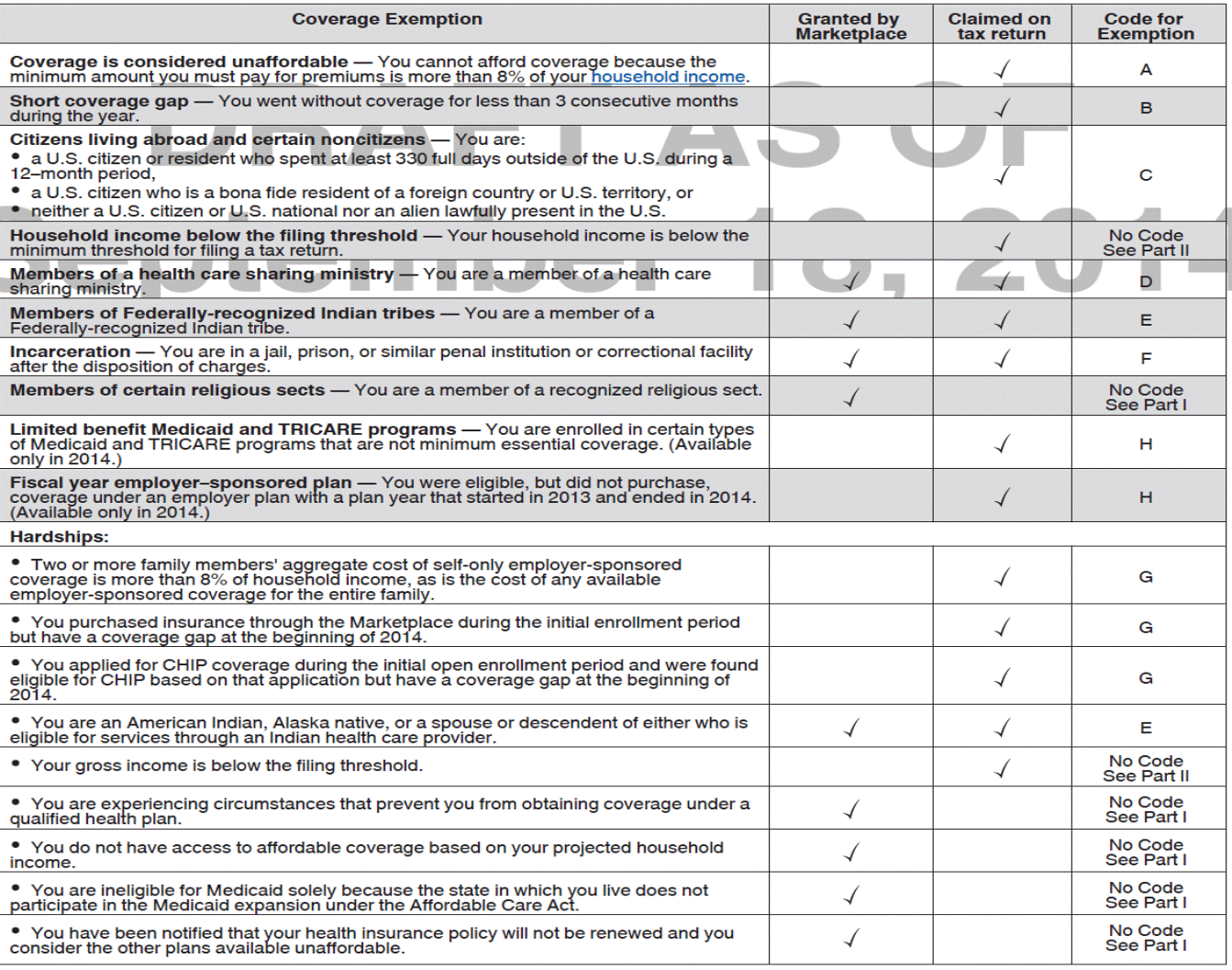
Part III - Coverage Exemptions Claimed on Return:
You can claim a coverage exemption for yourself or another member of your tax household using Part III.
Part III - Exemption Type:
Enter the code for the appropriate coverage exemption you are claiming as listed below:

Form 9465
Use Form 9465 to pay for taxes you owe in monthly installments (only for those who are unable to pay the full amount at this time).
Note: If you are currently in bankruptcy, do not file Form 9465. Call your local IRS District Office Special Procedures function.
Home Office (Business Use of Home) Worksheet
Use the Business Use of Home worksheet to figure:
(a) The allowable expenses for business use of your home on Schedule A, Schedule F and Form 4835
(b) Any carryover to the current tax year of amounts not deductible in the previous year
File the Business Use of Home Worksheet if any of the following apply:
A part of your home is exclusively used on a regular basis:
(a) As your principal place of business for any of your trades or businesses
(b) As a place of business used by your patients, clients, or customers to meet
or deal with you in the normal course of your trade or business
(c) In connection with your trade or business if it is a separate structure that is not attached to your home
Required: You must select the applicable Schedule or Form from the Choices box at the top of the page. Without this input, the expenses default to a Schedule A deduction.
Casualty Losses:
If you have a casualty loss on your home used as an office, then complete the worksheet on line 5b of Business Use of Home Worksheet. This will calculate not only the deduction for line 5b but also the deduction for line 26.
Additionally, in order to deduct the personal portion of the casualty loss to Schedule A, a separate Form 4684 must be completed. The personal portion or (%) of the appropriate sections of Section A, Form 4684 must be entered. For example, if you use your home office 10% for business, then 90% of the cost basis, insurance reimbursement and FMV before and after the casualty should be entered on Form 4684.
Note: If you have a casualty gain from your home used as an office, then enter on a separate Form 4684 and do enter on the Form 8829 worksheet.
Depreciation Percentages:
If you first used your home in the current tax year enter the following percentages for the first month of usage.
JAN 2.461% MAY 1.605% SEP 0.749%
FEB 2.247% JUN 1.391% OCT 0.535%
MAR 2.033% JUL 1.177% NOV 0.321%
APR 1.819% AUG 0.963% DEC 0.107%
If you first used your home after May 12, 1993 but before the current tax year enter 2.564%. If you first used your home after May 12, 1993 but before May 13, 1993, see Publication 946.
After May 12, 1993, and you stopped using your home for business before the end of the year, see Publication 946. After 1986 and before May 13, 1993, see Publication 946. If you first used your home before 1987, see Pub. 534.
Statement of Clergy Income
Part I - Housing / Parsonage Allowance
Use the Part I worksheet to determine the taxable amount (if any) of the housing allowance. Enter the amount designated by the employer on line 11 of the worksheet. On lines 1 through 8 enter the allowable living expenses. Be sure to also enter the fair rental value of the lodging.
CrossLink will determine the amount of the housing allowance that is excluded from income and any excess allowance will be included in income on Form 1040, line 21.
Part II - Gross Clergy Income
CrossLink will calculate the amount of wages and taxable income to be allocated based on your entries on the W-2 and Schedule C.
WAGES FROM FORM W-2
Check the box for Ministers and Members of Religious Orders on the W-2, line 1 if the wages were received as a minister or member of a religious order from a church or qualified church controlled organization that has a certificate in effect electing an exemption from employer social security and Medicare taxes and the taxpayer has NOT filed Form 4361 and received IRS approval to be exempt from paying self-employment tax. See Help on the Form W-2 for additional information.
RENT FREE HOUSING
If the taxpayer received rent-free housing, indicate the amount on Part II, line 3, column B.
SCHEDULE C ALLOCATIONS
If expenses are to be allocated between wages and Schedule C, check the box on the Schedule C labeled, "Check box to allocate expenses on Minister worksheet."
Part III - Professional Expenses (Allocable)
Use Part III to indicate expenses to be allocated between wages and Schedule C. Amounts entered on lines 1 through 7 will be allocated based on the ratios calculated in Part II. The allocated amounts will then be carried to Schedule C, Part V, and Form 2106, line 4 (allocated to wages).
Part IV - Nondeductible Expenses
CrossLink will calculate the amount of expenses attributable to nontaxable income based on amounts in Part II. These amounts will then be added back to the Schedule C, Part V, and Form 2106, line 10.
Part V - Clergy SE Tax Income
Based on entries in the previous sections, CrossLink will calculate the amount of wages and Housing allowance that should be subject to SE tax. The line 3 amount will be carried to Schedule SE, line 2.
Publication 517 Worksheets
These four worksheets detail how the ministerial income and deductions are calculated and allocated.
Worksheet 1 - Percentage of Tax-Free Income
Ministerial Income worksheet 1 is automatically calculated based on the Statement of Clergy Income. This worksheet shows the percentage of income that is tax-free.
Worksheet 2 - Allowable Deductions for Schedule C
Ministerial Income worksheet 2 is automatically calculated based on the Schedule C entries assigned to the Statement of Clergy Income.
Worksheet 3 - Allowable Deductions for Form 2106
Ministerial Income worksheet 3 is automatically calculated based on the Form 2106 expenses assigned to the Statement of Clergy Income.
Worksheet 4 - Net Self-Employment Income
Ministerial Income worksheet 4 calculates the self-employment income that is carried to Schedule SE.